Outsource Laser Cutting vs Buying a Plasma Table (DIY Guide)
I remember standing in my first 800-square-foot shop, staring at a stack of 50 baseplates I had just hand-cut with a torch and cleaned up with a grinder. My back ached, my shop was covered in fine black dust, and I had spent six hours on a task that should have taken twenty minutes. I realized then that I wasn’t running a business; I was barely managing a hobby that paid less than minimum wage once I factored in the grinding wheels and electricity. For many of us in the 35-to-55 age bracket, the transition from hobbyist to side-hustler is marked by this exact realization. We start to value our time as a finite resource. The question eventually shifts from “Can I make this?” to “Should I make this in-house or pay someone else to cut it?”
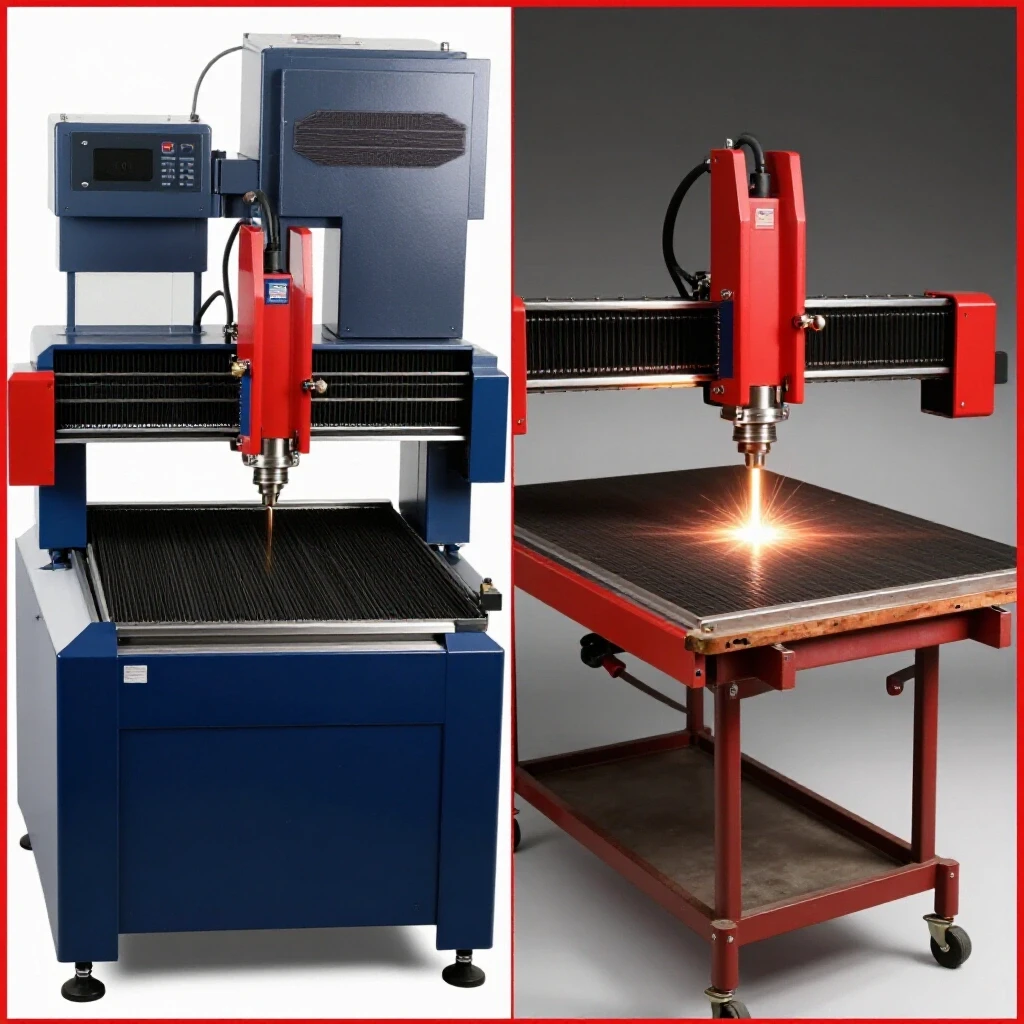
Deciding whether to send your files to a professional laser service or invest in a CNC plasma table is one of the most significant financial crossroads you will face. It isn’t just about the price of the machine. It is about understanding your true shop rate, the cost of your labor, and how long it takes to recover a five-figure investment. I have spent 16 years tracking these numbers, and I can tell you that the “cool factor” of owning a machine often blinds us to the reality of the balance sheet. This guide will break down the math so you can make a decision based on data, not just the desire for a new tool in your workshop.
Establishing a Professional Shop Rate and Overhead Baseline
A shop rate is the total cost of operating your business for one hour, including your desired profit and all fixed expenses. It serves as the foundation for every quote you send to a customer and determines whether your equipment investments will ever actually pay for themselves over time.
Most side-hustlers make the mistake of picking a number out of the air—usually $40 or $50 an hour—because it sounds like “good money.” In reality, a professional fabrication shop rate usually falls between $65 and $120 per hour. To find your number, you must account for “hidden” costs like shop rent (or a portion of your mortgage), insurance, software subscriptions, and even the heat and lights. If you don’t factor these in, you are essentially subsidizing your customers’ projects out of your own pocket.
Building on this, you have to look at your billable hours. If you spend 20 hours a week in the shop but only 10 of those are spent actually cutting or welding, your shop rate must cover the total cost of those 20 hours. This is where many small shops fail; they forget that the time spent sweeping the floor, answering emails, and picking up material is still a business expense.
| Expense Category | Annual Estimated Cost | Monthly Impact |
|---|---|---|
| Shop Utilities (Power/Heat) | $2,400 | $200 |
| Insurance & Licensing | $1,200 | $100 |
| Software (CAD/Invoicing) | $600 | $50 |
| Small Tool Replacement | $1,200 | $100 |
| Total Fixed Overhead | $5,400 | $450 |
If you work 40 billable hours a month, your overhead burden is $11.25 per hour before you even pay yourself or buy a single piece of steel. Understanding this “burden factor” is the first step in deciding if you can afford to bring a new machine into the mix.
The Financial Logic of Using External Cutting Services
Outsourcing involves sending your digital designs to a third-party facility that uses high-end industrial equipment to cut your parts. This approach requires zero capital investment in machinery and provides a fixed cost per part, which makes fabrication job costing significantly more predictable for a growing business.
Interestingly, the biggest advantage of using a professional service is the cut quality. Industrial laser systems produce parts with almost zero dross (the slag left on the bottom of a cut) and a very small kerf, which is the width of the material removed by the cutting process. On mild steel up to 1/2 inch, a laser-cut edge is often “weld-ready” straight out of the box. This eliminates the labor-intensive grinding and filing required with other methods.
As a result, your “cost per part” from an outside vendor isn’t just the invoice price. You have to subtract the labor hours you save on post-processing. If a local shop charges $10 per bracket, and it takes you 15 minutes to clean up a hand-cut version, you are essentially paying $10 to save $20 worth of your time (assuming an $80 shop rate).
- Pros: No maintenance, no utility spikes, high precision, and predictable bidding.
- Cons: Lead times (often 1-2 weeks), shipping costs, and minimum order charges.
Evaluating the Investment in a Workshop Plasma System
Investing in a CNC plasma table means bringing the cutting process in-house, which requires a significant upfront cost for the machine, air filtration, and electrical upgrades. This move is usually justified when your monthly outsourcing bills start to approach the monthly payment or depreciation value of the machine.
When I evaluate a tool ROI, I look at the machine’s depreciation cycle. If you spend $8,000 on a 4×4 plasma table and expect it to last five years, that machine costs you $133 per month just for existing. You then add the “consumable burden,” which includes the electrodes, nozzles, and shields that wear out during use. Unlike a drill bit that lasts months, plasma consumables are high-wear items that can cost $15 to $30 per set and may only last for a few hours of arc-on time.
Furthermore, you must consider your shop’s infrastructure. A plasma cutter requires a massive amount of clean, dry air and a dedicated 50-to-80-amp electrical circuit. If your shop only has a 100-amp sub-panel, running the table, the compressor, and the lights all at once might push your system to the limit. These “hidden” infrastructure costs can easily add another $1,000 to $2,000 to the initial purchase price.
Tracking Consumable Usage and Hidden Operating Costs
In a small metalworking business, consumables like electrodes and nozzles are often the most underestimated expense in the budget. Tracking these meticulously is the only way to ensure your side-hustle metalworking remains profitable over the long term.
I recommend keeping a simple logbook next to the machine. Record every time you change a nozzle and how many “pierces” or linear feet of cut it handled. For mild steel, especially as you approach 1/2 inch thickness, the wear and tear increases exponentially. If you are not adding a “consumable surcharge” to your customer quotes, you are slowly eroding your profit margins.
- Electrode: The core of the torch that generates the arc.
- Nozzle: Directs the plasma gas and wears out as the orifice widens.
- Swirl Ring: Controls the gas flow; lasts longer but is expensive to replace.
- Shield: Protects the other components from molten metal spray.
Comparing Cut Quality and Labor Requirements
The difference in output quality between an industrial laser and a shop-level plasma table directly impacts your hourly profitability. High-quality cuts require less “touch time,” which is the manual labor spent finishing a part before it can be welded or painted.
On mild steel up to 1/2 inch, a plasma table will produce a slight taper on the edge and a layer of dross on the bottom. While modern high-definition plasma systems are very good, the entry-level tables most side-hustlers buy will require at least some cleanup. If you are making 100 small parts, spending three minutes cleaning each part adds five hours of unbilled labor to the job.
Building on this, the “kerf” or width of the cut is much wider on a plasma table (roughly 0.040″ to 0.060″) compared to a laser (0.005″ to 0.010″). This means you cannot cut extremely fine details or small holes with a plasma table as easily as you can with an outsourced laser service. If your work involves intricate signs or tight-tolerance mechanical parts, the laser may be the only viable option regardless of the cost.
| Feature | Outsourced Laser | In-House Plasma |
|---|---|---|
| Edge Quality | Excellent (Weld-ready) | Good (Requires deslagging) |
| Precision | +/- 0.005″ | +/- 0.020″ to 0.030″ |
| Material Range | Wide (inc. Stainless/Alum) | Mostly Conductive Metals |
| Setup Time | None (Upload file) | High (Nesting, Loading, Cleaning) |
| Cost Structure | Variable (Per Part) | Fixed (Machine) + Variable (Consumables) |
The Break-Even Analysis: When to Pull the Trigger
A break-even analysis is the mathematical point where the cost of owning a machine becomes lower than the cost of paying someone else to do the work. This is the most critical part of calculating shop rates and making long-term equipment decisions.
To find your break-even point, look at your last six months of invoices from your cutting service. Let’s say you spend an average of $500 a month on laser-cut parts. If you buy a plasma table for $10,000, your monthly cost (depreciation + consumables + power) might be around $300. However, you also have to factor in the labor time you will now spend cutting those parts yourself. If it takes you 10 hours a month to cut those parts, and your labor is worth $50/hour, your “in-house” cost is actually $800. In this scenario, you are losing $300 a month by owning the machine.
The machine only becomes profitable when the volume of work is high enough that the “per part” savings outweigh the cost of your time and the machine’s overhead. For many part-time fabricators, that point isn’t reached until they are doing $1,000 to $1,500 in monthly cutting volume.
Mastering Job Bidding and Material Markups
Accurate fabrication job costing requires a formula that accounts for material, labor, overhead, and a “safety margin” for errors. Pricing your work too low is the fastest way to burn out and close your shop doors.
I use a “tiered markup” strategy for materials. I never sell metal at the price I paid for it. Buying, transporting, and storing metal is a service in itself. For a small job, I might mark up the steel by 50% to 100%. For a larger job involving several full sheets, I might drop that markup to 20% or 30%. This covers the time I spent at the steel yard and the floor space the material occupies in my shop.
- Material Cost: (Price per lb/sq ft x Quantity) + 20-50% Markup.
- Machine Time: (Hourly Machine Rate x Hours).
- Labor Time: (Hourly Shop Rate x Hours).
- Consumable Surcharge: (5-10% of the total labor/machine cost).
- Subcontracting: (Outsourced Invoice + 15-20% Handling Fee).
By adding a handling fee to outsourced parts, you ensure that you are still making a profit on the “management” of the project, even if you didn’t cut the parts yourself. This is a standard industry practice that many beginners overlook.
Sourcing Material and Managing Inventory Economics
The way you buy your raw material can have a massive impact on your bottom line, especially when managing small workshop budgets. Buying “shorts” or remnants from a local supplier is great for one-off projects, but it makes bidding nearly impossible for repeat work.
To achieve consistent small metal shop pricing, you need to establish a relationship with a local steel service center. Ask for their “price sheet” for full 4×8 or 5×10 sheets of mild steel. Even if you don’t have a forklift, many suppliers will deliver for a flat fee. Buying in bulk—even just three or four sheets at a time—can drop your material cost by 30% compared to buying small pieces.
Interestingly, if you choose to outsource, the cutting service often gets a much better “tier” of pricing on steel than you ever will. Sometimes, the price they charge for a finished part is only slightly higher than what you would pay for the raw material alone. This is because they buy steel by the truckload. Always ask your laser provider for a “material included” quote versus a “labor only” quote to see where the value lies.
Digital Tools for Modern Shop Management
Managing a side-hustle requires efficient bookkeeping and estimation tools to ensure you aren’t losing money in the “cracks” of your daily operations. You don’t need expensive enterprise software; a few simple apps can transform your workflow.
- Estimation Spreadsheets: Create a Google Sheet that calculates your bid based on linear inches of cut and material weight. This ensures your quotes are consistent.
- Invoicing Software: Tools like Wave or Square allow you to send professional invoices and track which customers have paid. They also help track expenses for tax time.
- Nesting Software: If you buy a plasma table, software like SheetCam or Pronest is essential. It helps you fit as many parts as possible onto a sheet of metal, reducing waste.
- Inventory Trackers: Use a simple digital log to track your current stock of electrodes and nozzles so you never run out in the middle of a rush job.
Conclusion: Making the Profitable Choice for Your Shop
Deciding between external laser services and an in-house plasma system isn’t a “one-time” decision. It is a choice you should re-evaluate every six months as your business grows. For many, starting with an outsourced model is the smartest financial move. It allows you to build a customer base and perfect your designs without the burden of a large equipment loan or the steep learning curve of CNC operation.
Once your volume is consistent and you find yourself frustrated by lead times or the lack of flexibility, that is the moment to look at the plasma table market. By then, you will have a clear understanding of your shop rate and your material needs. You won’t be guessing; you will be making a calculated investment based on documented history.
The goal of any fabrication business is to produce high-quality work at a price the market will bear while making enough profit to sustain your lifestyle and your shop’s growth. Whether you choose the precision of a laser service or the independence of a plasma table, let the math guide your hands.
Frequently Asked Questions
How do I know if my shop rate is high enough?
If you are consistently winning every job you bid on, your rate is likely too low. A healthy shop rate should feel slightly “uncomfortable” to quote but should cover all expenses plus a 20% profit margin. If you can’t pay your shop’s bills and yourself a fair wage, you need to raise your rate.
Is the dross from a plasma table really that hard to remove?
On mild steel, “high-speed” dross is usually brittle and can be chipped off with a hammer or a scraper. However, “low-speed” dross is welded to the part and requires significant grinding. This is why learning the correct cut speeds for different thicknesses is essential for minimizing labor costs.
What is the average lifespan of plasma consumables?
This varies wildly based on air quality and pierce height. In a clean, dry air environment, you might get 100 to 300 pierces out of a single nozzle and electrode. If your air is wet or oily, you might destroy a set in ten minutes.
Does outsourcing laser cutting save money on shipping?
Usually, no. Shipping heavy steel parts is expensive. To make outsourcing viable, try to find a local or regional laser shop where you can pick up the parts yourself, or order enough parts at once to justify the freight cost.
Can I cut 1/2 inch mild steel on a standard 220V plasma table?
Yes, most 60-amp to 80-amp plasma cutters can handle 1/2 inch steel. However, the cut speed will be slow, and the edge taper will be more pronounced than on thinner materials. It also puts a significant strain on your air compressor.
How much should I mark up outsourced services?
A standard markup is 15% to 20%. This covers the time you spent preparing the CAD files, communicating with the vendor, paying the invoice upfront, and inspecting the parts upon arrival.
What is the most common mistake when buying a first plasma table?
Underestimating the importance of the air supply. Most people focus on the table and the cutter but forget that a plasma torch requires a high-volume compressor and an expensive refrigerated air dryer to produce clean cuts and protect consumables.
Should I charge for CAD design time separately?
Yes. Design time is a professional service. If a customer provides a “napkin sketch,” you should charge your full shop rate for the time it takes to turn that into a cut-ready DXF file. If they provide a perfect file, you can waive this fee.
How do I calculate “linear foot” costs for bidding?
Divide the total cost of a sheet of metal plus your machine’s hourly operating cost by the number of feet it can cut in an hour. This gives you a baseline “cost per foot” that you can use to quickly estimate jobs based on the total cut path in your software.
Is it worth buying a used plasma table?
It can be, but be cautious. CNC electronics and torch height controllers have improved significantly in the last five years. A used table might be a bargain, but if the software is outdated or the mechanical parts are worn, you could spend more on repairs than you saved on the purchase.
(This article was written by one of our staff writers, Michael Hargrove. Visit our Meet the Team page to learn more about the author and their expertise.)