How to Safely Inspect and Buy a Used Welding Table (Guide)
When I first transitioned from a hobbyist to a professional fabricator, I made a mistake that nearly cost me my business. I bought a heavy steel slab from a local scrap yard, thinking I had saved a fortune on a workspace. Three weeks into a high-precision railing job, I realized the surface was bowed by nearly a quarter-inch in the center. Every joint I tacked was out of square, and I spent forty hours of unbillable labor fixing mistakes. That experience taught me that in a small metal shop, your foundational equipment is not just a tool; it is a financial asset that either generates profit or leaks money through hidden labor costs.
Why Surface Accuracy Dictates Your Fabrication Job Costing
Fabrication job costing is the process of calculating every dollar spent on labor, materials, and overhead to ensure a project is profitable. If your workspace is uneven, you will spend more time shimming parts and correcting warpage, which directly inflates your labor hours and shrinks your profit margins.
In my sixteen years of running a shop, I have learned that a reliable work surface is the bedrock of accurate bidding. When you estimate a job, you assume your tools will help you work efficiently. A defective used surface acts as a “hidden tax” on every hour you work. If you spend an extra ten minutes per hour fighting an unlevel table, you are losing nearly 17% of your productive capacity. For a side-hustle metalworking pro charging $85 per hour, that is $14.45 lost every single hour.
- Labor Burden: The total cost of an employee or owner’s time, including wages and taxes.
- Precision Variance: The amount of error introduced into a project by faulty equipment.
- Opportunity Cost: The profit you lose by spending time on rework instead of new projects.
| Impact Factor | Accurate Surface | Warped/Damaged Surface | Financial Result |
|---|---|---|---|
| Setup Time | 15 Minutes | 45 Minutes | 3x Labor Cost |
| Rework Rate | < 2% | > 12% | Lower Profit Margin |
| Consumable Use | Standard | High (More grinding/fitting) | Increased Overhead |
| Tool Life | Long | Short (Over-clamping stresses) | Faster Depreciation |
Assessing Structural Integrity and Flatness in Pre-owned Equipment
Evaluating a pre-owned metalworking surface requires a methodical approach to ensure it can support heavy loads without shifting or flexing. Structural integrity refers to the ability of the frame and top plate to maintain their shape under pressure, which is vital for maintaining consistent shop rates.
When I inspect a potential acquisition, I start with a high-quality six-foot straight edge and a set of feeler gauges. I lay the straight edge across the diagonals and the center. If a 0.010-inch feeler gauge can slide under the straight edge at any point, that surface will require extra work to produce professional-grade results. You must also look for “daylight” under the straight edge, which indicates localized low spots. These dips are often caused by excessive heat from previous welding projects that “pulled” the metal out of alignment.
- Planarity: The state of a surface being perfectly flat in all directions.
- Deflection: The degree to which a structural element is displaced under a load.
- Heat Distortion: Permanent warping caused by uneven cooling after high-temperature work.
Identifying Surface Defects and Material Contamination
Surface defects include cracks, deep gouges, or chemical contamination that can ruin the finish of your workpieces. In small metal shop pricing, the cost of cleaning or repairing a used asset must be factored into the initial investment to determine the true return on investment.
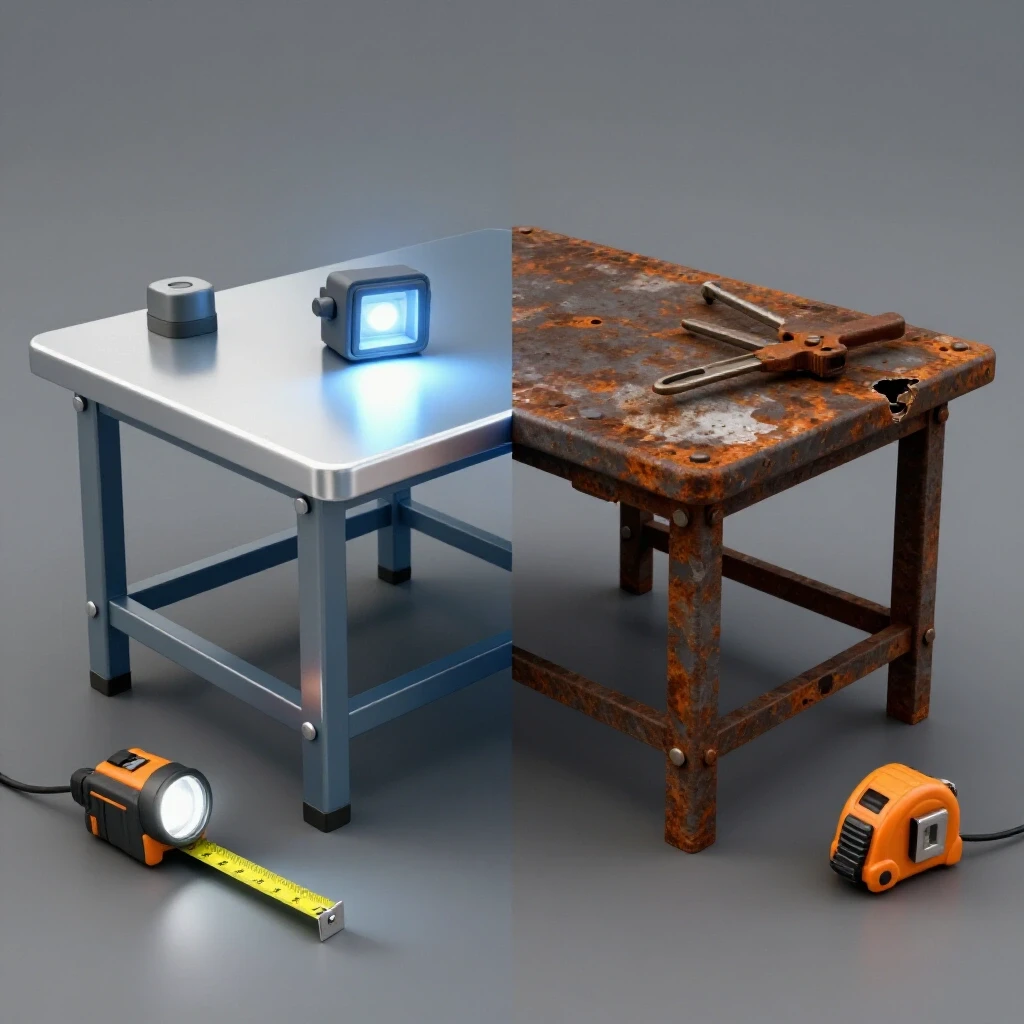
Look closely for “arc strikes” or areas where a previous owner grounded their welder directly to the table. These spots create hard, raised bumps that prevent your work from sitting flat. More importantly, check for heavy rust or pitting. While surface rust is common, deep pitting can harbor moisture and oils. When you go to weld a clean piece of aluminum or stainless steel on a contaminated surface, those impurities can migrate into your weld pool, leading to failed inspections and costly rework.
- Inclusions: Foreign materials trapped on or within the metal surface.
- Pitting: Small, deep holes caused by corrosion that weaken the top plate.
- Spatter Buildup: Small beads of molten metal that have fused to the work surface.
Evaluating Frame Rigidity and Load Capacity
The frame of a work surface must be rigid enough to handle the weight of your projects without vibrating or sagging. Calculating shop rates involves knowing your equipment’s limits; a flimsy frame limits the size of the jobs you can safely accept, thereby capping your income potential.
I always check the welds on the leg-to-table joints. Look for “cold” welds or cracks in the paint, which suggest the frame has been overloaded or dropped. A rigid frame should have cross-bracing or a heavy lower shelf. If you push on the corner of the table and it sways even slightly, it will not provide the stability needed for precision assembly. This instability can lead to “dimensional drift,” where a project starts square but ends up skewed because the table shifted during the build.
- Lateral Stability: The ability of a structure to resist side-to-side movement.
- Static Load: The constant weight of the table and the workpiece.
- Dynamic Load: The changing forces applied during hammering, clamping, or moving parts.
The Financial Logic of Equipment Amortization
Amortization is the accounting practice of spreading the cost of an expensive tool over its useful life. For a side-hustle metalworking business, understanding this helps you determine if a used asset is a bargain or a burden on your monthly budget.
If you buy a used work surface for $1,200 and expect it to last 10 years (120 months), your monthly amortization cost is only $10. However, if that surface requires $400 in repairs and an extra hour of setup time every week, the “true cost” skyrockets. I use a simple formula to see if an upgrade makes sense: (Monthly Cost + Monthly Labor Loss) / Billable Hours. If the result is higher than your current overhead, the asset is a poor investment.
- Calculate the initial acquisition cost.
- Add the cost of any necessary tools for cleaning or leveling (e.g., grinders, shims).
- Estimate the useful life in years.
- Divide the total cost by the number of months to find the monthly “burden.”
Quantifying the Return on Investment for Used Shop Assets
Return on Investment (ROI) measures the gain or loss generated on an investment relative to the amount of money invested. In a fabrication setting, a high-quality used surface pays for itself by reducing the time spent on non-billable activities like leveling and squaring.
Interestingly, many shop owners forget to track “consumable burden” when evaluating equipment. A rough or pitted surface requires more sanding discs and cleaning chemicals to keep your workpieces pristine. By tracking these minor expenses over six months, you can see the clear financial benefit of a smoother, flatter surface. A table that saves you just 30 minutes of grinding per week adds up to 26 hours of saved labor per year. At a $100/hour shop rate, that is a $2,600 annual return on your investment.
- Payback Period: The time it takes for an investment to generate enough profit to cover its own cost.
- Efficiency Gain: The percentage increase in output after upgrading equipment.
- Net Profit Margin: The percentage of revenue remaining after all operating expenses are paid.
Why Hidden Consumables Bleed Small Shop Profits
Consumables are items that are used up during production, such as welding gas, wire, and abrasives. While a work surface isn’t “consumed,” its condition directly dictates how many of these smaller items you burn through during a job.
Building on this, a used table with poor grounding points forces your welder to work harder, which can lead to increased wire waste or poor gas coverage as you struggle with positioning. When I consult with small shops, I often find they underprice their work because they don’t track the $5 here and $10 there spent on extra flap discs needed to clean up marks left by a bad table. Accurate welding consumable tracking is only possible when your work environment is consistent.
- Consumable Burden Factor: A percentage added to a quote to cover the cost of small supplies.
- Abrasive Lifecycle: The amount of work a single grinding disc can perform before needing replacement.
- Shielding Gas Efficiency: The ratio of gas used to the length of the weld produced.
Creating a Verification Checklist for Pre-owned Surfaces
A verification checklist ensures that you don’t miss critical details during a high-pressure inspection. This systematic approach mirrors the way professional shops handle quality control for their outgoing fabrication jobs.
Before you commit to an acquisition, go through these steps. First, check for structural squareness by measuring the diagonals of the top plate. Second, inspect the underside for hidden repairs or “scabbing,” where extra metal was welded on to hide cracks. Third, verify that the feet are adjustable. In many small shops, the floor isn’t perfectly level; you need a way to compensate for this without using wooden blocks or scrap metal shims, which can slip and cause safety hazards.
- Visual Inspection: Look for cracks, heavy rust, and arc strikes.
- Flatness Test: Use a straight edge and feeler gauges (target < 0.015″ variance).
- Squareness Check: Measure corner-to-corner diagonals.
- Rigidity Test: Check for sway or flex under manual pressure.
- Grounding Check: Ensure there is a clean, dedicated spot for ground clamps.
- Footing Inspection: Verify adjustable leveling feet are functional and not seized.
How to Formulate a Real Material Markup
Material markup is the additional percentage you charge a customer over the raw cost of metal to cover your time for sourcing, handling, and storage. A used table provides the storage and layout space necessary to manage this inventory efficiently.
As a result of having a reliable layout area, you can buy materials in bulk and store them safely. If you buy steel at $1.00 per pound and charge the customer $1.50, that 50% markup covers the “hidden” time you spent unloading the truck and organized the rack. Without a flat, sturdy surface to process this material, your handling time increases, which eats into that markup. Professional shops often use a sliding scale for markups: 50-100% for small jobs and 20-35% for large, material-heavy projects.
- Sourcing Overhead: The time and fuel spent acquiring raw materials.
- Scrap Factor: The percentage of material lost to offcuts and mistakes.
- Inventory Carrying Cost: The expense of storing material before it is sold.
Analyzing Post-Job Profits and Equipment Performance
Post-job profit analysis is the practice of comparing your estimated costs to your actual spending once a project is finished. This is the only way to know if your equipment—including your used work surface—is helping or hurting your bottom line.
If you consistently find that your “Actual Labor” exceeds your “Estimated Labor” on assembly tasks, your workspace is likely the culprit. I suggest keeping a simple logbook next to your bench. Note every time you have to stop to fix a tool or adjust a part that won’t sit flat. At the end of the month, tally these minutes. You will likely find that “saving money” on a lower-quality used surface is actually costing you hundreds of dollars in lost efficiency.
Common Rookie Mistakes in Equipment Acquisition
One of the most common mistakes is prioritizing thickness over flatness. A one-inch thick plate that is warped is far less valuable than a half-inch plate that is perfectly true. In the world of fabrication job costing, precision is the product you are selling, not just the weight of the steel.
Another mistake is ignoring the height of the surface. A table that is too low or too high leads to physical fatigue. Fatigue causes mistakes, and mistakes cause rework. When inspecting a used item, consider if the height can be adjusted to match your specific needs. If you have to spend $200 on steel to build a new base for a “cheap” table, that table wasn’t actually a bargain.
- The “Thick Steel” Trap: Assuming thickness equals quality.
- Ignoring Ergonomics: Forgetting that comfort equals speed.
- Underestimating Repair Time: Thinking you can “just grind it flat” (hint: you usually can’t).
Final Steps for a Profitable Shop Setup
Optimizing the financial efficiency of your workshop starts with the ground you stand on and the surface you work on. By being meticulous during the inspection of pre-owned assets, you protect your shop’s hourly rate and ensure your bids remain competitive.
As you move forward, remember that every piece of equipment should have a clear path to paying for itself. Use the data you’ve gathered—the flatness measurements, the frame checks, and the labor estimates—to make a logical decision. A professional shop isn’t built overnight, but it is built one smart, verified investment at a time. This disciplined approach to equipment will separate you from the hobbyists and position you as a profitable professional in the metalworking industry.
Frequently Asked Questions
How flat does a used welding surface really need to be? For most general fabrication, a variance of 1/32 of an inch (about 0.031″) over four feet is acceptable. However, for precision frames or furniture, you should aim for less than 0.015″. If the surface is more than 1/16″ out of flat, the time you spend shimming will likely cost more than the table is worth within the first year of professional use.
Can I fix a warped steel plate by heating it? While “flame straightening” is a real technique, it is extremely difficult to master and often results in more warping if done incorrectly. For a small shop owner, the labor hours required to fix a badly warped plate usually exceed the cost of simply finding a better used surface. It is better to pass on a warped item than to assume you can fix it easily.
Is rust a dealbreaker when inspecting a used table? Surface rust is rarely a dealbreaker. It can be removed with a wire wheel or a chemical rust converter. However, deep pitting is a concern. Pits can trap debris and moisture, leading to weld contamination. If the pitting covers more than 20% of the surface or is deeper than 1/32″, it may interfere with your ability to clamp parts securely and flatly.
What is the best way to check for frame cracks? Clean the joints with a wire brush and look for fine lines in the paint or metal. You can also use a “ring test” by tapping the frame with a hammer. A solid frame will produce a clear, consistent ring, while a cracked or failed joint will often result in a dull “thud” or a vibrating rattle.
How do I factor the cost of a used table into my shop rate? Take the total cost (purchase price + transport + repairs) and divide it by five years (60 months). Then, divide that monthly cost by your average billable hours per month. For example, a $600 table used for 40 hours a month costs only $0.25 per hour. This “equipment burden” is a small but essential part of your total hourly rate.
Should I worry about the type of steel used in the table? Most used tables are mild steel (A36). This is standard and works well for most fabrication. The main concern is whether the surface has been “hardfaced” or coated with something that could produce toxic fumes when you weld near it. Always clean a used surface down to bare metal before your first project to ensure safety and weld quality.
What tools should I bring to an inspection? At a minimum, bring a 4-foot or 6-foot machinist’s straight edge, a set of feeler gauges (0.002″ to 0.030″), a tape measure to check squareness, and a bright flashlight to look for cracks and surface defects. A small level is also helpful, but remember that the table’s flatness relative to itself is more important than whether it is level to the ground at the seller’s location.
How much does a heavy table’s weight affect my ROI? A heavier table offers better stability and less vibration, which leads to cleaner welds and more accurate assemblies. However, if the weight makes the table impossible to move in your small shop, it could hinder your workflow. Consider the “cost of space” in your ROI; if a massive table prevents you from taking on other profitable work, a smaller, high-quality surface might actually be more profitable.
Is a table with “bolt holes” better than a solid top? Tables with a grid of holes (fixture tables) allow for much faster setups using specialized clamps. If you do repetitive small-batch work, the efficiency gain from a hole pattern can be massive. However, for a general-purpose used table, a solid top is often cheaper and easier to find. Just ensure the solid top hasn’t been drilled full of random, jagged holes that interfere with flatness.
What should I do if the feet aren’t adjustable? If you find a great table with fixed feet, you can weld on your own heavy-duty leveling mounts. Factor the cost of these mounts (usually $20-$50 each) and your labor time into the acquisition cost. A table that isn’t level to your shop floor will cause “racking” in your frames, where the project looks square on the table but twists when you set it on the floor.
(This article was written by one of our staff writers, Michael Hargrove. Visit our Meet the Team page to learn more about the author and their expertise.)