How Much Capital is Needed to Start a Metalworking Shop (Fix)
When I first moved my metalworking gear from a cluttered corner of my garage into a dedicated shop space, I thought I knew my numbers. I had a welder, a grinder, and a decent set of clamps. But within three months, I realized I was bleeding cash. I was pricing my work based on what “felt right” rather than the hard reality of my initial equipment spend and shop math.
Over the last 16 years, I have learned that the difference between a hobby that pays for itself and a profitable side-hustle is how you manage your startup funds. You cannot just buy tools and hope for the best. You need a clear view of your initial equipment investment, how that machinery loses value over time, and how much it costs to simply turn the lights on.
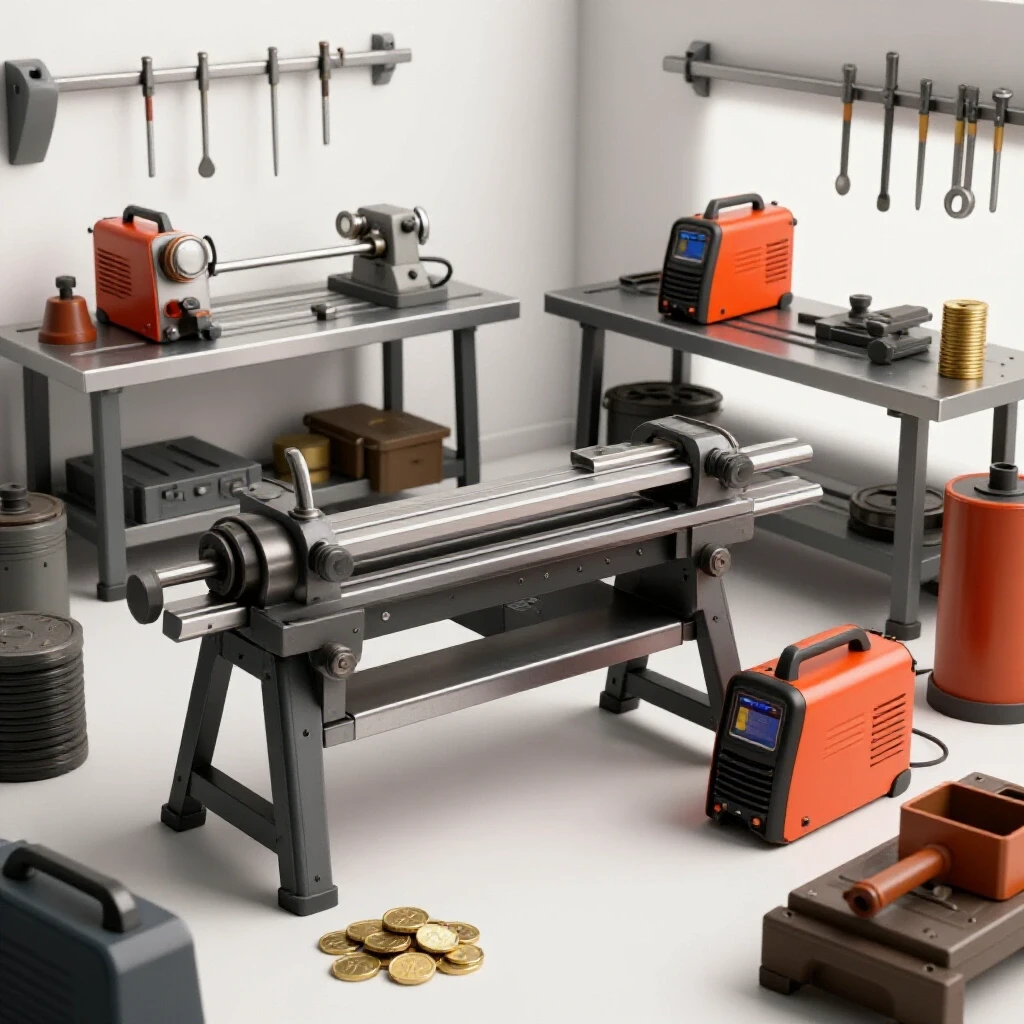
This guide focuses on the actual dollars required to get a metalworking business off the ground. We will look at two specific budget tiers: the $3,000 to $8,000 entry-level setup and the $25,000 to $60,000 professional-grade shop. My goal is to help you understand where every dollar goes before you strike your first arc for a paying customer.
Defining Your Initial Business Investment Baseline
Your startup budget is the total amount of money needed to buy equipment, tools, and initial stock before you open for business. This figure sets the stage for your future pricing. If you spend too much on unneeded tools, your hourly rate will have to be sky-high just to break even.
When planning your entry into the market, you must decide what kind of work you will do. A shop focused on heavy structural welding requires different tools than one focused on precision machining. I often see new owners buy “everything” and end up with machines that sit idle. To avoid this, you must categorize your spending into essential machinery, hand tools, and safety equipment.
The following table shows the two common paths for a new fabrication business.
| Investment Category | Entry-Level Setup (DIY/Used) | Mid-Scale Professional Shop |
|---|---|---|
| Primary Welding Units | $1,500 – $3,000 | $8,000 – $15,000 |
| Cutting & Prep Tools | $500 – $1,500 | $5,000 – $12,000 |
| Fabrication Tables & Clamping | $400 – $1,200 | $3,000 – $8,000 |
| Precision Machinery (Mill/Lathe) | $0 – $1,500 (Used) | $7,000 – $18,000 |
| Safety & Dust Collection | $600 – $800 | $2,000 – $7,000 |
| Total Estimated Capital | $3,000 – $8,000 | $25,000 – $60,000 |
The Entry-Level Fabrication Budget ($3,000–$8,000)
This budget level is for the hobbyist transitioning to paid side-work. It relies heavily on high-quality used equipment and versatile multi-process machines. At this stage, your goal is to keep overhead low so you can offer competitive rates while learning the ropes of professional fabrication job costing.
I started at this level by scouring local auctions. I found an old Hobart welder that outlived three newer machines. In this bracket, you should focus on a solid MIG or TIG setup, a portable bandsaw, and a sturdy workbench. You won’t have the fastest production times, but your low debt allows you to be patient with your growth. Your primary goal is to prove your skills can generate a return before you commit to larger purchases.
The Professional Mid-Tier Workshop Investment ($25,000–$60,000)
This investment level is for those who need higher production speeds and tighter tolerances. It includes new, warrantied machinery like CNC plasma tables, industrial mills, or high-end lathes. This level of spending requires a deep understanding of shop math to ensure the equipment pays for itself through increased efficiency.
When you spend $40,000 on a shop, you are no longer just a “guy with a welder.” You are a manufacturing entity. You must account for machine amortization, which is the process of spreading the cost of an asset over its useful life. For example, if a $10,000 plasma table lasts five years, it costs you $2,000 per year just to own it. That cost must be baked into every quote you send to a client.
Building a True Shop Rate Based on Your Setup Costs
A shop rate is the hourly price you charge for your time and the use of your facility. It is not just your “take-home” pay. It must cover your equipment depreciation, your shop space, and the profit needed to grow the business. Without a calculated rate, you are likely working for less than minimum wage.
To calculate this, I use a simple formula: (Total Annual Overhead + Desired Annual Salary) / Billable Hours. Most side-hustlers can realistically bill about 500 to 800 hours a year while working a full-time job. If your equipment costs you $5,000 a year in depreciation and you want to make $20,000, your rate needs to be at least $50 per hour before you even consider material costs.
- Labor Rate: What you would pay a skilled welder to do the work.
- Overhead Burden: The cost of the building, insurance, and administrative tasks.
- Machine Rate: The specific cost of running a high-value tool, like a CNC mill.
Why Machine Amortization Matters for Your Bottom Line
Amortization is the practice of spreading the cost of a large purchase over the years you expect to use it. This ensures that you are collecting enough money from customers to replace the tool when it eventually wears out. It turns a “big surprise expense” into a predictable part of your pricing.
If I buy a $15,000 lathe and expect it to last 10 years, I need to “collect” $1,500 every year from my jobs to cover that machine. If I use that lathe for 500 hours a year, the machine itself costs $3.00 per hour. If I forget to include this in my fabrication job costing, I am essentially giving the customer a piece of my machine for free.
Essential Equipment Costs and Selection Strategies
Choosing the right tools is the most critical part of managing your initial funds. Every dollar spent on a tool that doesn’t make money is a dollar taken from your profit. You must balance the desire for “new and shiny” with the practical need for “reliable and productive.”
In my experience, it is better to have three high-quality tools than ten mediocre ones. A cheap welder that breaks down mid-job will cost you more in lost time and reputation than a professional unit costs upfront. When building your shop, prioritize the tools that directly relate to the services you plan to sell. If you are doing architectural railings, spend your money on a high-end cold saw and a top-tier TIG welder.
- Welding Power Sources: Budget $2,000 for a reliable multi-process unit.
- Material Handling: Do not overlook the cost of carts, racks, and forklifts (if needed).
- Measurement Tools: High-quality calipers and squares are non-negotiable for professional work.
Initial Material and Consumable Capitalization
Consumables are the items you “use up” while working, such as welding gas, grinding discs, and drill bits. While these are ongoing costs, your initial startup needs a “seed” stock of these items. Underestimating this initial buy is a common mistake that can stall your first few jobs.
You should expect to spend about 5% to 10% of your total equipment budget on your first round of consumables and raw materials. This includes a variety of steel shapes (flat bar, tube, angle), several tanks of shielding gas, and a bulk supply of abrasives. Buying in bulk upfront often saves 15% to 20% compared to buying small packs at a retail store.
- Shielding Gas: Buy your first two tanks outright rather than leasing.
- Abrasives: Purchase “shop packs” of 25 or 50 discs to lower the cost per unit.
- Fasteners: A basic assortment of Grade 5 or Grade 8 bolts saves hours of hardware store runs.
Workshop Infrastructure and Hidden Setup Costs
Infrastructure refers to the bones of your shop, such as lighting, electrical circuits, and work surfaces. These are often “hidden” costs because they aren’t as exciting as a new welder. However, a poorly lit shop with inadequate power will slow you down and lead to mistakes.
I once spent $2,000 on a used mill only to find out it would cost another $1,500 to run the 220V power and buy the phase converter needed to run it. When you are looking at how much money you need to start, always look at your walls and ceiling first. Proper LED lighting and a well-distributed compressed air system are essential for a professional workflow.
- Electrical Upgrades: Budget at least $1,000 for sub-panels and 220V outlets.
- Workbenches: A flat, heavy steel table is the foundation of every good project.
- Storage: Pallet racking or heavy-duty shelving keeps your floor clear and safe.
Avoiding Common Budgeting Pitfalls for New Owners
The biggest trap for new shop owners is “Shiny Object Syndrome.” It is easy to convince yourself that you need a $10,000 fiber laser when a $500 manual plasma cutter would do the job. You must be disciplined with your capital. If a tool doesn’t have a clear path to paying for itself within 18 to 24 months, wait to buy it.
Another pitfall is failing to account for “scrap and rework.” In your first year, you will make mistakes. You will cut a piece of expensive stainless steel too short. You must have a small “cushion” in your startup capital to cover these learning moments. I recommend keeping at least 10% of your total budget as a cash reserve for these unexpected hiccups.
Analyzing the Return on Investment for Major Tools
Before you swipe your card for a major piece of equipment, you need to run a simple ROI (Return on Investment) calculation. This tells you how many hours or jobs it will take to pay off the tool. This is the core of small metal shop pricing and long-term survival.
Let’s say you want to buy a $5,000 ironworker. If that machine saves you two hours of manual drilling and cutting per week, and your shop rate is $75/hour, you are saving $150 per week. At that rate, the machine pays for itself in about 33 weeks. That is a fantastic investment. If the machine only saves you 10 minutes a week, it might take years to pay off, and your capital is better spent elsewhere.
| Tool Investment | Cost | Time Saved Per Week | Payback Period (Weeks) |
|---|---|---|---|
| Cold Saw | $3,500 | 3 Hours | 16 |
| CNC Plasma Table | $12,000 | 8 Hours | 20 |
| Magnetic Drill | $1,200 | 1 Hour | 16 |
| Heavy Duty Positioner | $2,500 | 2 Hours | 17 |
Practical Steps to Launching Your Shop
Starting a shop is a marathon, not a sprint. You don’t need to have every tool on day one. Start with the essentials that allow you to complete 80% of the jobs in your niche. As you complete jobs and build a cash reserve, you can “earn” the right to upgrade your equipment.
- Audit Your Current Gear: List what you have and what it is worth.
- Define Your Niche: Decide if you are a “repair shop” or a “product shop.”
- Set Your Budget: Choose between the $3k-$8k or $25k-$60k path.
- Buy the Essentials: Focus on power, light, and a primary cutting/welding setup.
- Track Everything: Use a spreadsheet to log every penny spent on the setup.
Frequently Asked Questions
How do I decide between buying new or used machinery? Used machinery offers the best value for your initial investment, often costing 30% to 50% less than new. However, you must factor in the time and cost of potential repairs. New machinery is best for complex electronics like CNC controllers where a warranty provides peace of mind and prevents downtime.
What is the most important tool to spend money on first? The most important tool is your primary cutting source. Whether it is a high-quality bandsaw or a plasma cutter, clean and accurate cuts make every subsequent step (fitting and welding) much faster. Poor cuts lead to “gap-filling” with the welder, which wastes time and consumables.
How much should I set aside for my initial material stock? A good rule of thumb is $1,000 to $2,000 for a basic assortment of mild steel. This should include common sizes of square tubing, flat bar, and some 11-gauge sheet. Having material on hand allows you to take on small “walk-in” jobs immediately without waiting for a delivery.
What is a realistic hourly rate for a new side-hustle shop? Depending on your region, most small fabrication shops start between $65 and $95 per hour. If you have specialized skills like TIG welding aluminum or precision machining, you can often charge $110 to $150 per hour. Always check local rates to stay competitive but profitable.
How do I factor in the cost of my shop space if I own the building? Even if you own the building, you should charge the business “rent.” Look at what it would cost to lease a similar-sized space in your area. This ensures that the business is truly profitable and can survive if you ever have to move into a commercial lease.
Why is “shop math” more important than welding skill? You can be the best welder in the world, but if you don’t know your costs, you will go out of business. Shop math allows you to see where you are losing money, which jobs are most profitable, and when it is time to buy a new machine to increase efficiency.
Do I need a CNC machine to be a professional shop? No. Many successful shops focus entirely on manual fabrication or repair work. A CNC machine is a tool for volume and repeatability. Only invest in CNC if your business model requires making dozens or hundreds of the same part.
How often should I re-evaluate my equipment investment and shop rate? I recommend a full financial review every six months. Check your actual spending against your estimates. If your consumable costs have risen or you’ve added new machinery, you may need to adjust your hourly rate to maintain your profit margins.
What is the “hidden” cost most people forget when starting? Tooling for machines is the most common forgotten cost. If you buy a $5,000 mill, you will likely spend another $2,000 on vises, end mills, collets, and clamping kits. Always add a 20% “tooling tax” to the sticker price of any major machine.
How do I track my consumable usage for better pricing? Start a simple logbook. Note how many grinding discs you use on a typical project or how many hours a tank of argon lasts. Over time, you can create a “consumable burden” (usually 5% to 10% of the material cost) to add to every quote automatically.
Is it better to specialize in one metal or be a generalist? For a startup, being a generalist helps you find where the local demand is. However, specializing in a specific niche (like stainless steel kitchen equipment or off-road parts) allows you to streamline your tool purchases and become much more efficient, which leads to higher profits.
How do I know when my shop has outgrown its initial capital? When you are consistently turning down work because your current machines are too slow or your space is too cramped, it is time to look at the next level of investment. Use the profits from your first phase to fund the expansion of the second phase.
(This article was written by one of our staff writers, Michael Hargrove. Visit our Meet the Team page to learn more about the author and their expertise.)