Avoid Costly Pricing Mistakes in Welding Side Hustles (Tips)
When I first opened my own small fabrication shop after years in the industry, I thought I knew exactly how to charge for my work. I looked at what the big shops were charging, dropped my price by twenty percent to stay competitive, and assumed the profit would follow. Two months later, I realized I was essentially paying my customers for the privilege of working in my own garage. I had failed to account for the silent killers of a small metalworking business: the grinding discs, the shield gas, and the slow decline of my equipment’s value.
Establishing a profitable side-hustle metalworking venture requires more than just being a good welder. It demands a shift in mindset from a hobbyist who buys tools to a business owner who invests in assets. During my sixteen years in manufacturing, I have seen many talented fabricators fold because they treated their shop math like an afterthought. They focused on the bead quality but ignored the burden rate.
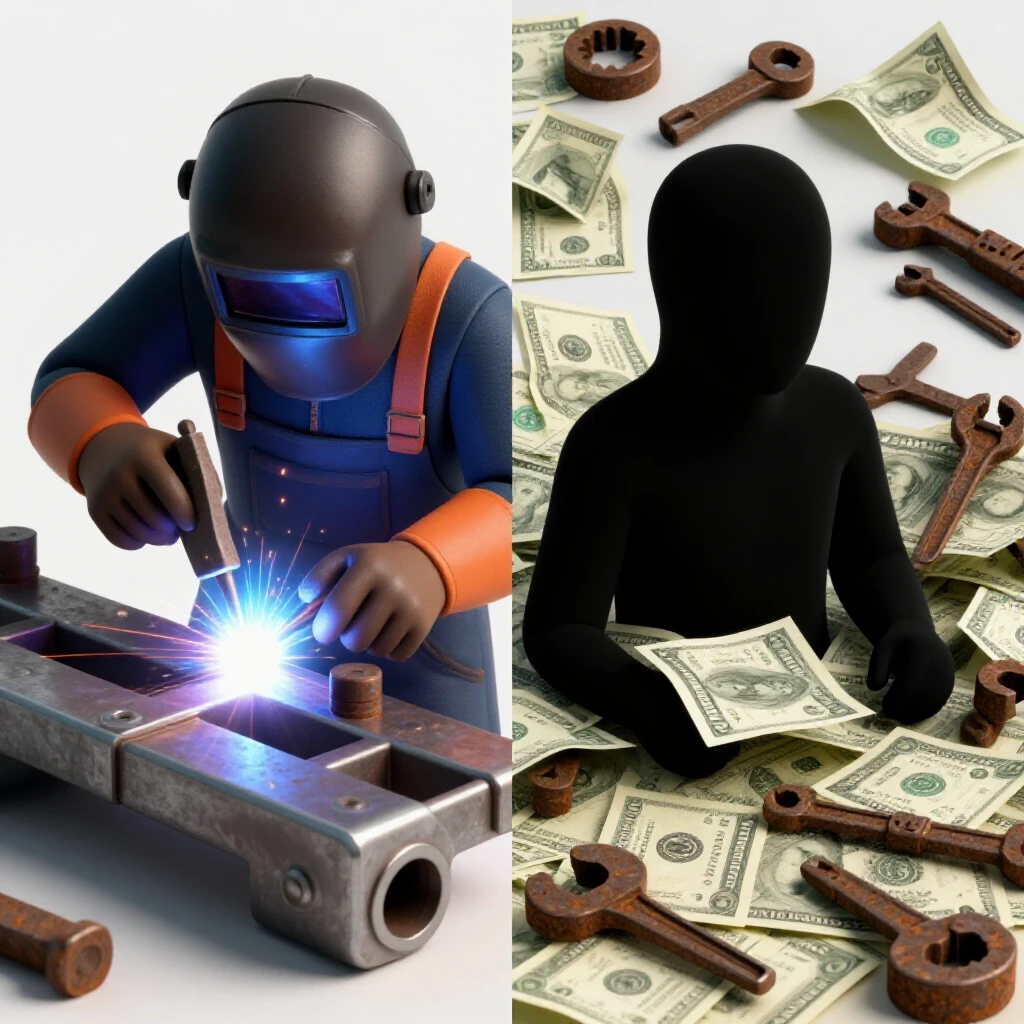
This guide is designed to help you look at your workshop through the lens of a financial analyst. We will move away from “guesstimating” and toward a data-driven model for small metal shop pricing. By the end of this article, you will have the tools to calculate a shop rate that actually covers your bills and puts money back into your pocket for that next equipment upgrade.
Determining Your Baseline Shop Hourly Rate
A shop hourly rate is the total amount of money your business must earn for every hour of active work to cover all expenses and generate profit. This figure includes your labor, the cost of keeping the lights on, and the eventual replacement of your machinery. It serves as the foundation for every quote you send to a client.
Many side-hustlers make the mistake of only charging for their time. If you decide your time is worth $30 an hour and you charge a client exactly that, you are losing money. You are neglecting the electricity for the welder, the rent or mortgage on the space, and the specialized software you might use for design. In my experience, a realistic shop rate for a part-time fabricator usually falls between $65 and $120 per hour, depending on your region and specialty.
To find your number, you must look at your total monthly shop costs and divide them by the number of billable hours you actually work. Note that “billable hours” are only the hours spent cutting, fitting, and welding. Time spent sweeping the floor or talking to customers is overhead that your billable hours must cover.
Tracking Fixed and Variable Overhead
Overhead represents the ongoing expenses of operating your business that are not directly tied to a specific project. Fixed overhead includes items like shop rent or equipment leases that stay the same every month. Variable overhead includes utilities like electricity and heating, which may fluctuate based on how much you are actually fabricating.
When I was starting out, I ignored my home electricity bill because it felt “too small to count.” However, a high-output TIG welder or a large air compressor can pull significant power. If you are running a side business out of a residential garage, your utility bill might jump by $50 to $100 a month. If you do not account for this in your hourly rate, that money comes directly out of your take-home pay.
- Shop Rent/Mortgage Allocation: $200 – $500/month
- Utilities (Power/Water/Heat): $50 – $150/month
- Software Subscriptions (CAD/Invoicing): $20 – $60/month
- Small Tool Replacement Fund: $50/month
The Impact of Equipment Depreciation on ROI
Equipment depreciation is the process of allocating the cost of a major tool over its expected useful life. Instead of viewing a $5,000 welder as a one-time expense, you should view it as a cost per hour used. This ensures that when the machine finally wears out, you have already collected the funds to buy its replacement.
I recommend using a simple straight-line depreciation model for your metal business ROI calculators. If you buy a professional-grade plasma cutter for $3,000 and expect it to last five years (or about 2,000 hours of arc time), that tool costs you $1.50 for every hour it is running. Many shop owners forget this and are shocked when they don’t have the cash to replace a broken machine.
| Equipment Item | Purchase Price | Expected Life (Years) | Annual Depreciation |
|---|---|---|---|
| Multi-Process Welder | $4,500 | 5 | $900 |
| Horizontal Band Saw | $1,200 | 8 | $150 |
| 80-Gallon Compressor | $1,800 | 10 | $180 |
| Ironworker/Press | $6,000 | 15 | $400 |
Developing Accurate Fabrication Estimates
Fabrication job costing is the practice of predicting the total cost of a specific project before work begins. This involves breaking the project down into three main categories: raw materials, consumable supplies, and total labor hours. Accuracy here is the difference between a profitable weekend and working for free.
One of the biggest pitfalls in side-hustle metalworking is underestimating the “non-welding” time. You might think a project will take four hours of welding, but you forget the two hours of material pickup, the hour of prep work, and the hour of cleanup. I have found that a “buffer factor” of 15% to 20% on top of your estimated labor time is often necessary to stay profitable.
Why Hidden Consumables Bleed Small Shop Profits
Welding consumable tracking involves monitoring the use of items that are used up during a project, such as shield gas, welding wire, and abrasives. These items are often small individually but can account for 10% to 15% of the total project cost. Ignoring them is a common way to lose your margin on a job.
In my consulting work, I often see shops charge for steel but forget the argon. A standard “K” size cylinder of Argon can cost $60 to $100 to refill. If you are TIG welding stainless steel, you can burn through a tank surprisingly fast. I suggest adding a “Consumable Burden Factor” to every quote, which is usually a flat percentage of the total labor or material cost.
- Shielding Gas (Argon/C25): $5 – $10 per hour of arc time
- Grinding/Flap Discs: $3 – $7 per disc (estimate 1 disc per 2 hours of fab)
- Welding Wire/Rod: $2 – $5 per pound used
- Anti-spatter/Nozzle Gel: $1 – $2 per project
Pricing Material with Handling and Waste in Mind
Material pricing is the strategy of marking up the raw steel or aluminum used in a project to cover the costs of sourcing, transporting, and storing it. It also accounts for “drops” or scrap pieces that you cannot use for other jobs. A simple pass-through of the material cost is rarely enough to cover your efforts.
I typically recommend a material markup of at least 20% to 35% for small shops. If you have to drive thirty minutes to the steel yard, wait in line, and haul 500 pounds of tubing back to your shop, that is time and fuel that must be paid for. Additionally, if a project requires 18 feet of a 20-foot stick of tubing, the customer should pay for the full 20 feet, as the remaining two feet is often useless scrap.
Sourcing Strategies and Bulk Purchasing for Better Margins
Reducing your Cost of Goods Sold (COGS) is one of the most effective ways to increase your profit without raising your prices. By finding better ways to buy metal and supplies, you keep more of the money from every job. This requires moving away from “big box” stores and building relationships with local industrial suppliers.
When I transitioned from a hobbyist to a business owner, I stopped buying my grinding discs at the local hardware store. I started buying them in boxes of 50 from industrial supply houses. This simple change dropped my cost per disc from $8.00 down to $3.50. Over a year of fabrication work, those small savings add up to hundreds of dollars in extra profit.
- Establish a Commercial Account: Even as a side-hustle, most steel yards will give you a “tier two” pricing bracket if you have a business name and buy regularly.
- Buy Full Lengths: Avoid buying pre-cut “short” pieces. Buying 20-foot sticks of steel is almost always 40% cheaper per foot than buying 4-foot sections.
- Consolidate Gas Refills: Take all your tanks in at once to save on fuel and time. Some suppliers offer a discount for multiple refills in one transaction.
- Shop Surplus and Remnants: Many large industrial fabricators sell their “drops” or off-cuts at a steep discount. This is perfect for small brackets or gussets.
Using Data to Refine Future Project Bids
Analyzing post-job profits is the habit of comparing your original estimate to the actual costs incurred once the project is finished. This process, often called a “job autopsy,” is the only way to find out if your pricing model is actually working. It allows you to see where you were too optimistic and where you were spot on.
I used to keep a simple notebook where I wrote down the estimated hours versus the actual hours for every gate, trailer, or bracket I built. After six months, I noticed a pattern: I was always 30% low on my grinding and finishing time. Because I had the data, I was able to adjust my future quotes and stop losing money on the “pretty” part of the job.
Digital Tools for Better Shop Management
In the modern shop, you don’t need a complex accounting degree to track your finances. There are several digital tools that can help you automate your metal business ROI calculators and invoicing. These tools keep your records organized and professional, which also helps when dealing with higher-end clients.
- QuickBooks or FreshBooks: Great for tracking general shop expenses and sending professional invoices that allow for credit card payments.
- Jobber or Housecall Pro: Useful if your side-hustle involves going to job sites, as they track travel time and allow for on-site quoting.
- Excel or Google Sheets: Still the best tool for building a custom fabrication job costing template that you can tweak over time.
- Evernote or Keep: Excellent for snapping photos of material receipts so you don’t lose them before you can bill the client.
Common Pricing Mistakes to Avoid
Even with a good shop rate, there are subtle traps that can ruin your profitability. One of the most common is the “friend and family” discount. While it is tempting to help out people you know, remember that your welder doesn’t know it’s a “friend” job; it still consumes gas and electricity.
Another mistake is failing to charge for design time. If a client comes to you with a napkin sketch and you spend three hours in CAD making it manufacturable, those three hours are billable work. If you don’t charge for them, your effective hourly rate for the whole project drops significantly. Always be clear with the customer that design and consultation are part of the service.
- Mistake: Not charging for “shop consumables” on small jobs.
- Mistake: Forgetting to include the cost of specialized shipping or delivery.
- Mistake: Estimating based on “best-case scenario” instead of average speed.
- Mistake: Absorbing the cost of a mistake instead of building a small “contingency” into the quote.
Practical Steps for Implementation
If you are currently struggling with your shop’s finances, don’t try to change everything overnight. Start by tracking your time and expenses for the next three jobs with total honesty. Record every minute spent in the shop and every dollar spent at the supply store.
Once you have that data, compare it to what you actually charged the customer. If you find that you earned less than your target shop rate, it is time to raise your prices or find ways to be more efficient. Remember, your customers are paying for your expertise, your equipment, and your shop space—not just your time.
- Calculate your monthly fixed overhead (rent, power, insurance).
- Determine your target annual profit and divide it by your estimated billable hours.
- Create a standard quote template that includes lines for materials, consumables, labor, and markup.
- Review every finished job to see where your estimate differed from reality.
Frequently Asked Questions
What is a standard material markup for metal fabrication?
Most small shops use a markup between 20% and 50%. A 20% markup is standard for large material orders where handling is minimal. A 50% markup is more appropriate for small projects where you have to spend significant time sourcing, picking up, and cutting small amounts of specialty metal.
How do I calculate the cost of welding gas per project?
The most accurate way is to track your flow meter setting (CFH) and the total arc time. If you run at 20 CFH and a tank holds 250 cubic feet, you have 12.5 hours of weld time. Divide the cost of the refill by 12.5 to get your hourly gas cost. Most shops find this to be between $5 and $10 per hour.
Should I charge for the time spent quoting a job?
For small, standard jobs, quoting is usually considered part of your overhead. However, for complex projects that require hours of design or engineering, you should inform the client that there is a non-refundable design fee that may be credited toward the final project cost if they move forward.
What is the average shop rate for a mobile welder versus a shop-based welder?
Mobile welders often charge a higher hourly rate (often $100-$150) to cover vehicle maintenance, fuel, and the convenience of on-site service. Shop-based side-hustlers usually fall in the $65-$100 range, as they have lower travel costs but higher fixed facility costs.
How do I account for grinding and finishing in my pricing?
Grinding often takes as long as, or longer than, the actual welding. A good rule of thumb for beginners is to estimate your welding time and then double it to account for fit-up, tacking, grinding, and cleanup. This ensures your labor quote reflects the total effort required.
Is it better to give a flat project price or an hourly estimate?
Most customers prefer a flat project price because it gives them budget certainty. However, you should only give a flat price if you have a very clear scope of work. For repair work where the extent of the damage is unknown, an hourly rate with a “not to exceed” cap is safer for the shop owner.
How often should I adjust my shop rate?
You should review your shop rate at least once a year. If your utility costs go up or you invest in a new, expensive piece of machinery, you may need to increase your rate immediately to maintain your profit margins and ensure a positive return on investment.
Does my experience level affect what I can charge?
Yes, but not in the way most people think. A highly experienced welder might work twice as fast as a beginner. If they both charge $80 an hour, the experienced welder actually makes less money for the same project. As you get faster, you should transition to flat-rate pricing based on the value of the finished item, which increases your effective hourly rate.
How do I price for “drops” or leftover material?
The customer should pay for the material required to do their job. If you have to buy a 10-foot stick to get a 7-foot piece, the customer pays for the 10-foot stick. The 3-foot “drop” is now “free” inventory for you, which you can use for small parts on a future job, effectively increasing your profit on that next project.
Should I include the cost of PPE in my job quotes?
PPE like gloves, lenses, and respirators are part of your variable overhead. Instead of charging a “glove fee” to a customer, you should include the annual cost of these items in your baseline shop hourly rate calculation. This keeps your quotes clean and professional while still covering your costs.
(This article was written by one of our staff writers, Michael Hargrove. Visit our Meet the Team page to learn more about the author and their expertise.)