Designing Rolling Cart Bases for Custom Fabrication (DIY Fix)
For two decades, I have navigated the transition from a cluttered garage setup to a streamlined, high-output fabrication facility. The stress of scaling up usually hits when you realize that your floor space hasn’t grown, but your equipment list has. I remember the specific morning I realized my workflow was broken; I spent forty minutes moving three different machines just to get a single sheet of 10-gauge steel onto my old manual plasma table. That inefficiency is a silent profit killer. By applying lean manufacturing principles and engineering custom mobile equipment supports, I transformed my shop into a space where material flows logically rather than chaotically.
Mapping Workshop Material-Flow Loops for Peak Efficiency
Workshop material flow is the systematic path raw materials take from the delivery door through processing, welding, and out to the customer. Efficiency is measured by the distance a part travels and the number of times it is handled before completion.
In my early years, I treated my shop like a storage unit where tools were placed wherever they fit. This led to “back-and-forth” loops that wasted hours every week. Building a linear flow pattern means your material should move in one general direction. For instance, your stock rack should sit near the entry, followed by your CNC plasma table or cold saw, then the welding stations, and finally the grinding or finishing area.
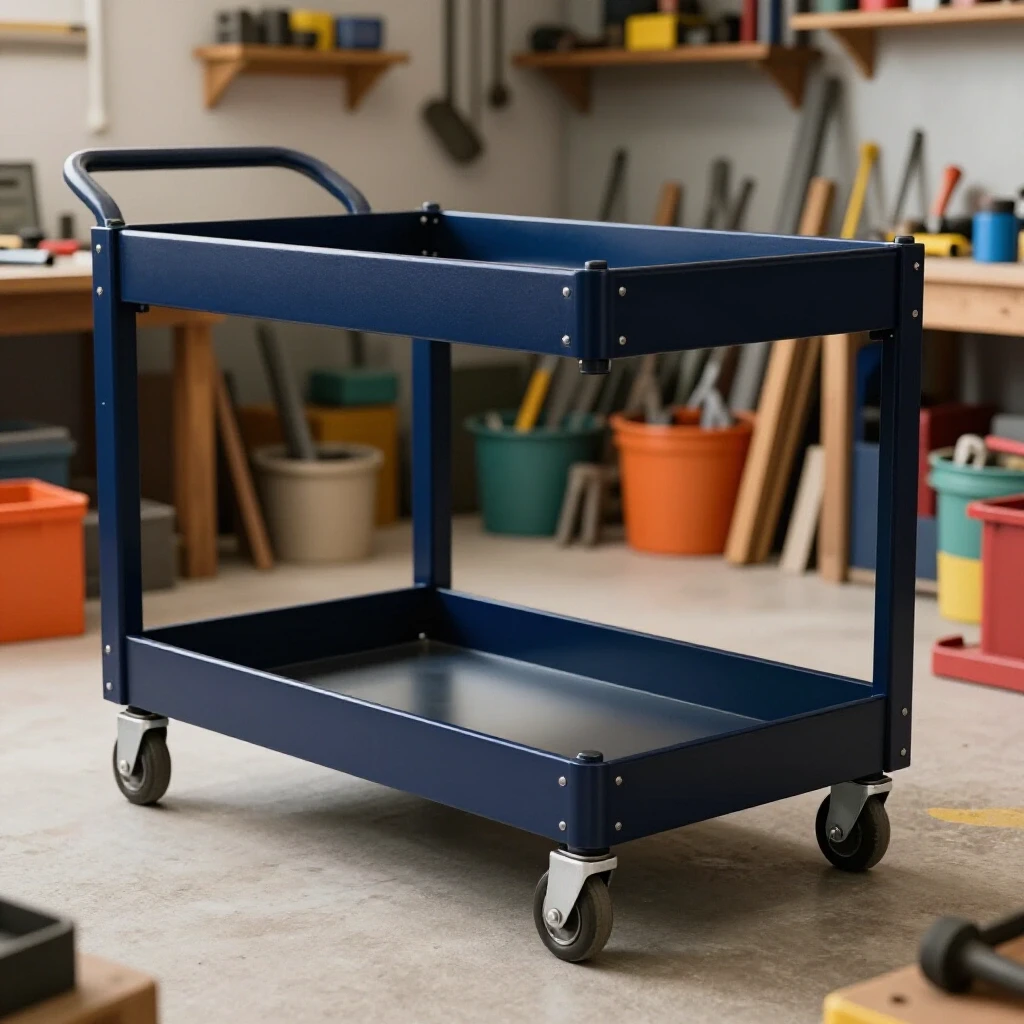
To visualize this, I use a simple “spaghetti diagram” where I trace my steps during a standard project. If the lines cross over themselves repeatedly, the layout is failing. By mounting heavy machinery on custom-welded steel frames with high-capacity rollers, you can rearrange the shop in minutes to suit specific production runs. This flexibility is the foundation of a micro-manufacturing environment.
Engineering High-Capacity Mobile Frameworks for Heavy Machinery
A mobile equipment frame is a custom-fabricated steel structure designed to support the weight of industrial tools while allowing for easy repositioning. These frames ensure that heavy equipment remains rigid and level during operation.
When I started building my own machinery stands, I learned quickly that standard hardware store wheels wouldn’t cut it. A CNC plasma table or a heavy ironworker requires a base that won’t flex under load. I prefer using 2-inch or 3-inch square steel tubing with a wall thickness of at least 3/16 of an inch. This provides the torsional rigidity needed to keep precision equipment calibrated even when it is being moved across a concrete floor.
Selecting Structural Profiles for Maximum Rigidity
Structural profiles are the specific shapes of steel, such as square tubing or C-channel, used to build a frame. The choice of profile determines how much the base will deflect or “spring” under the weight of the machine.
For most shop applications, square or rectangular tubing is superior to angle iron. While angle iron is cheaper, it lacks the resistance to twisting that a closed-box section provides. If you are mounting a tool with a high center of gravity, like a vertical milling machine, a wider footprint is essential. I calculate the “tip factor” by ensuring the base extends at least 20% beyond the machine’s footprint in every direction.
Caster Load Ratings and Floor Interface Physics
Caster load ratings indicate the maximum weight a single wheel can support. Floor interface physics refers to how the wheel material and diameter affect the force required to start and maintain motion.
I always follow the “Rule of Three” when calculating weight capacity. Even if a stand has four wheels, I assume only three will be touching the floor at any given time due to floor imperfections. If your machine weighs 1,500 pounds, each caster should be rated for at least 500 pounds. I highly recommend heavy-duty polyurethane-on-iron wheels. They don’t flat-spot like rubber, and they roll over small metal chips far better than hard nylon.
- Polyurethane: Best for grip and floor protection.
- Phenolic Resin: Very hard, easy to roll, but noisy.
- Cast Iron: Maximum durability, but will damage epoxy floor coatings.
Optimizing 3-Phase Power Delivery in a Scaling Shop
A 3-phase power system uses three alternating currents to provide more consistent and efficient energy to large motors. It is the industrial standard for equipment like CNC systems, large compressors, and heavy-duty welders.
Most home-based or light commercial shops only have single-phase 240V power. When I integrated my first 3-phase CNC mill, I had to choose between a static converter, a rotary phase converter (RPC), or a Variable Frequency Drive (VFD). For a shop that is scaling up, a rotary phase converter is often the most robust DIY-friendly solution. It uses a 3-phase idler motor to generate the third leg of power, providing a balanced load that won’t burn out expensive CNC electronics.
| Converter Type | Best Use Case | Efficiency | Cost Factor |
|---|---|---|---|
| Static Converter | Single-speed motors (Drill press) | Low (60% power) | Lowest |
| Rotary Converter (RPC) | Multiple machines, CNC | High (95% power) | Moderate |
| VFD | Single machine speed control | Excellent | High per unit |
| Phase Perfect (Digital) | Sensitive CNC electronics | 100% | Highest |
Designing High-Volume Clean Air Filtration Systems
Clean air filtration involves capturing airborne particulates and fumes at the source before they enter the shop’s general atmosphere. It relies on Cubic Feet per Minute (CFM) and static pressure to move air through filters.
When you add a CNC plasma table to your workflow, air quality becomes a major safety concern. I quickly learned that a standard shop-vac is useless against plasma smoke. You need a dedicated dust collection system with a minimum of 1,000 to 1,200 CFM for a small table. I designed my system using a cyclone separator, which drops the heavy slag into a bin before the fine smoke reaches the HEPA filters. This prevents the filters from clogging every two days and maintains the “static pressure” needed to pull smoke away from the torch.
Calculating Duct Static Pressure Losses
Static pressure loss is the resistance air meets as it travels through pipes and bends. High resistance reduces the actual CFM reaching your tool, making the filtration system ineffective.
To keep my shop air clean, I avoid using flexible ribbed hosing wherever possible. I use smooth-walled 6-inch PVC or spiral-wound metal ducting. Every 90-degree bend in your ductwork is equivalent to adding 10 to 15 feet of straight pipe in terms of resistance. I always use two 45-degree elbows with a short straight section between them to create a “long-radius” turn. This simple change increased the suction at my grinding station by nearly 25% without upgrading the blower motor.
Integrating CNC Plasma and Automated Workflows
CNC integration is the process of moving from manual cutting to computer-controlled precision. It involves setting up a gantry system, a plasma power source, and a software chain consisting of CAD and CAM.
The transition to automation was the steepest learning curve I faced. It wasn’t just about the machine; it was about the software. CAD (Computer-Aided Design) is where you draw the part, and CAM (Computer-Aided Manufacturing) is where you tell the machine how to cut it. I recommend starting with “closed-loop” motors (servos or hybrid steppers). Unlike traditional steppers, these provide feedback to the controller. If the torch hits a piece of tip-up slag, the machine knows it missed a step and stops, rather than ruining a $200 sheet of material.
- CAD Software: Fusion 360 or Rhino for design.
- CAM Software: SheetCam is a shop favorite for plasma pathing.
- Controller: Mach4 or CommandCNC for hardware communication.
Capital Depreciation and Scaling Metrics
Capital depreciation is the reduction in the value of your machinery over time due to wear and tear. Tracking this helps you understand the true cost of production and when to upgrade.
When I invest in a new CNC system or a heavy fabrication table, I don’t just look at the sticker price. I calculate the “payback period.” If a $15,000 CNC plasma table saves me 20 hours of manual labor a month at a shop rate of $75/hour, it pays for itself in 10 months. Understanding these numbers allowed me to stop viewing equipment as an expense and start seeing it as a revenue generator.
Workshop Layout Efficiency Matrix
This matrix helps me decide which machines need to be prioritized for mobile bases versus fixed positions.
| Machine Type | Weight (lbs) | Mobility Priority | Power Req. |
|---|---|---|---|
| CNC Plasma Table | 800 – 2,000 | High (Cleaning access) | 240V + Air |
| Ironworker | 2,500 – 5,000 | Low (Needs stability) | 3-Phase |
| Welding Station | 400 | Very High (Project size) | 240V |
| Cold Saw | 600 | Moderate (Stock length) | 3-Phase |
Practical Steps for System Commissioning
Commissioning is the final process of testing every component of a new setup to ensure it meets safety and performance standards. It is the “shake-down” run for your shop upgrades.
Once I finish building a custom mobile base and mounting a machine, I perform a “leveling check.” Even on wheels, a machine must be level to operate correctly. I use heavy-duty leveling casters that have a retractable rubber foot. Once the machine is in position, I wind down the feet to lift the wheels off the ground. This provides a solid, non-vibrating connection to the shop floor, which is critical for precision cutting and operator safety.
- Check Bolt Torque: Ensure all fasteners connecting the machine to the base are tight.
- Verify Phase Balance: Use a multimeter to check that the voltage between all three legs of your 3-phase power is within 5%.
- Static Pressure Test: Measure the airflow at the furthest duct intake to ensure the filtration is working.
- Dry Run: Run a CNC program without the torch on to check for gantry binding or cable snagging.
Conclusion
Transitioning a workshop from a hobbyist level to a professional fabrication space is a journey of constant refinement. By focusing on the physics of material flow and the engineering of rigid, mobile foundations for your tools, you can overcome the limitations of a small footprint. Integrating 3-phase power and advanced air filtration isn’t just about following codes; it’s about creating an environment where you can work faster, safer, and with higher precision. The most successful shops I’ve seen aren’t the ones with the newest gadgets, but the ones where every square foot has been intentionally optimized for throughput. Start by looking at your floor layout today—every step you save is a step toward a more profitable operation.
FAQ
What is the best steel thickness for building heavy equipment bases? For most equipment weighing between 500 and 2,000 pounds, 3/16″ or 1/4″ wall square tubing is ideal. Thinner material like 1/8″ may flex under heavy vibration, which can affect the accuracy of CNC tools or cause welds to fatigue over time.
How do I stop my mobile equipment from vibrating while in use? The most effective DIY fix is using leveling casters. These have a built-in thumbwheel that lowers a solid rubber or nylon pad to the floor. This lifts the wheel off the ground and creates a stable, vibration-dampening foundation.
Can I run a 3-phase motor on single-phase power without a converter? Not directly. You need a device to create the third phase. A Variable Frequency Drive (VFD) is a great choice for single machines, as it also allows for speed control. However, for a whole shop, a rotary phase converter is more practical.
How much space should I leave around my CNC plasma table? I recommend a minimum 3-foot access zone on at least three sides. This allows you to load full sheets of material, perform maintenance on the gantry, and safely clear out slag and small parts that fall through the slats.
Why is my dust collector losing suction after I moved it? You likely increased the “static pressure” by using long runs of flexible hose or too many sharp elbows. Ensure your main trunk line is as straight as possible and use smooth-walled pipe to minimize air resistance.
What is the “Rule of Three” for caster weight capacity? Shop floors are rarely perfectly flat. The Rule of Three assumes that only three wheels will carry the entire load at any moment. To find the required caster rating, divide the total weight of the machine and the stand by three.
Are stepper motors or servo motors better for a DIY CNC setup? For a professional-leaning shop, “closed-loop” steppers or servos are better. They communicate their position back to the computer, preventing the machine from losing its place if the torch encounters an obstruction, which saves material and time.
How do I calculate the CFM needed for my grinding station? A general rule of thumb for metalworking is to aim for an air velocity of 3,500 to 4,000 feet per minute (FPM) at the hood. For a standard 6-inch duct, this equates to roughly 700-800 CFM of actual airflow.
Is it worth building a mobile base for an ironworker? Ironworkers are extremely heavy and have a high center of gravity. If you must make one mobile, the base needs to be very wide to prevent tipping. Most professionals keep them stationary but place them near the material entry point.
What is the biggest mistake when scaling up a fabrication shop? The biggest mistake is “islands of automation.” This happens when you buy a fast CNC machine but don’t optimize the material flow leading to and from it. The machine ends up sitting idle because you can’t load or unload it fast enough.
(This article was written by one of our staff writers, Edward Sinclair. Visit our Meet the Team page to learn more about the author and their expertise.)