How to Buy and Swap Welding Gas Cylinders Safely (DIY Tips)
After fifteen years of maintaining a fabrication shop, I have learned that the most critical component of a project isn’t always the welder itself, but the high-pressure vessel feeding it. I remember a Saturday afternoon early in my career when I was finishing a roll cage for a client. My MIG welder began to sputter, the arc became unstable, and the weld pool turned into a porous mess. I had ignored my gas levels, and my local supplier was closed. That mistake cost me two days of productivity and taught me that gas management is a core technical skill, not just a chore.
In my workshop journals, I track every cylinder exchange just as meticulously as I track the duty cycle of my inverter power sources. Most tool reviews focus on the “out-of-the-box” experience, but for those of us who operate equipment daily, the long-term reliability of our gas supply is what keeps the shop profitable. Managing pressurized cylinders involves understanding metallurgy, valve standards, and safety protocols that go far beyond the marketing hype of the welding machines themselves.
Establishing a Reliable Gas Supply Strategy
This process involves selecting the correct vessel size and type to match your specific fabrication needs while ensuring the equipment meets national safety standards. It requires a balance between the physical footprint of the tank in your shop and the frequency of necessary exchanges at a certified supplier.
When you begin looking at welder buying guides, you often see the machine, but rarely the tank. In my experience, the cylinder is the one tool that never becomes obsolete if you maintain it correctly. I categorize my gas needs based on project volume. For a home shop, a 125-cubic-foot (cf) cylinder is often the “sweet spot.” It is large enough to handle several hours of continuous arc time but small enough to move without specialized heavy machinery.
If you are planning long-term equipment purchases, consider the following volume metrics I have logged over hundreds of project hours:
- Small Portables (20–40 cf): Best for mobile repairs or light-gauge sheet metal. These run out quickly, often in under two hours of trigger time.
- Medium Shop Tanks (80–125 cf): The industry standard for serious DIY fabricators. These provide a solid balance of portability and capacity.
- Large Industrial Tanks (250–330 cf): These offer the lowest cost per cubic foot of gas but require a dedicated cart and are difficult to transport in a standard vehicle.
Technical Standards for High-Pressure Cylinders
High-pressure cylinders are seamless steel or aluminum vessels designed to hold gases at pressures often exceeding 2,000 pounds per square inch (psi). They are governed by strict manufacturing and testing standards to ensure they can withstand the rigors of a workshop environment without structural failure.
Understanding the markings on the neck of a cylinder is just as important as knowing the duty cycle of your welder. Every tank has a “birth certificate” stamped into the metal. I never accept a tank from a supplier without checking the hydrostatic test date. This date tells you when the tank was last pressurized to its limit to check for expansion. In the United States, most steel cylinders require a re-test every ten years, though some have a star symbol indicating a ten-year interval is permitted instead of the standard five.
| Feature | Standard Requirement | Why It Matters for Reliability |
|---|---|---|
| Hydrostatic Test Date | Every 5 to 10 years | Ensures the metal hasn’t fatigued or thinned. |
| CGA Valve Type | CGA 580 (Argon/Mix) | Prevents connecting the wrong gas to your machine. |
| Wall Thickness | NEMA/DOT Specs | Determines the maximum safe pressure (PSI). |
| Neck Ring | Permanent Attachment | Identifies ownership and prevents “orphan” tanks. |
Evaluating Ownership vs. Exchange Models
This refers to the legal and financial arrangement between the fabricator and the gas supplier regarding who owns the physical cylinder. It determines whether you pay a one-time purchase fee for a tank or enter into a long-term lease agreement with recurring costs.
In my early years, I struggled with the “buy vs. lease” dilemma. Through my maintenance logs, I found that for a small-scale manufacturer, owning tanks under 150 cubic feet is almost always more cost-effective. When you own the tank, you aren’t tied to a monthly lease fee that eats into your overhead. However, you must ensure the tank you buy is an “owner tank” with a smooth neck ring. If a tank has a company name embossed on the neck ring, most suppliers will refuse to fill it for you unless you have a lease agreement with that specific company.
I once bought a used 250 cf tank at an estate sale for a bargain price, only to find out it was a leased tank from a company that had gone out of business. No one would touch it. I lost the initial investment because I didn’t check the neck ring. Now, I always verify that the tank is “blank” or marked as a customer-owned vessel before handing over any money.
Physical Inspection Protocols for Shop Safety
A physical inspection is a systematic visual check of the cylinder’s exterior, valve, and safety relief devices to identify signs of damage or wear. This protocol ensures that the vessel is safe to introduce into your workspace and will not fail under pressure.
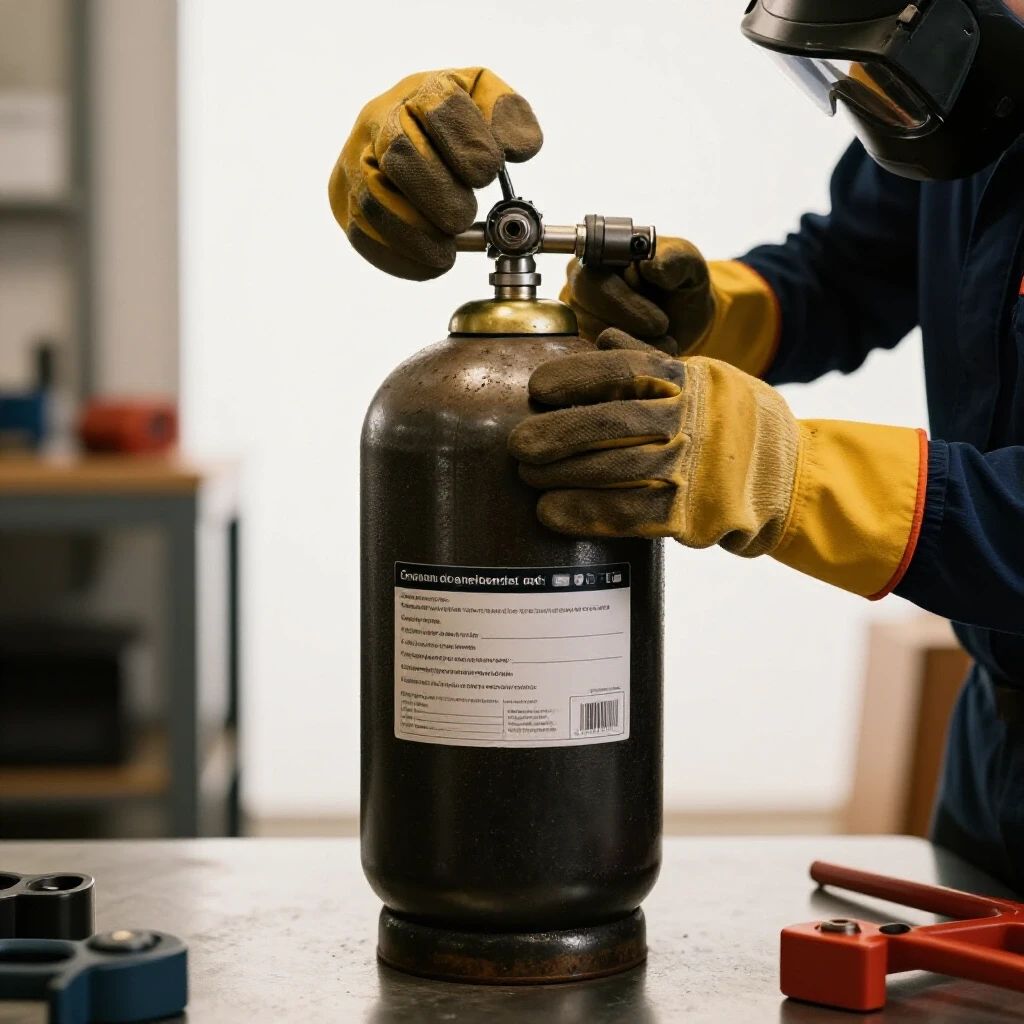
Before I bring a new cylinder into my shop, I perform a three-point inspection. First, I look for “pitting” or deep rust, especially on the bottom of the tank. If a tank has been sitting on a damp concrete floor for years, the base can thin out, creating a massive safety hazard. Second, I check the valve threads. If the threads are stripped or deformed, you will never get a gas-tight seal with your regulator, leading to wasted gas and inconsistent weld quality.
Third, I examine the valve handwheel. It should turn smoothly without the use of tools. I’ve seen many fabricators use a pipe wrench to open a stuck valve, which is a recipe for disaster. If the valve is stuck, the internal seals are likely shot. Take it back to the supplier. A faulty valve can lead to a slow leak that empties your tank overnight, a frustration I have documented several times in my shop logs before I tightened my inspection criteria.
Safe Transport and Handling Logistics
Transportation logistics involve the methods used to move high-pressure cylinders from the supplier to the workshop and around the shop floor. This includes using proper restraints, protective caps, and ergonomic movements to prevent physical injury or equipment damage.
The most dangerous part of gas management is moving the tanks. A full 125 cf cylinder is essentially a heavy, steel projectile if the valve is knocked off. I never move a tank without the steel safety cap screwed on tight. This cap protects the valve from impact if the tank tips over. In my 15 years of fabrication, I have seen one “flying cylinder” incident in a commercial shop; it went through a cinder block wall. It is a risk you simply do not take.
When transporting tanks in a vehicle, I always secure them in an upright position. While some argue that argon or CO2 can be transported horizontally for short distances, keeping them vertical is the safest practice to prevent the valve from being the lowest point of the vessel. I use heavy-duty ratcheting straps to secure the tanks to a structural point in the truck bed, never relying on bungee cords or gravity.
- Always keep the safety cap on during transit.
- Secure the cylinder to a cart or wall immediately upon arrival.
- Never lift a cylinder by the valve or the handwheel.
- Use a dedicated cylinder cart with a safety chain for shop movement.
Integrating Gas Management into Workshop Maintenance
This involves creating a system to track gas levels, cylinder age, and consumption rates alongside other tool maintenance tasks. It ensures that you never run out of consumables mid-project and that your equipment remains in peak operating condition.
I treat gas cylinders like any other piece of precision machinery. In my digital maintenance log, I keep a “Gas Consumption Tracker.” By recording the flow rate (measured in Cubic Feet per Hour or CFH) and the arc time, I can predict exactly when a tank will run dry. For example, if I am running 20 CFH on a 125 cf tank, I know I have about 6 hours of actual “trigger time.”
This data-driven approach prevents the “Sunday Afternoon Shutdown” I experienced early on. It also helps me evaluate the efficiency of my equipment. If my logs show I am burning through gas faster than the math suggests, I know I have a leak in my lead or a faulty solenoid in the welder. This is how you avoid overpaying for consumables and keep your shop running at maximum efficiency.
- Label every tank: Use a tag to indicate if it is “Full,” “In Use,” or “Empty.”
- Log the exchange date: Track how long a tank lasts to identify hidden leaks.
- Inspect the regulator seating: Every time you swap a tank, check the O-ring or the brass-to-brass seat for debris.
- Check for “Hydro” expiration: Mark your calendar six months before a tank’s test date expires so you can exchange it while it is still “in date.”
Why Valve Selection and CGA Standards Matter
The Compressed Gas Association (CGA) sets the standards for valve outlets to ensure that you cannot accidentally connect a flammable gas to an oxygen regulator. For most DIY welding, you will deal with CGA 580 for inert gases (Argon, Helium, Nitrogen) and CGA 320 for Carbon Dioxide.
Understanding these fittings is part of being a professional fabricator. I’ve seen beginners try to use adapters to force a connection. This is a significant failure point. If the regulator doesn’t fit the tank, it’s for a reason. Using the correct CGA fitting ensures a metal-to-metal seal that can withstand the 2,000+ psi pushing against it. In my shop, I keep a spare set of plastic washers for my CO2 regulators, as these are a common wear item that can cause a project-stopping leak if they deform over time.
Maximizing Tool Lifespan Through Proper Gas Selection
While the machine’s inverter or transformer is the heart of the welder, the gas is its lifeblood. Using the wrong gas or a contaminated cylinder can lead to “internal” tool wear, such as soot buildup in the liner or oxidation of the contact tip. My long-term metrics show that using high-quality, 99.99% pure argon for TIG welding significantly extends the life of my tungsten electrodes compared to using “bargain” gas that might have moisture contamination.
When you are evaluating tool performance metrics, don’t just look at the amperage output. Look at how the machine handles gas pre-flow and post-flow. These settings protect your weld and your torch components. A machine with a reliable gas solenoid will save you money in the long run by preventing gas waste during the start and end of every weld.
Practical Benchmarks for Cylinder Management
To keep your shop running smoothly, you should aim for certain operational benchmarks. These are based on my 12 years of high-load testing and shop management.
- Leak Rate: A properly set up system should hold pressure overnight. If you close the tank valve and the regulator gauge drops to zero within an hour, you have a leak that needs addressing.
- Exchange Efficiency: You should never pay a “re-testing fee” if you exchange your tank before the hydrostatic date expires. Suppliers usually absorb the cost of testing as part of their fleet maintenance if the tank is still in date.
- Storage Safety: Cylinders must be stored at least 20 feet away from highly combustible materials or separated by a fire-rated wall. I keep my tanks in a dedicated rack, chained at the “shoulder” of the bottle to prevent tipping.
Frequently Asked Questions
How can I tell if a used cylinder is a “lease” tank or an “owner” tank? Look at the neck ring, which is the thick metal collar at the top of the tank. If it is smooth or has “Customer Owned” stamped on it, you likely own it. If it has a company name like “Airgas” or “Praxair” embossed in the metal, that company technically owns the tank, and you may have trouble getting it filled without a lease agreement.
What is the “star” or “plus” sign next to the hydrostatic date? A “plus” sign (+) following the test date means the cylinder can be filled to 10% above the marked service pressure. A “star” symbol indicates the cylinder is eligible for a 10-year re-test interval instead of the standard 5-year interval, provided it meets specific safety criteria during inspection.
Can I use an oxygen regulator on an argon tank? No. CGA standards are designed to prevent this. An oxygen regulator uses a CGA 540 fitting, while argon uses a CGA 580. Attempting to bypass these fittings with adapters is dangerous and can lead to equipment failure or injury.
Why does my CO2 tank feel like it has liquid sloshing inside? Unlike argon, which is stored as a compressed gas, CO2 is stored as a liquid under pressure. This is normal. It also means that CO2 tanks are measured by weight (e.g., 20 lbs) rather than by cubic feet of gas.
How do I know if my cylinder valve is leaking? The most reliable way is to close the tank valve but leave the regulator attached. Watch the high-pressure gauge. If the needle drops while the tank is closed, gas is escaping either through the regulator connection or the valve stem itself.
What should I do if I find a cylinder with a very old test date? If the date is expired, do not attempt to have it filled. Take it to a certified gas supplier. They will typically charge a “hydro-test fee” (usually between $30 and $60) to re-certify the tank. Once certified, it is safe to use for another 5 to 10 years.
Is it safe to store welding gas in a hot garage during the summer? Cylinders are designed to handle temperature fluctuations, but they should never be exposed to temperatures exceeding 125 degrees Fahrenheit. Every cylinder has a safety relief device (a burst disc) designed to vent the gas if the pressure gets too high due to heat.
How tight should the regulator be on the tank? You want it “snug” but not “cranked.” Use a dedicated cylinder wrench or a large adjustable wrench. Over-tightening can damage the brass seats or the threads. A firm pull with one hand is usually sufficient to create a seal.
Why is my gas flow fluctuating while I weld? This is often caused by a freezing regulator (common with CO2) or a failing seal. If you are using a high flow rate, the gas expansion can cause the regulator to ice up. If it’s not freezing, check for kinks in your gas hose or a loose connection at the back of the welder.
Can I move a cylinder without a cart if I’m careful? While you can “walk” a cylinder on its base for very short distances, it is not recommended for DIYers. The risk of the tank slipping and falling is too high. Always use a cart with a safety chain to ensure the tank remains upright and stable.
Conclusion and Next Steps
Managing your gas supply is a fundamental part of maintaining a high-performance fabrication shop. By focusing on the technical specifications of your cylinders and following strict inspection and transportation protocols, you ensure that your shop remains both safe and productive. I recommend starting a maintenance log today. Track your next gas exchange, note the hydrostatic date, and monitor your consumption. This data will help you move away from the “marketing hype” of the welding industry and toward a more professional, reliable, and cost-effective operation. Your tools are an investment; protect that investment by mastering the logistics of the gases that power them.
(This article was written by one of our staff writers, David Reynolds. Visit our Meet the Team page to learn more about the author and their expertise.)