Is Buying a High-End Wilton Bench Vise Worth It? (Review)
When I first opened my manufacturing shop, I spent weeks obsessing over the price of every single bolt and grinding disc. I remember standing in front of a row of bench vises, looking at a professional-grade Wilton and then at a generic import that cost a quarter of the price. At the time, my side-hustle was just beginning to transition into a full-time business, and I was terrified of overspending on “name brand” prestige.
What I didn’t realize then was that tools aren’t just purchases; they are capital assets that either contribute to your hourly efficiency or drain your bank account through failure and frustration. In the world of fabrication job costing, every minute you spend fighting a tool that slips or breaks is a minute you aren’t billing. My goal is to help you look past the sticker price and understand the long-term financial impact of investing in high-quality workholding equipment for your small shop.
Establishing Your Base Shop Rate and Overhead
Your shop rate is the total cost of keeping your doors open and your machines running, divided by the number of hours you can actually bill to a client. It is the foundation of every quote you send out and determines whether your side-hustle is actually making money or just a very expensive hobby.
Many fabricators make the mistake of picking a number out of thin air, like $50 or $75 an hour, because it “sounds right” or matches a competitor. However, without knowing your specific overhead, you might be losing money on every weld. Overhead includes everything from rent and electricity to insurance and the gradual wear and tear on your equipment.
- Fixed Costs: Rent, insurance, and software subscriptions that stay the same every month.
- Variable Costs: Electricity, heating, and consumables like welding gas or sanding belts.
- Labor: Not just the time you spend welding, but the time spent quoting, cleaning, and sourcing material.
To calculate a true shop rate, I recommend tracking every penny for three months. If your total monthly expenses are $2,000 and you can only realistically bill 80 hours a month while working around a day job, your break-even rate is $25/hour before you even pay yourself or make a profit.
Factoring in Equipment Depreciation and Longevity
Depreciation is the process of spreading the cost of a major tool over its expected useful life to reflect its true daily cost to your business. Instead of seeing a $1,000 vise as a one-time hit, you should see it as a small daily expense over the decades it will serve you.
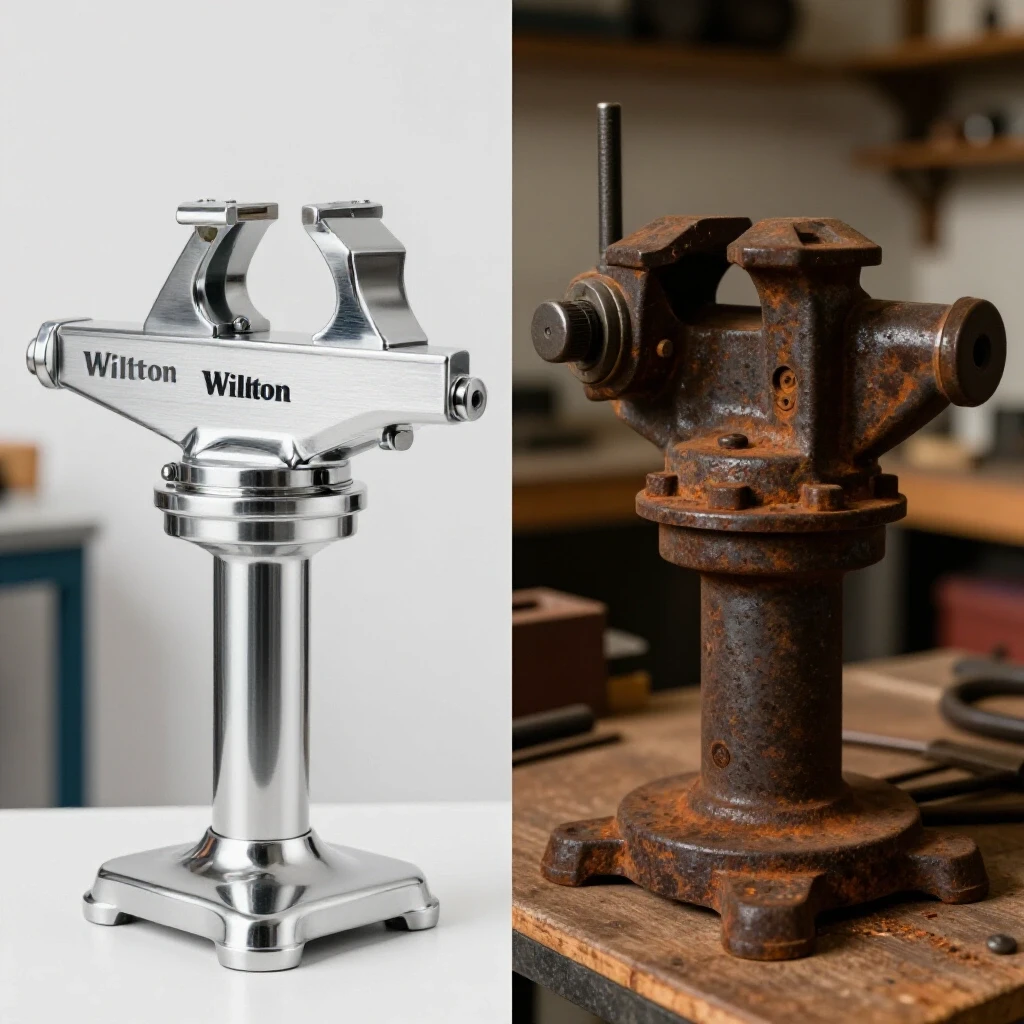
A high-end vise made of ductile iron or cast steel is often rated for a 20- or 30-year lifespan in a professional setting. If you buy a premium Wilton for $1,200 and expect it to last 20 years, the cost is only $60 per year, or about $5 per month. Compare this to a $200 budget vise that might crack under heavy striking or high-torque bending within two years. The budget option actually costs you $100 per year in replacement costs, plus the lost productivity when it fails in the middle of a rush job.
- Premium Vise: $1,200 / 20 years = $60/year.
- Budget Vise: $200 / 2 years = $100/year.
- Hidden Cost: The time spent removing a broken vise and mounting a new one usually equals two hours of billable labor.
When you think about metal business ROI calculators, the longevity of the tool is the most important variable. A tool that never needs to be replaced is a tool that eventually pays for itself by simply existing while you continue to bill labor hours.
Analyzing the Return on Investment for Professional-Grade Workholding
Return on Investment (ROI) is a calculation that measures the profit generated by an investment relative to its initial cost. In a fabrication shop, a high-quality vise provides ROI through increased clamping force, better precision, and reduced physical fatigue.
If you are working on a high-precision fabrication job, a vise that holds a part perfectly square saves you from having to grind or shim a workpiece later. If a cheaper vise allows a part to slip while you are drilling a large hole, you might scrap a $200 piece of material and lose three hours of work. In that single moment, the “expensive” vise would have paid for half of its own cost by preventing the error.
Tool ROI Comparison: Professional vs. Entry-Level
| Metric | High-End Ductile Iron Vise | Standard Cast Iron Vise |
|---|---|---|
| Initial Investment | $1,100 – $1,500 | $150 – $300 |
| Expected Lifespan | 30+ Years | 2 – 5 Years |
| Clamping Force | 15,000+ lbs | 5,000 – 8,000 lbs |
| Annualized Cost | $40 – $50 | $60 – $75 |
| Risk of Casting Failure | Extremely Low | Moderate to High |
| Resale Value | 60% – 80% | 10% – 20% |
As the table shows, the high-end option is actually cheaper on a per-year basis. Furthermore, the resale value of a premium brand like Wilton remains incredibly high. If you ever decide to close your shop, you can often sell a used Wilton for a significant portion of what you paid for it, whereas a generic vise is often treated as scrap metal.
Why Hidden Consumables Bleed Small Shop Profits
Consumables are the small, “disposable” items like grinding wheels, welding wire, shielding gas, and drill bits that are used up during a project. Many side-hustlers fail to track these accurately, leading to “profit bleed” where the money they thought they made is actually sitting in the scrap bin or the dust collector.
I’ve seen shops that mark up their material by 20% but forget to charge for the $40 worth of flap discs and the $15 of electricity used to run the welder. To stop this, you need to establish a “consumable burden factor.” This is a percentage added to every job to cover the things that are too small to count individually.
- Track your spend: Keep every receipt for abrasives and gas for one month.
- Compare to revenue: If you spent $500 on consumables and did $5,000 in sales, your burden factor is 10%.
- Apply to quotes: Every quote should include a line item for “Shop Supplies” at that 10% rate.
By automating this in your fabrication job costing, you ensure that you aren’t paying out of pocket for the privilege of working for a client. It also helps you justify the purchase of better tools; a more rigid vise might allow you to use more aggressive grinding techniques, potentially reducing the number of discs you consume per job.
Building a Realistic Job Estimation Model
A job estimation model is a structured spreadsheet or document that helps you predict the total cost of a project before you send a quote. It should include sections for material, labor, overhead, consumables, and your desired profit margin.
When I was consulting for a small fab shop in Ohio, the owner was frustrated that he was busy but never had any cash in the bank. We looked at his bidding process and realized he was only charging for “arc time”—the actual minutes he was welding. He wasn’t charging for the time he spent at the steel yard, the time he spent cleaning the parts, or the time he spent in the office.
- Material Cost: The actual price of the steel plus a 20-35% markup for sourcing and handling.
- Labor Hours: Every hour spent on the project, multiplied by your shop rate.
- Consumables: Use your burden factor (e.g., 10% of labor).
- Subcontracting: If you need powder coating or laser cutting, add that cost plus a 15% management fee.
- Profit Margin: A flat 10-20% added to the very end to grow the business.
Using this model, a “simple” $200 job often turns out to be a $450 job. If the customer won’t pay it, you are better off not doing the work. Taking a loss-making job “just to stay busy” is a fast track to burnout and bankruptcy.
The Financial Impact of Clamping Force and Precision
Clamping force refers to the amount of pressure a vise can apply to a workpiece to hold it stationary. Precision refers to how squarely the jaws meet and how little they deflect under load. In professional fabrication, these aren’t just technical specs—they are financial metrics.
If you are threading a large pipe or using a heavy pipe wrench, a budget vise with low clamping force will let the part spin. This ruins the finish of the material and can lead to injury. A premium vise with a 15,000-lb clamping rating ensures the part stays put, allowing you to work faster and with more confidence.
- Speed: Higher clamping force allows for heavier cuts and faster material removal.
- Safety: Parts that don’t move don’t fly out and break things (or people).
- Accuracy: Jaws that remain parallel ensure that your layout lines stay true during assembly.
Interestingly, the “sealed” design of many high-end vises protects the internal lead screw from filings and debris. This reduces the time you spend on maintenance. If you spend 15 minutes a week cleaning out a cheap vise, that’s 13 hours a year. At a $75/hour shop rate, that’s nearly $1,000 in lost billable time over a year just because of a poorly designed tool.
Sourcing Material and Managing Your Supply Chain
Material sourcing is the process of finding, purchasing, and transporting the raw metal needed for your projects. For a small shop owner, this is often one of the most overlooked costs. If you are driving an hour to the steel yard to pick up $50 worth of tubing, you have just spent $75 of your time and $20 in gas to get that material.
To stay profitable, you must optimize your material handling. This means buying in bulk when possible and charging for the “logistics” of getting the steel to your bench.
- Inventory Management: Keep common sizes of flat bar and angle iron in stock so you don’t have to run to the supplier for every small job.
- Drop Management: Save your “drops” (leftover pieces) and organize them. Selling a bracket made from a scrap piece is 100% profit on the material side.
- Delivery Fees: If a supplier offers delivery for $50, take it. It is almost always cheaper than closing your shop for half a day to go get it yourself.
In my experience, small metal shop pricing succeeds when the owner treats their time as the most valuable commodity. If a premium tool or a delivery service saves you three hours a month, that is three hours you can spend on high-margin fabrication work.
Analyzing Post-Job Profits and Cost Variance
Post-job reconciliation is the act of comparing your original estimate to the actual costs incurred after the job is finished. This is where you learn the “truth” about your pricing. If you quoted 10 hours but the job took 15, you need to know why.
Cost variance is the difference between what you expected to spend and what you actually spent. Common causes of variance include unexpected material price hikes, tool failure, or “scope creep” where the customer asks for extra features without a change order.
- Review the labor: Did the welding take longer because the fit-up was poor?
- Review the consumables: Did you go through more sanding discs than expected?
- Review the overhead: Did a machine breakdown eat into your profit?
By performing this analysis on every project, you refine your bidding accuracy. Over time, your quotes will become more realistic, and your profit margins will become more predictable. This data-driven approach is what separates a professional fabricator from someone who is just “playing shop.”
Digital Tools for Shop Management and Estimation
In the modern era, you don’t need to do all this math on a legal pad. There are several digital tools and platforms designed to help small shop owners track their finances and manage their projects.
- QuickBooks or FreshBooks: Essential for tracking expenses, sending professional invoices, and monitoring your overall business health.
- Google Sheets/Excel: I still use custom-built spreadsheets for job estimation because they are infinitely flexible. You can build in your specific shop rate and consumable burden.
- Trello or Asana: Great for managing your workflow, especially if you have multiple projects in different stages (e.g., “Waiting for Material,” “In Fabrication,” “Ready for Pickup”).
- Square or Stripe: For taking digital payments. Yes, they take a 3% fee, but you get paid instantly, which improves your cash flow.
Using these tools allows you to focus on the work rather than the paperwork. It also gives you a professional appearance that justifies a higher shop rate. When a client receives a clean, itemized digital invoice, they are much less likely to haggle over the price than if you give them a handwritten note.
Is the Investment in High-End Equipment Justifiable?
When we look at the economics of a high-end workholding tool, we have to ask if it helps us achieve our primary goal: consistent profitability. A vise is the literal center of your workshop. Almost every part you make will touch it at some point.
If you are serious about scaling your side-hustle, you cannot afford to have your “center” be a point of failure. The financial reality is that a premium tool provides a predictable, low-cost-per-year service that protects your margins. It prevents scrapped parts, reduces maintenance time, and maintains its value for decades.
- Reliability: You know it will hold every time you tighten the handle.
- Professionalism: High-quality tools signal to clients (and yourself) that you take your work seriously.
- Long-term Savings: It is the last vise you will ever have to buy.
My recommendation for any shop owner moving from hobbyist to professional is to invest in the “anchor” tools first. A high-quality vise, a flat welding table, and a reliable welder are the foundation of your business. Buy them once, buy them right, and then focus your energy on the math that makes you money.
Practical Steps for Your Next Project
To put these principles into action, I suggest a simple exercise for your next fabrication job. Before you strike an arc, do the following:
- Calculate your hourly burden: Add up your monthly shop expenses and divide by your billable hours.
- Set a profit goal: Decide that you want to make a 15% profit on top of your labor and materials.
- Track every disc: Count how many grinding and cutting discs you use for this one job.
- Review the time: Use a stopwatch to see how much time you spend on non-welding tasks like setup and cleanup.
Once the job is done, look at the numbers. You might be surprised to find that the “simple” project didn’t actually make you any money once the overhead was factored in. This is the moment where most shop owners realize they need to raise their rates and invest in better equipment to increase their efficiency.
Frequently Asked Questions
What is the most important factor in a bench vise for a metal shop? For metalworking, the material of the body is critical. Ductile iron is significantly stronger than standard gray cast iron and can withstand the shocks of hammering and heavy bending without cracking. Additionally, a sealed lead screw is vital for preventing metal shavings from grinding down the internal threads over time.
How do I justify a $1,000+ tool to my spouse or business partner? Focus on the “cost per year” and the resale value. Explain that a $1,000 tool that lasts 30 years costs $33 a year, whereas a $200 tool that lasts 3 years costs $66 a year. Furthermore, show them the used market prices; high-end vises often sell for 70% of their original price even after a decade of use.
What is a realistic shop rate for a part-time side-hustle? Depending on your location and specialty, most independent fabricators should be charging between $65 and $120 per hour. If you are charging less than $50, you are likely not covering your overhead and depreciation, meaning you are essentially paying for the privilege of working.
How do I factor in the cost of electricity for my welder? For most small shops, electricity is a relatively small part of the overhead, but it adds up. A good rule of thumb is to look at your monthly bill and see the “baseline” (what it costs when you aren’t working) versus the “active” cost. Usually, adding $2-$5 per hour to your shop rate covers the power for a standard TIG or MIG setup.
Should I mark up the price of the steel I buy? Absolutely. You should mark up material by at least 20-35%. This covers the time you spent ordering it, the fuel to go get it, the floor space it takes up in your shop, and the risk that you might make a mistake and need to buy more.
What happens if I break a “lifetime warranty” tool in a commercial shop? Read the fine print. Many consumer-grade tools have warranties that are voided if used in a “commercial or industrial setting.” This is why buying professional-grade equipment is important; their warranties and build quality are specifically designed for the daily abuse of a working shop.
How do I track consumables without it taking too much time? Don’t track every individual screw. Instead, use the “burden factor” method. Add up your total spending on consumables over a quarter and divide it by your total labor hours. Add that dollar amount (e.g., $8/hour) to every quote as a “shop supplies” fee.
Is it better to buy a used high-end vise or a new mid-range one? A used high-end vise (like an older Wilton Bullet) is almost always a better investment than a new mid-range one. As long as the casting isn’t cracked and the lead screw is smooth, a 40-year-old professional vise will still outperform a brand-new budget model.
How do I know if my shop is actually profitable? Profit is what is left over after you have paid all expenses, including your own “fair market” wage. If you are paying the shop bills but don’t have enough left to pay yourself what you would earn working for someone else, your shop is not yet truly profitable.
What is the best way to handle “scope creep” with a customer? Always use a written quote that specifies exactly what is included. If the customer asks for a change, stop work and send a “Change Order” email stating, “That will add X hours of labor and Y in materials to the final cost. Do you want me to proceed?” Never do extra work for free.
(This article was written by one of our staff writers, Michael Hargrove. Visit our Meet the Team page to learn more about the author and their expertise.)