Lean Manufacturing Guidelines for Small Welding Shops (Guide)
I remember standing in the center of my shop ten years ago, surrounded by a tangled mess of extension cords, half-finished frames, and a thick layer of grinding dust. I had just landed a contract for fifty identical gate hinges, and I realized my “hobby” setup was failing me. I was walking five miles a day just moving between the bandsaw and the welding table. That was the moment I stopped thinking like a hobbyist and started thinking like a manufacturing engineer.
Scaling a small fabrication business is rarely about buying more tools. It is about how those tools interact within your limited square footage. When you move from one-off repairs to small-batch production, the physics of your workspace change. You start to notice that every minute spent hunting for a 5/8-inch wrench or dragging a heavy plate across the floor is profit leaking out of your pocket. My goal is to share the systematic changes I made to transform that chaotic garage into a high-output micro-factory.
Optimizing Advanced Workshop Layout for Maximum Throughput
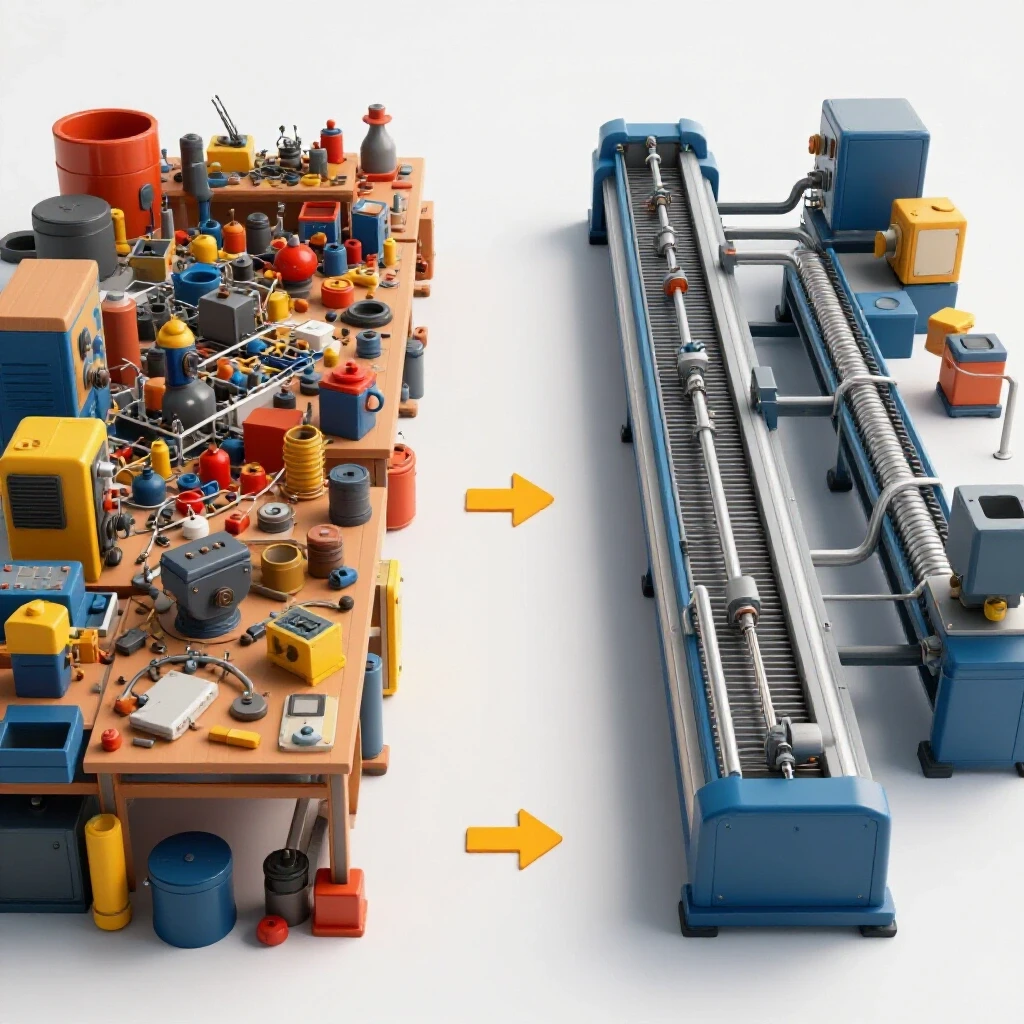
A strategic floor plan focuses on reducing the physical distance a part travels from raw material to the shipping crate. This involves mapping out “work cells” where all necessary tools for a specific task are within arm’s reach.
In my early days, I placed tools wherever there was an open outlet. This was a mistake. Now, I organize my shop into zones: dirty (grinding and cutting), hot (welding and plasma), and clean (CAD design and final assembly). By keeping the grinding dust away from the CNC electronics and the welding fumes away from the clean assembly bench, I reduced machine downtime significantly.
Building on this, I use a “linear flow” model. Material enters through the large bay door, moves to the rack, then to the saw, then to the weld table, and finally out the door. If your parts are moving back and forth across the shop like a pinball, you are losing money. I aim for a 3-foot minimum access zone around every major machine. This ensures I can move around a large project without tripping or bumping into a sensitive CNC gantry.
Workshop Layout Flow Comparison
| Layout Style | Material Travel Path | Efficiency Rating | Best Use Case |
|---|---|---|---|
| Perimeter Placement | Circular/Random | Low | General repair and low-volume hobby work |
| Process Zoning | Grouped by Task | Medium | Custom fabrication with varying project types |
| Linear Flow | Straight Line | High | Repeatable small-batch production |
| Cell-Based | Circular Workstation | High | Single-operator high-complexity assembly |
Analyzing Structural Floor Loads and Machine Leveling
A shop floor must be more than just flat; it must be structurally sound enough to support concentrated weights without shifting. This is especially critical when integrating precision equipment like a CNC plasma table.
Most residential garage slabs are 4 inches thick, which is generally sufficient for light welding tables. However, once you add a 4×8 water table filled with several hundred gallons of fluid, the weight can exceed 3,000 pounds. If the slab settles or cracks, your CNC gantry will lose its level, leading to angled cuts and premature motor wear.
When I installed my first heavy gantry, I used a precision machinist’s level to check the rails every six months. I found that seasonal soil shifts were actually tilting my table by nearly an eighth of an inch. To fix this, I moved to heavy-duty leveling feet with large base plates to distribute the load. If you are planning a heavy equipment upgrade, verify your floor load rating. A 6-inch reinforced slab is the industrial standard for peace of mind.
Solving the 3-Phase Power Converter Challenge
Industrial-grade machinery often requires 3-phase power, which provides a more consistent delivery of electricity than the single-phase power found in most homes. For a small shop, getting this power usually requires a converter.
I initially struggled with the technical side of power delivery. I had to choose between a Rotary Phase Converter (RPC) and a Variable Frequency Drive (VFD). An RPC uses a large idler motor to create a third leg of power, which is great for running multiple machines at once. A VFD is better for a single machine because it allows you to control the motor speed, but it can be sensitive to the “dirty” electrical noise generated by plasma cutters.
Interestingly, the National Electrical Code (NEC) has specific requirements for grounding these systems. In a welding environment, improper grounding doesn’t just cause “ghost” signals in your CNC; it can be a safety hazard. I recommend a dedicated ground rod for your CNC plasma table to isolate it from the high-frequency interference of your TIG welder.
3-Phase Power Conversion Options
- Rotary Phase Converter (RPC): Best for running an entire shop of manual 3-phase tools. It is reliable but can be noisy and draws power even when the tools aren’t cutting.
- Static Phase Converter: The cheapest option, but it only delivers about two-thirds of the motor’s rated horsepower. I generally avoid these for production work.
- Variable Frequency Drive (VFD): Ideal for individual machines like a drill press or mill. It provides soft starts and speed control but requires one unit per motor.
- Digital Phase Converter: The most expensive and most efficient. It provides “clean” power that is safe for sensitive CNC electronics.
Engineering High-Volume Air Quality and Dust Management
Air quality management is often overlooked until the shop walls are covered in black soot. High-volume filtration is about more than just a fan in the window; it is about “capture velocity.”
To keep my shop clean, I designed a duct network based on Cubic Feet per Minute (CFM) requirements. For a standard grinding station, you need at least 500 to 800 CFM at the hood to pull dust away from your face. For a CNC plasma table, that number jumps to 1,500–2,000 CFM if you are using a downdraft system.
I used a multi-stage cyclone collector for my heavy grinding area. The cyclone drops the heavy sparks and metal chips into a bin before the fine dust reaches the expensive HEPA filters. This prevents the filters from clogging every week. When designing your ductwork, avoid 90-degree elbows. Use 45-degree sweeps to reduce “static pressure loss,” which is the resistance the air faces as it moves through the pipes.
Air Filtration CFM Requirements by Tool
| Tool Station | Recommended CFM | Duct Diameter | Filtration Type |
|---|---|---|---|
| TIG/MIG Welding Bench | 400 – 600 | 4 – 6 inch | Fume Extraction Arm |
| 2×72 Belt Grinder | 600 – 900 | 6 inch | Cyclone Pre-separator |
| 4×8 CNC Plasma Table | 1,500 – 2,200 | 8 – 10 inch | High-Volume Downdraft |
| General Shop Air | 1,000 (Ambient) | N/A | Ceiling-Mounted Box Filter |
Successful CNC Plasma Table Setup and Integration
Integrating automation is the biggest hurdle for most advanced shop owners. It represents a shift from “thinking with your hands” to “thinking with a computer.”
The learning curve is steep. When I first got my CNC plasma table, I spent more time troubleshooting “torch height control” (THC) than actually cutting parts. THC is a system that monitors the voltage of the plasma arc to keep the torch at a consistent distance from the metal. If it isn’t tuned correctly, the torch will dive into the plate or rise too high, ruining the cut.
I found that the secret to a reliable CNC workflow is “clean” air and “clean” power. Moisture in your compressed air lines will eat through plasma consumables in minutes. I installed a refrigerated air dryer to ensure the air hitting my torch was bone-dry. This single upgrade doubled the life of my nozzles and electrodes, reducing my operating costs.
- Use shielded cables for all CNC components to prevent electromagnetic interference (EMI).
- Ensure the table is perfectly square by performing a “diagonal check” (measuring from corner to corner).
- Keep a log of your “cut charts”—the specific speed and amperage settings for different metal thicknesses.
Bridging the Gap with CAD/CAM Software
Software is the bridge between your idea and the finished metal part. CAD (Computer-Aided Design) is where you draw the part, and CAM (Computer-Aided Manufacturing) is where you tell the machine how to cut it.
For years, I struggled with file management. I would have five different versions of a bracket drawing and couldn’t remember which one was the “final” version. I eventually moved to a cloud-based CAD system that allows for version control. Now, if I make a mistake, I can see exactly what changed.
In the CAM stage, you need to worry about “lead-ins” and “lead-outs.” These are small paths the torch takes before it reaches the actual line of your part. If your lead-in is too short, you will leave a “divot” or a bump on the finished edge. I spent a full weekend testing different lead-in styles on 10-gauge steel until I found the setting that required zero post-cut grinding.
Actionable Benchmarks for Shop Efficiency
To know if your changes are working, you need to track your metrics. I use a simple spreadsheet to monitor my “arc-on time.” This is the percentage of the day the welder or plasma cutter is actually running. In a disorganized shop, arc-on time is often as low as 15%. By optimizing my layout and material handling, I pushed my shop to nearly 40%.
- The 5S Method: Sort, Set in order, Shine, Standardize, and Sustain. Every tool has a labeled home.
- Material Handling: Use heavy-duty carts with 5-inch casters. Never carry a heavy plate if you can roll it.
- Consumable Inventory: Keep a “minimum stock” level for welding wire, gas, and plasma tips. When you hit the minimum, order more immediately.
- Maintenance Intervals: Every Monday morning, I spend 30 minutes greasing CNC rails and checking air compressor oil.
Building a semi-professional shop is a marathon, not a sprint. The financial anxiety of spending thousands on a phase converter or a CNC table is real. However, when you look at the “amortization”—the cost of the machine spread over its useful life—the numbers often make sense. A $10,000 machine that lasts five years only costs about $166 a month. If that machine saves you ten hours of labor a month, it has already paid for itself.
Frequently Asked Questions
How do I know if my shop floor can handle a CNC plasma table? Most 4-inch concrete slabs can handle the weight of a 4×4 or 4×8 table if the weight is distributed. However, check for existing cracks. If you are using a water table, calculate the weight of the water (8.34 lbs per gallon) plus the steel plate. If the total exceeds 2,500 lbs, consider adding steel plate pads under the legs to spread the load.
What is the difference between stepper motors and servo motors on a CNC? Stepper motors move in “steps” and are very common in entry-level tables. They are affordable but can “lose steps” if the torch hits an obstacle, ruining the part. Servo motors have “closed-loop” feedback, meaning they always know exactly where they are. If a servo motor gets stuck, it will stop the machine rather than cutting in the wrong place. For production work, servos are worth the extra cost.
How do I calculate the duct size for my dust collection system? Duct size depends on the air velocity needed to keep dust moving. For metal dust, you need a velocity of about 4,000 to 4,500 feet per minute (FPM). If your fan pulls 1,000 CFM, a 6-inch duct will give you roughly 5,000 FPM. If the duct is too large, the air moves too slowly and the dust will settle and clog the pipe.
Is a rotary phase converter better than a VFD for a small shop? If you have multiple 3-phase machines like a mill, a lathe, and a cold saw, a rotary phase converter is usually better. It acts as a central power station. If you only have one machine, a VFD is cheaper and gives you speed control. Just be aware that VFDs can be sensitive to the electrical noise found in welding shops.
How often should I change my air filtration filters? In a high-output shop, you should check your pre-filters every month. If you notice a drop in suction (measured by a manometer), it’s time to clean or replace them. HEPA final filters can last a year or more if your cyclone or pre-filters are doing their job correctly.
What is the best way to prevent CNC plasma “ghosting” or signal interference? The most effective way is to use a “Star Grounding” system. Connect the CNC table, the control box, and the plasma power supply to a single ground point. Then, run a heavy-gauge wire from that point to a dedicated ground rod driven into the earth outside your shop. This prevents electrical “noise” from the plasma arc from messing with the computer signals.
How much space do I really need around my welding table? I recommend at least 3 feet of clear space on all sides. This allows you to walk around a large project without having to climb over tools. If you are working on long items like railings, you may need 10 to 15 feet of “in-feed” and “out-feed” space.
Can I run a CNC plasma cutter on a standard residential air compressor? You can, but you will likely run out of air on long cuts. Most CNC plasma torches require 6 to 8 CFM at 90 PSI continuously. A typical 5-horsepower, 60-gallon compressor can barely keep up. For production, a 7.5-horsepower compressor with a larger tank is highly recommended to prevent the machine from stopping mid-cut due to low pressure.
What are the most common mistakes when setting up a new shop layout? The biggest mistake is “island” tool placement, where tools are scattered in the middle of the floor with cords running across walkways. Another mistake is ignoring “material flow,” which leads to carrying heavy steel back and forth across the shop. Always plan your layout so the material moves in one direction.
How do I manage the learning curve of CAD/CAM software? Start with simple shapes. Don’t try to design a complex assembly on day one. Use online tutorials specifically for “Sheet Metal Design” rather than general 3D modeling. Once you understand how “kerf” (the width of the cut) and “lead-ins” work, the rest becomes much easier.
(This article was written by one of our staff writers, Edward Sinclair. Visit our Meet the Team page to learn more about the author and their expertise.)