Acetone vs Mineral Spirits for Pre-Weld Cleaning (Review)
I have spent the last 18 years in heavy fabrication shops and industrial mills, and if there is one thing I have learned, it is that the most frustrating failures often start with the simplest oversights. I remember a contract for a series of high-pressure fluid manifolds where we hit a wall. Every third weld failed a dye-penetrant test for sub-surface porosity. We checked the gas flow, we swapped the tungsten, and we even recalibrated the wire feeder. Nothing worked until I looked at the rag sitting next to the prep station. We were using a heavy-duty degreaser that left a microscopic oily film, and that film was gassing out the moment the arc struck.
Systematic troubleshooting is about isolating variables until only the truth remains. In the world of metalworking, your choice of cleaning agent is a critical variable. Whether you are prepping mild steel for a structural repair or cleaning 6061 aluminum for a TIG bead, the chemical interaction between your solvent and your base metal dictates the integrity of the final joint. This guide focuses on the diagnostic process of selecting and using surface decontaminants to eliminate weld defects and mechanical inconsistencies.
Establishing a Systematic Diagnostic Framework for Surface Integrity
A diagnostic framework is a structured approach to identifying why a process is failing by examining every input, from the base material to the chemical cleaners used.
In my experience, fabricators often jump to adjusting machine settings when they see a weld defect. However, a professional diagnostic approach starts with the surface. If the metal is not chemically clean, your voltage and wire speed settings are irrelevant. You must observe the surface under a bright light, isolate the type of contaminant (is it shop dust or cutting fluid?), and control the cleaning variable by using a solvent that matches the task.
The Role of Observation in Metal Preparation
Observation is the act of using visual and tactile cues to determine the state of a workpiece before any mechanical or thermal work begins.
Before I even touch a grinder, I look for “water break” patterns. If you wipe a surface and the solvent beads up, you still have hydrocarbons present. A truly clean surface allows a liquid to “wet out” or spread evenly. If you ignore this, you are inviting hydrogen into your weld pool, which leads to porosity—those tiny, weakened pockets of gas that ruin structural integrity.
Isolating Contaminants: Oils, Coolants, and Grime
Contaminant isolation is the process of identifying the specific foreign substance on a metal surface to choose the most effective removal method.
Not all shop dirt is the same. Heavy machining oils used in lathes or mills are often petroleum-based and require a solvent with high solvency power. On the other hand, light dust or fingerprints might only need a quick flash-dry cleaner. If you use a weak cleaner on heavy oil, you simply smear the grease around, creating a thin, invisible layer of carbon that will contaminate your weld.
Solvent Selection: High Volatility vs. Low Volatility Agents
Choosing between a rapid-evaporating agent and a slower-drying degreaser is a decision based on the required “dwell time” and the risk of leaving behind residue.
In my shop, I categorize cleaners by how they behave when they hit the metal. High-volatility agents, like certain ketones, vanish almost instantly. This is great for speed but poor for dissolving thick, dried-on grease. Low-volatility agents, like various petroleum distillates, stay wet longer. This allows them to penetrate deep into the pores of the metal, but they require a secondary “dry wipe” to ensure no film remains before you strike an arc.
Rapid-Evaporating Solvents and Arc Stability
A rapid-evaporating solvent is a chemical cleaner that transitions from liquid to gas at room temperature in a matter of seconds, leaving no liquid behind.
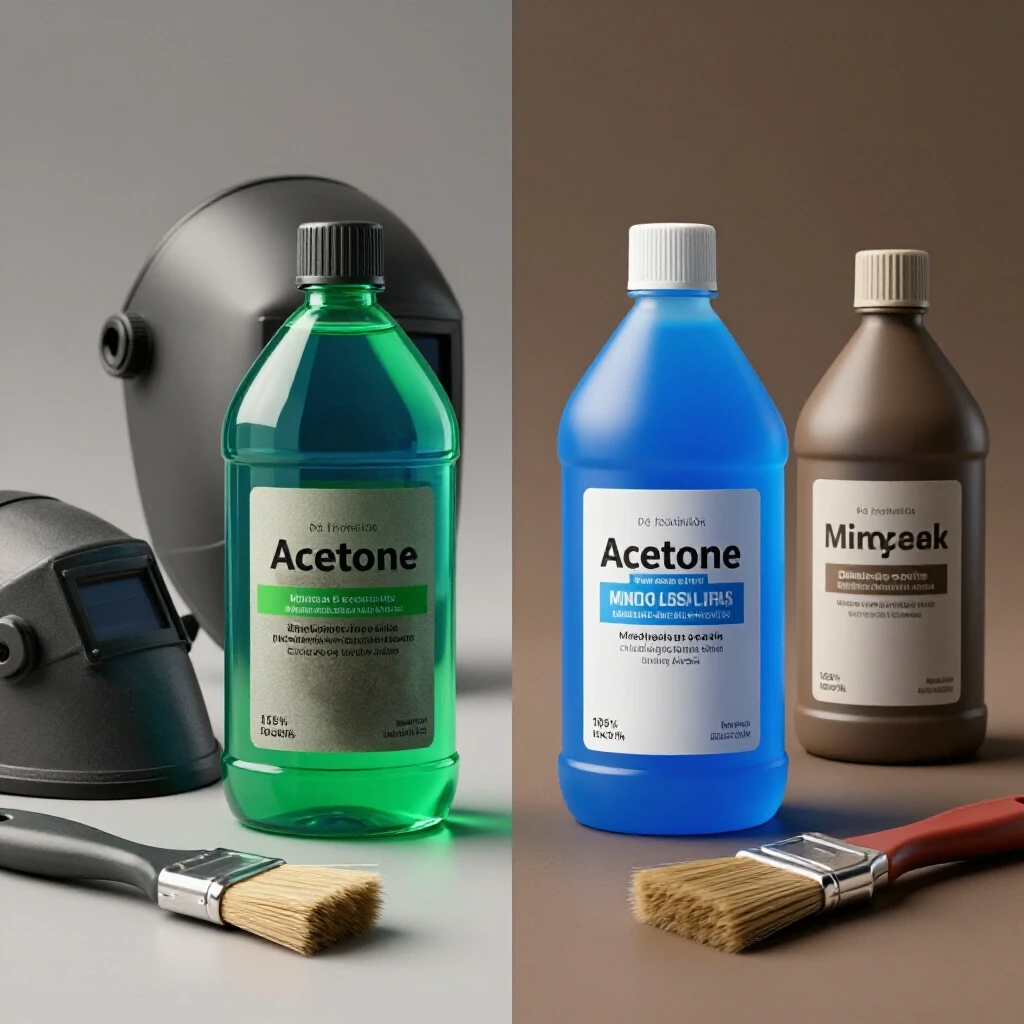
Acetone is the gold standard for this category. I use it when I need a surface that is bone-dry and ready for a TIG arc within ten seconds. Because it flashes off so fast, there is almost zero risk of liquid solvent being trapped in a joint fit-up. Trapped liquid is a primary cause of “blow-back” where the heat of the weld causes the solvent to expand rapidly, popping the weld puddle and creating a void.
Heavy-Duty Degreasers and Residue Management
Heavy-duty degreasers are solvents with a slower evaporation rate that are designed to break down tough, viscous oils and lubricants.
Mineral spirits fall into this category. They are excellent for cleaning a lathe bed or wiping down a large plate covered in shipping oil. However, they are “oily” by nature compared to ketones. If you use them for pre-weld prep, you must follow up with a clean, lint-free cloth. If you don’t, the residual hydrocarbons will break down under the heat of the arc, releasing hydrogen and carbon into the weld, which leads to brittleness and cracking.
| Feature | High-Volatility (e.g., Acetone) | Low-Volatility (e.g., Mineral Spirits) |
|---|---|---|
| Evaporation Rate | Very Fast (< 10 seconds) | Slow (2-5 minutes) |
| Residue Risk | Extremely Low | Moderate to High |
| Cleaning Power | Excellent for light oils/dust | Superior for heavy grease/wax |
| Best Use Case | Final wipe before TIG/MIG | Initial cleaning of raw stock |
| Storage Need | Airtight (evaporates in open air) | Stable in open containers |
Troubleshooting Weld Porosity and Surface Defects
Weld porosity refers to the presence of small cavities or holes in a weld caused by the entrapment of gas during the solidification process.
When a reader tells me they have porosity, I tell them to look at their cleaning rags. If you use a solvent that leaves a film, you are essentially “feeding” the weld pool contaminants. I have seen 2.0% porosity levels drop to zero just by switching from a slow-drying petroleum-based cleaner to a fast-drying ketone for the final wipe. It is a simple fix, but it requires a disciplined workflow.
Identifying Hydrogen Entrapment
Hydrogen entrapment is a condition where hydrogen atoms are absorbed into the molten weld pool and become trapped as the metal cools, leading to internal voids.
The heat of a welding arc is intense enough to break down any residual solvent molecules into their base elements. If you use a cleaner like mineral spirits and don’t wipe it completely dry, the hydrogen in those spirits enters the puddle. In aluminum, this shows up as “peppery” porosity. In steel, it can lead to under-bead cracking. Always ensure the metal is “dry to the touch” and has no “rainbow” sheen before starting.
The Impact of Residue on Arc Start and Stability
Arc stability is the consistency and smoothness of the electrical discharge between the electrode and the workpiece.
I’ve diagnosed many “erratic arc” issues that were actually chemical issues. A thin film of unevaporated mineral spirits acts as an insulator. When you try to start your arc, the high frequency might jump, but the main welding current struggles to establish a path. This causes “arc wandering.” Switching to a cleaner that leaves zero residue ensures the electrons have a clear, conductive path into the base metal.
Mechanical Alignment and the Role of Cleanliness
Mechanical alignment is the process of ensuring that machine components, such as a lathe spindle or a mill table, are perfectly positioned relative to one another.
We often think of cleaning only in terms of welding, but it is just as vital for machinery maintenance. If you are mounting a vise to a mill table and there is a film of oil or grit, you can easily be off by 0.002 inches. I use fast-drying solvents to clean the mating surfaces of my precision tools because I know they won’t leave a film that could “lift” the tool off the reference surface.
Eliminating Tool Chatter through Surface Prep
Tool chatter is a resonant vibration that occurs during machining, resulting in a poor surface finish and potential tool damage.
One often overlooked cause of chatter is “workholding slip.” If your chuck jaws or collets have a film of mineral spirits or oil on them, the workpiece can micro-slip under heavy cutting loads. This slip creates a harmonic vibration. I always degrease my collets with a fast-evaporating solvent to ensure maximum friction. A clean, dry grip is a rigid grip.
Spindle Backlash and Contamination
Spindle backlash is the amount of play or “lost motion” in a mechanism caused by gaps between mating parts, such as gears or lead screws.
While solvents don’t fix worn gears, using the wrong cleaner on a spindle can wash out the essential grease. If you are cleaning a machine, be careful not to let high-penetration solvents like mineral spirits seep into sealed bearings. I have seen spindles develop 0.005 inches of extra play because someone “cleaned” the machine so thoroughly they stripped the internal lubrication.
Case Study: The “Mystery” Porosity in a 5086 Aluminum Hull
I once consulted for a boat builder who was seeing intermittent porosity in their MIG welds on 5086 aluminum. They were using a petroleum-based degreaser because it was cheap and effective at removing the heavy wax used in the plate rolling process.
They thought they were being thorough by wiping it down, but the “dwell time” of the mineral spirits was too long. The solvent was soaking into the micro-fissures of the aluminum oxide layer. When they welded, the heat drew that solvent out. We changed the protocol: use the mineral spirits for the bulk removal, then follow up with a heavy scrub of a fast-evaporating ketone. The rework rate dropped from 15% to less than 1% overnight. This taught me that troubleshooting isn’t just about what you use, but the order in which you use it.
Diagnostic Tools and Calibration Checklists
To master your shop’s output, you need more than just a rag and a bottle. You need a way to verify your results.
- Digital Dial Indicator: Use this to check for runout after cleaning your spindle or workholding. A clean surface should show zero deviation.
- Infrared Heat Tracker: Use this to see how fast your solvent is evaporating. A cold spot on the metal indicates the solvent is still present and working.
- Smartphone Vibration Analyzer: If you suspect tool chatter from a slippery collet, use an app to find the resonant frequency and see if cleaning the mating surfaces changes the dampening.
- Ultraviolet (UV) Light: Some oils and mineral spirits fluoresce under UV light. This is a great way to “see” the invisible film left behind after a poor wipe-down.
Pre-Weld Surface Inspection Checklist
- [ ] Visual Check: Is the surface free of visible grease, scale, and rust?
- [ ] Tactile Check: Does the metal feel “tacky” or “slick”? (It should feel “dry” and “grabby”).
- [ ] Water Break Test: Does a drop of water spread out (clean) or bead up (contaminated)?
- [ ] Solvent Dwell Time: Has the cleaner had at least 30 seconds to flash off?
- [ ] Rag Inspection: Is your wiping cloth clean, or are you just moving dirt around?
Actionable Benchmarks for Shop Success
When you are troubleshooting, you need hard numbers to know if you are winning.
- Weld Porosity Limits: For structural steel (AWS D1.1), any pore larger than 1/32 inch is a red flag. If you see this, stop and re-clean.
- Mechanical Tolerances: When mounting a vise, your “runout” across a 6-inch span should be less than 0.0005 inches. If it is higher, check for a film of oil on the table.
- Evaporation Time: At 70°F, a 1-inch square of acetone should disappear in under 8 seconds. Mineral spirits may take 180 seconds or more.
The difference between a “good enough” fabricator and a master is the attention to the invisible. You cannot see a hydrogen atom, and you can barely see a 0.001-inch film of oil. But you can see the results in a cracked weld or a ruined part. By choosing the right solvent—using the heavy lifters for the bulk grime and the fast-evaporators for the final “surgical” clean—you eliminate the variables that cause downtime.
Next time you face a “mystery” defect, don’t just turn the knobs on your welder. Grab a fresh rag, select the right solvent for the specific contaminant, and start with a truly clean slate. It is the most effective tool in your diagnostic arsenal.
FAQ: Mastering Surface Decontamination for Fabrication
Why does using a slow-drying degreaser often lead to weld porosity? Slow-drying agents like mineral spirits often leave a thin, oily residue. When the welding arc hits this film, it breaks the hydrocarbons down into hydrogen gas. This gas gets trapped in the molten metal as it cools, creating small holes or “porosity” that weaken the joint.
Can I use a fast-drying solvent to remove heavy shipping grease from new steel? You can, but it is inefficient. Fast-drying agents like acetone evaporate so quickly they don’t have time to “soak” and break down heavy, thick grease. You will end up using a massive amount of solvent and rags. It is better to use a heavier degreaser first, then finish with a fast-evaporating wipe.
How do I know if my cleaning agent has completely evaporated? The most reliable way is the “chill test.” As a solvent evaporates, it cools the metal. If the surface still feels colder than the surrounding metal, or if you see a “fog” on the surface, the solvent is still flashing off. Wait until the metal returns to ambient temperature.
Is it necessary to clean the filler rod as well as the base metal? Absolutely. TIG rods, in particular, often have residual oils from the drawing process. I always pull a rag soaked in a fast-evaporating solvent down the length of the rod. You would be surprised how much black grime comes off a “clean” rod.
Does the type of metal affect which solvent I should use? Yes. Aluminum is much more porous than steel and has a thick oxide layer that traps contaminants. For aluminum, a fast-evaporating, zero-residue solvent is mandatory to prevent “peppery” porosity. Steel is more forgiving but still requires a residue-free surface for critical or high-pressure welds.
Can a dirty surface cause my welder’s arc to “wander”? Yes. A film of oil or unevaporated solvent acts as an electrical insulator. This forces the arc to search for a cleaner, more conductive path, leading to an unstable and wandering arc that makes it difficult to control the weld puddle.
What is the best way to clean a machine table before mounting a precision vise? Use a fast-evaporating solvent that leaves no residue. You want the “metal-on-metal” contact to be as tight as possible. Any film left by a heavier degreaser can create a microscopic “cushion” that throws off your alignment by several thousandths of an inch.
Is there a risk of “trapped solvent” in lap joints? This is a major risk. If you use a slow-drying cleaner, it can wick into the gap between two overlapping plates. When you weld, that trapped liquid turns into gas instantly, causing “blow-outs” where the weld metal is literally kicked out of the joint. Always use a fast-evaporating agent for lap joints.
How often should I change my cleaning rags during a project? As soon as the rag shows a visible grey or black streak, switch to a clean section or a new rag. If you keep using a dirty rag, you are simply redistributing a thinner layer of the same contaminant across a larger area, which is worse than not cleaning at all.
Does temperature affect how these solvents work? Significantly. In a cold shop (below 50°F), even “fast-drying” solvents will linger much longer. You may need to wait twice as long for the metal to be truly dry. Conversely, in a hot shop, acetone may evaporate so fast it doesn’t have time to dissolve the oils you are trying to remove.
(This article was written by one of our staff writers, Paul Whitaker. Visit our Meet the Team page to learn more about the author and their expertise.)