Choose the Right Workshop Vacuum for Steel Shavings (Review)
When I started my first fabrication business sixteen years ago, I spent most of my time worrying about the big numbers. I tracked the cost of my welder, the price of cold-rolled steel, and the rent for my small bay. I completely ignored the small things, like the time I spent sweeping up steel shavings or the cost of replacing tools that were ruined by metal dust. I soon realized that side-hustle metalworking fails not because of a lack of skill, but because of a lack of systems. To move from a hobbyist to a professional, you must view every piece of equipment, including your metal debris extraction system, as a financial asset that must pay for itself.
Establishing a True Shop Rate and Overhead Burden
A shop rate is the total hourly cost required to keep your business running, including your desired profit. It covers fixed costs like rent and insurance, as well as variable costs like electricity and maintenance. Knowing this number prevents you from underpricing your fabrication job costing.
In my experience, many small shop owners pick a number out of thin air, often around $40 or $50 an hour. When you factor in the true overhead burden, most small metal shops need to be at $65 to $120 per hour to remain viable. This rate must account for the “non-billable” time spent on shop maintenance and cleaning. If you spend five hours a week cleaning up steel shavings with a broom, you are losing hundreds of dollars in potential shop income. Investing in high-performance extraction equipment isn’t about cleanliness; it is about reclaiming those billable hours.
- Fixed Overhead: Rent, insurance, and base utility fees.
- Variable Overhead: Electricity for machines, welding gases, and cleaning supplies.
- Labor Rate: What you would pay a skilled tech to do the work, plus your profit margin.
Calculating Machinery Amortization and Maintenance
Amortization is the accounting practice of spreading the cost of an expensive tool over its expected lifespan. By tracking this, you can determine exactly how much a machine costs you every hour it sits in your shop. This helps in calculating a realistic return on investment for new equipment.
Steel shavings are incredibly abrasive and can destroy the internal components of your expensive machinery. If fine metal particles enter the cooling fans of your welder or the ways of your lathe, you are shortening the life of those assets. When I analyze tool ROI, I look at how a proper extraction system extends the life of my primary machines. If a $500 extraction unit prevents a $5,000 lathe from needing a $1,000 rebuild, the payback period for that unit is almost immediate. You aren’t just buying a vacuum; you are buying an insurance policy for your most expensive assets.
| Equipment Type | Expected Life (Unprotected) | Expected Life (With Extraction) | ROI Impact |
|---|---|---|---|
| CNC Mill/Lathe | 5,000 Hours | 8,000 Hours | High |
| TIG/MIG Welder | 4 Years | 7 Years | Medium |
| Precision Gauges | 2 Years | 5 Years | High |
Technical Performance Metrics for Metal Debris Extraction
Airflow and suction power are measured in Cubic Feet per Minute (CFM). For metalworking, you need higher airflow than standard woodworking because steel shavings are significantly heavier than sawdust. Proper filtration ensures that microscopic metal dust does not recirculate into your shop air.
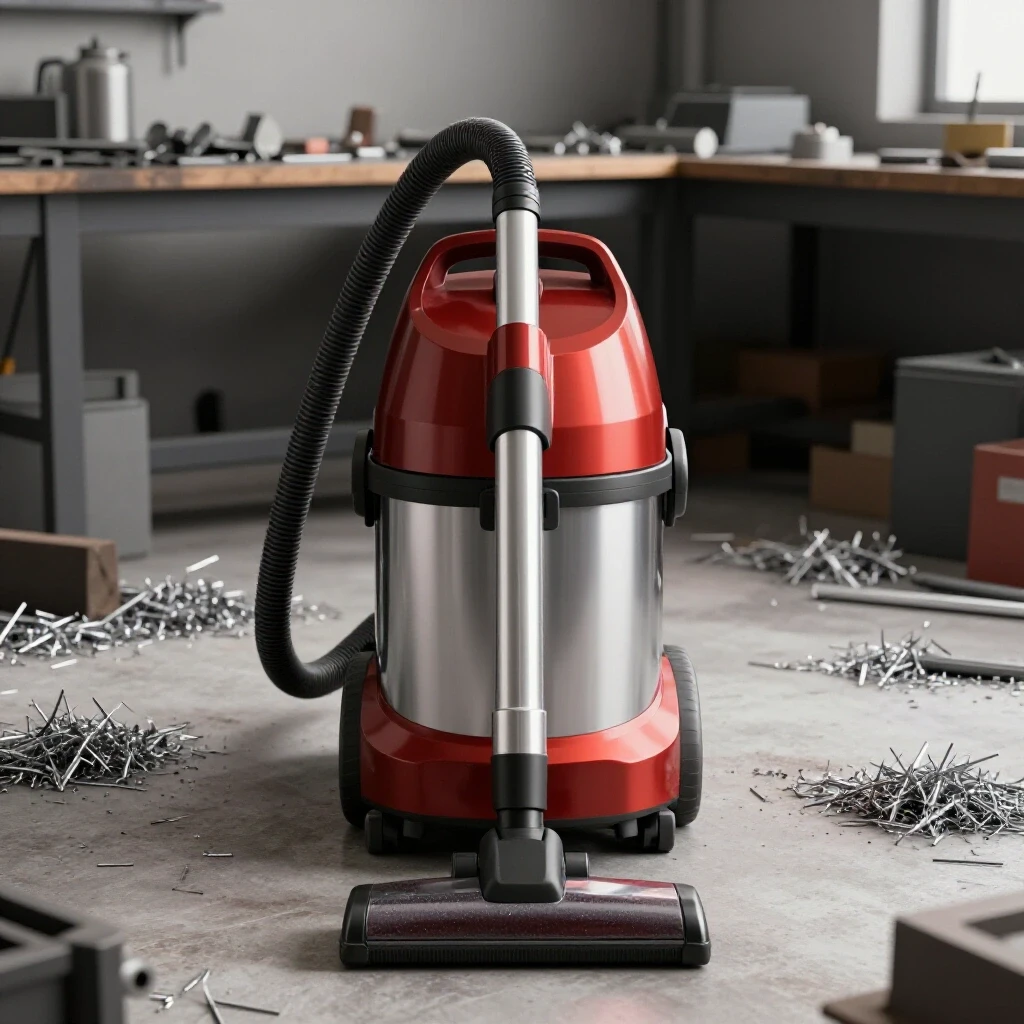
When you are evaluating equipment for side-hustle metalworking, look for a minimum of 150 CFM. Steel chips are dense and require high velocity to move through a hose without clogging. If the airflow is too low, the shavings will settle in the hose, causing a loss of suction and wasting your time. I have seen many shop owners buy underpowered units that end up sitting in the corner because they simply cannot move the heavy debris generated by a drill press or a cold saw.
- Minimum Airflow: 150 CFM for efficient heavy chip recovery.
- Static Pressure: The “pulling” power needed to lift metal from deep crevices.
- Hose Diameter: Larger diameters reduce friction but require more CFM to maintain velocity.
Multi-Stage Filtration and Particle Capture
Multi-stage filtration uses several layers to trap debris, starting with large chips and ending with fine dust. For metal shops, the final stage must be rated for particles smaller than 10 microns. This protects both your respiratory health and your precision electronics.
Interestingly, it is the dust you cannot see that causes the most financial damage. Fine ferrous dust is conductive; if it settles on the circuit boards of your modern inverter welder, it can cause a short circuit. In my consulting work, I have seen “mysterious” equipment failures that were actually caused by poor dust management. By ensuring your extraction system captures sub-10-micron particles, you reduce the “consumable burden factor” of your electronics and keep your shop rate focused on production rather than repairs.
The Financial Impact of Abrasion-Resistant Equipment
Metal debris is sharp and heavy, which means the containers and hoses used to collect it must be durable. Abrasion resistance refers to a material’s ability to withstand the rubbing or scraping of these sharp steel shavings without wearing through.
I once worked with a shop owner who used a cheap plastic unit for his steel shavings. Within three months, the sharp chips had sandblasted a hole right through the side of the tank. This is a classic example of a “low-margin trap.” He saved $100 on the initial purchase but had to buy a new unit twice a year. For a professional shop, you want tanks made of stainless steel or heavy-duty reinforced polymers. These materials can handle the impact of high-velocity steel shards without failing, ensuring your small metal shop pricing doesn’t have to cover constant equipment replacements.
- Stainless Steel Tanks: Best for sharp, hot chips and long-term durability.
- Reinforced Hoses: Look for wire-reinforced or heavy-walled hoses to prevent punctures.
- Inlet Design: A tangential inlet helps spin the heavy debris away from the filter, extending filter life.
Consumable Tracking and Filter Replacement Costs
Consumables are items that get used up during the fabrication process, such as welding wire, gas, and filters. Tracking these costs allows you to apply a “consumable burden” to your quotes, ensuring the customer pays for the wear and tear on your gear.
In my 16 years of tracking shop data, I have found that most owners forget to include filter costs in their job estimates. If a specialized metal filter costs $80 and lasts for 200 hours of operation, that adds $0.40 to your hourly operating cost. While that seems small, these costs compound. I recommend adding a 5% to 10% “consumable burden” to every quote to cover these hidden expenses. This ensures that when it is time to buy a new filter or a replacement hose, the money is already in the bank.
Building a Fabrication Job Quote with Maintenance in Mind
Job costing is the process of totaling all labor, materials, and overhead for a specific project. A successful quote includes not just the time spent welding, but also the time spent preparing the area and cleaning up afterward.
When I write a quote, I include a “Shop Prep and Recovery” line item. For a project that generates a lot of steel shavings—like a large drilling or milling job—I know that cleanup will take at least 30 minutes. At a shop rate of $80/hour, that is $40 of labor. If you don’t charge for that time, you are essentially working for free during the cleanup phase. By using efficient extraction tools, you can reduce that 30-minute cleanup to 10 minutes, directly increasing your profit margin on that specific job.
- Material Cost: Raw steel plus a 15-20% markup for sourcing and handling.
- Labor Hours: Actual time spent cutting, welding, and grinding.
- Machine Time: Hours spent on the mill or lathe, including an amortization fee.
- Cleanup and Maintenance: The time required to return the shop to a workable state.
Analyzing Post-Job Profits and Equipment Payback Periods
A payback period is the amount of time it takes for an investment to earn back its initial cost through savings or increased earnings. Post-job profit analysis helps you see if your estimates were accurate and if your tools are paying off.
After a month of using a high-quality extraction system, look at your numbers. Are you finishing jobs faster? Is your shop cleaner, leading to fewer tripped breakers or fouled machines? If the system costs $600 and saves you two hours of cleaning per week at a $75 shop rate, the payback period is only four weeks. In the world of small business ROI calculators, a four-week payback is an absolute home run. This is how you make profitable operational decisions—by looking at the data, not just the sticker price.
- Track Time: Use a simple app or a notebook to log “cleanup time” before and after the upgrade.
- Monitor Repairs: Note any decrease in machine downtime or tool sharpening needs.
- Review Margins: See if your “Shop Prep” line item is becoming a source of profit rather than just a cost recovery.
Conclusion
Success in the fabrication business isn’t just about the quality of your welds; it is about the health of your balance sheet. By treating the management of steel shavings as a technical and financial challenge, you protect your equipment and your time. Focus on high-airflow systems with 150 CFM and sub-10-micron filtration to ensure your shop remains a productive environment. Remember that every minute you save on cleanup is a minute you can bill to a client. Start tracking your shop rate and your consumable burden today, and you will see your side-hustle transform into a sustainable, profitable business.
Frequently Asked Questions
Why is 150 CFM considered the minimum for steel shavings?
Steel shavings are much denser and heavier than wood dust or general dirt. To lift these metallic particles and move them through a vacuum hose without them settling and causing clogs, you need a high volume of air moving at a high speed. 150 CFM provides the necessary velocity to ensure that heavy debris reaches the collection tank efficiently.
How does sub-10-micron filtration affect my shop’s profitability?
Fine metal dust is often conductive and abrasive. If it isn’t captured, it can settle inside the electronic components of expensive welders or CNC controllers, leading to shorts and expensive repairs. By capturing these tiny particles, you extend the life of your primary tools, lowering your long-term maintenance costs and protecting your ROI.
Can I use a standard shop vacuum for metal fabrication?
Standard shop vacuums often lack the necessary CFM and durable tank materials to handle sharp, heavy steel shavings. The sharp edges can quickly puncture standard filters and plastic tanks. Furthermore, standard filters often allow fine, harmful metal dust to exhaust back into the room, which can damage your equipment and your health.
How do I calculate the “consumable burden” for my extraction system?
To calculate this, take the cost of a replacement filter and the estimated cost of a replacement hose, then divide that by their expected hours of use. For example, if a $100 filter lasts 250 hours, your burden is $0.40 per hour. Add this to your hourly shop rate to ensure these costs are covered by your clients.
What is the best tank material for collecting sharp metal debris?
Stainless steel is generally the best option because it is highly resistant to the abrasive and piercing nature of sharp steel shavings. Heavy-duty, high-density polyethylene (HDPE) can also work, but it may wear down faster than metal if you are frequently vacuuming high-velocity, sharp-edged chips.
Does a better extraction system really help with job bidding?
Yes, because it allows for more accurate labor estimates. If you know that your cleanup time is consistent and fast due to professional-grade equipment, you can bid more competitively without the fear of “hidden” labor hours eating your profit. It turns a variable cost into a predictable, manageable one.
What happens if I ignore the filtration of fine metal dust?
Ignoring fine dust can lead to “equipment creep,” where your machines begin to fail or lose precision faster than they should. This forces you to replace tools sooner, which increases your overhead and lowers your overall profit margins. It also creates a less professional work environment that can affect your productivity.
How do I factor equipment depreciation into my fabrication job costing?
Divide the total cost of the machine by its expected lifespan in hours. For example, a $1,000 piece of equipment expected to last 2,000 hours costs you $0.50 per hour in depreciation. You should include this “machine hour” fee in every quote to ensure you have the funds to replace the tool when it wears out.
Why is static pressure important for metalworking?
Static pressure is the measure of the vacuum’s ability to overcome resistance. In metalworking, you often have to pull shavings out of deep slots, holes, or machine beds. High static pressure ensures that the vacuum can still “pull” effectively even when the hose is partially restricted or when lifting heavy material vertically.
How often should I check my extraction system’s filters?
In a professional metal shop, you should inspect filters weekly. Metal dust can “blind” a filter more quickly than wood dust because it is heavier and can be oily. Keeping the filter clean ensures you maintain the 150 CFM required for efficient operation and prevents strain on the vacuum motor.
(This article was written by one of our staff writers, Michael Hargrove. Visit our Meet the Team page to learn more about the author and their expertise.)