Cost of a Copper Shop Air Distribution System (DIY Tutorial)
When I opened my first fabrication shop sixteen years ago, I spent the first six months tripping over a tangled mess of rubber air hoses. I was focused on the big-ticket items—the TIG welder, the vertical bandsaw, and the press brake—while ignoring the infrastructure that actually powered them. It wasn’t until I ruined a $400 powder-coating job because of moisture in my lines that I realized infrastructure is a financial asset, not just a convenience. Building a permanent air delivery network using copper is one of the most effective ways to stabilize your shop’s climate and protect your equipment ROI.
For a side-hustler, every dollar spent on the shop must be viewed through the lens of a payback period. If you spend $800 on materials and four days of your time on an installation, how many fabrication jobs will it take to recover that cost? This guide focuses on the hard numbers of installing a copper-based compressed air network, helping you move from a hobbyist mindset to a professional business model where every fitting and foot of pipe is accounted for in your overhead.
Establishing Your True Shop Rate and Infrastructure Burden
A shop rate is the hourly fee you charge to cover your labor, overhead, and profit. For most small metalworking shops, this falls between $65 and $120 per hour, depending on your local market and the complexity of your machinery.
Before you buy a single copper fitting, you must understand that the cost of your shop infrastructure is “burdened” into this hourly rate. If you spend $1,000 on a permanent air system, that cost needs to be amortized, or spread out, over the expected life of the system. If you plan to run your shop for ten years, that infrastructure costs you $100 per year, plus the “opportunity cost” of the time you spent installing it instead of doing billable fabrication work.
Calculating Your Hourly Overhead
To find your true shop rate, you need to list every fixed expense you have. This includes rent, insurance, power, and the depreciation of your tools. Depreciation is the process of deducting the cost of an expensive asset over its useful life. For example, a $3,000 air compressor that lasts 10 years “costs” you $300 a year in depreciation.
| Expense Category | Annual Cost (Example) | Monthly Cost |
|---|---|---|
| Shop Rent/Mortgage | $12,000 | $1,000 |
| Utilities (Power/Heat) | $2,400 | $200 |
| Insurance & Licensing | $1,200 | $100 |
| Tool Depreciation | $3,600 | $300 |
| Consumables (Gas, Wire) | $1,800 | $150 |
| Total Fixed Overhead | $21,000 | $1,750 |
If you work 20 hours a week on your side-hustle (80 hours a month), your overhead alone is $21.87 per hour. If you want to pay yourself $40 an hour and keep a 20% profit margin for future growth, your shop rate needs to be approximately $75 per hour. Understanding this math is the difference between a profitable business and an expensive hobby.
Why Copper is a Strategic Financial Choice for Air Lines
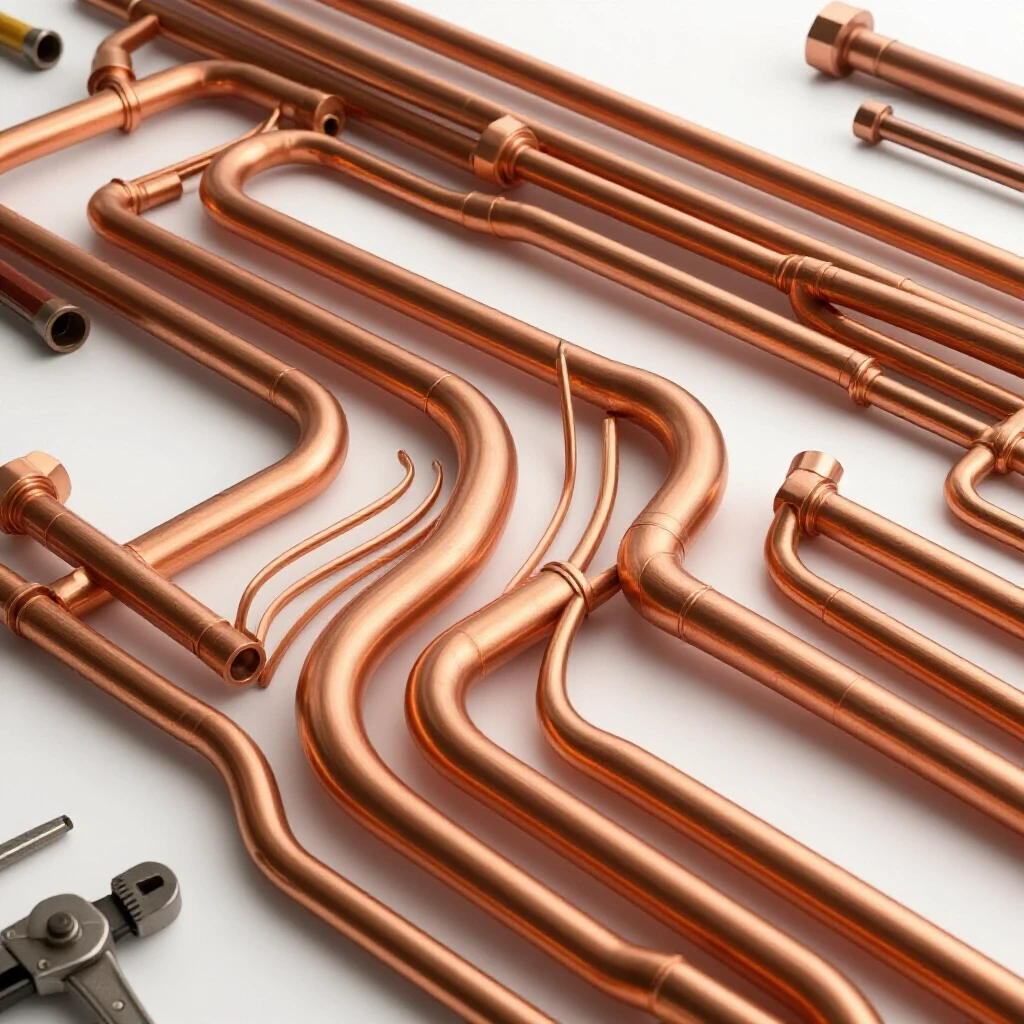
Copper is often chosen for workshop air distribution because of its thermal conductivity. As compressed air travels through the lines, it cools down, causing water vapor to condense into liquid. Copper transfers heat out of the air much faster than plastic or rubber, allowing you to catch that water in drop-legs before it reaches your expensive plasma cutter or paint gun.
In the world of fabrication job costing, “rework” is the ultimate profit killer. If you have to strip and re-paint a project because a drop of water hit the surface during the final coat, you have lost your profit margin for that entire job. Investing in a copper system is essentially an insurance policy against moisture-related failures.
Material Selection: Type L vs. Type M
When sourcing your copper, you will typically find two types at your local supplier: Type L (Blue stripe) and Type M (Red stripe). Type L has a thicker wall and is rated for higher pressures. While Type M is often sufficient for standard shop pressures (90-125 PSI), many professional fabricators prefer Type L for its durability and better resistance to physical damage in a busy shop environment.
- Type L Copper: Thicker walls, higher cost, better for long-term industrial use.
- Type M Copper: Thinner walls, lower cost, standard for residential and light commercial.
Estimating the Per-Foot Cost of Your Air Network
To create an accurate budget, you need to look at the “linear foot cost” of your installation. This isn’t just the price of the pipe; it includes the fittings, valves, and mounting hardware. In my experience, a 50-foot run with four drops (outlets) usually averages out to a specific price point per foot once all components are factored in.
Component Pricing Breakdown
Prices fluctuate based on the global copper market, but for a standard 1/2-inch or 3/4-inch system, you can use these estimates for your initial budget.
- Copper Pipe (1/2 inch): $2.50 – $3.50 per foot.
- Copper Pipe (3/4 inch): $4.00 – $5.50 per foot.
- 90-Degree Elbows: $1.50 – $3.00 each.
- Tee Fittings: $3.00 – $5.00 each.
- Ball Valves (Brass): $12.00 – $20.00 each.
- Drop-Ear Elbows (for outlets): $6.00 – $10.00 each.
Estimated 50-Foot System Budget (1/2-inch Type L):
| Item | Quantity | Estimated Cost |
|---|---|---|
| 50ft Type L Copper Pipe | 5 sticks (10ft) | $150.00 |
| Assorted Fittings (Tees/Elbows) | 20 pieces | $60.00 |
| Ball Valves (Main & Drains) | 6 units | $90.00 |
| Drop-Ear Mounting Elbows | 4 units | $35.00 |
| Solder, Flux, Gas, Brushes | 1 kit | $45.00 |
| Pipe Hangers/Clamps | 15 units | $30.00 |
| Total Estimated Material Cost | $410.00 |
This puts your material cost at roughly $8.20 per linear foot. If you are charging a shop rate of $80 per hour and the installation takes you 8 hours, your “total investment” is $1,050. This is the number you use to calculate your ROI.
Tracking Consumables and Hidden Operational Costs
One of the biggest mistakes small shop owners make is failing to track welding consumable usage and small shop supplies. For a copper installation, your consumables include solder, flux, cleaning pads, and the fuel for your torch (Propane or MAPP gas).
While $45 for a soldering kit might seem small, these “micro-expenses” add up. When you transition to client work, you should apply a “consumable burden factor” to your quotes. This is usually a percentage (3% to 5%) added to the total material cost of a job to cover things like shielding gas, grinding wheels, and shop rags.
The Cost of Joining Methods: Soldering vs. Press-Fit
There are two primary ways to join your copper lines: traditional “sweating” (soldering) or using a mechanical press tool (like a ProPress).
- Soldering: Low entry cost. You only need a $50 torch and basic supplies. However, it is time-intensive. If you value your time at $80/hour, the extra hours spent cleaning and heating joints might actually make this the more expensive option.
- Press-Fit: High entry cost. A manual or battery-powered press tool can cost between $600 and $2,000. The fittings are also more expensive. However, the installation is four times faster. For a side-hustler, a manual press tool might have a positive ROI if you plan on expanding your shop or doing plumbing work on the side.
Analyzing the ROI of Professional Air Distribution
How do you determine if spending $1,000 on a copper air system is a “profitable operational decision”? You look at the time saved and the reduction in equipment maintenance.
Time Savings and Efficiency
If you currently spend 5 minutes every hour untangling hoses or moving a portable compressor around, that is 40 minutes in an 8-hour day. At an $80 shop rate, that is $53 worth of lost billable time every single day.
- Daily Time Loss: 40 minutes ($53.33)
- Weekly Time Loss: 3.3 hours ($266.65)
- Monthly Time Loss: 13.3 hours ($1,066.60)
In this scenario, the copper system pays for itself in just one month of full-time work through efficiency gains alone. This is the “payback period”—the time it takes for an investment to generate enough savings or extra income to cover its initial cost.
Equipment Longevity
Moisture is the enemy of pneumatic tools. Impact wrenches, air ratchets, and plasma cutters all have internal components that rust or fail when exposed to wet air. If a professional air distribution system extends the life of a $1,500 plasma cutter by two years, that is a direct contribution to your bottom line.
Building a Custom Job Quote with Infrastructure in Mind
When you bid on a fabrication job, you aren’t just selling your time; you are selling the use of your facility. Your quote should be broken down into three main pillars: Materials, Labor, and Overhead/Consumables.
- Material Cost: The actual cost of the metal, plus a markup (usually 20% to 35%) to cover the time spent sourcing and transporting it.
- Labor Cost: Your shop rate multiplied by the estimated hours. Be honest about how long it takes to set up, clean, and package the job.
- Consumable Burden: A flat fee or percentage to cover the “hidden” costs like the air you used, the electricity for the welder, and the solder in your lines.
Example: Small Bracket Fabrication Job
- Raw Steel: $50
- Material Markup (30%): $15
- Estimated Labor (3 hours @ $85/hr): $255
- Consumable Burden (5% of Labor): $12.75
- Total Quote: $332.75
If you don’t have a reliable air system and you have to stop to drain your compressor tank every 20 minutes, that 3-hour job might take 4 hours. You’ve just lost $85 of profit because your infrastructure wasn’t optimized.
Sourcing Strategies for Small Shop Owners
To keep your overhead low, you need to be smart about where you buy your copper and fittings. Big-box hardware stores are convenient, but they are often the most expensive option.
- Plumbing Supply Houses: These businesses sell to contractors. If you show up with a professional attitude and a business name, they may give you “counter pricing,” which is lower than retail.
- Online Bulk Suppliers: For fittings like elbows and tees, buying in packs of 10 or 20 online can save you 40% compared to buying individual bags at a retail store.
- Scrap Yards: Occasionally, you can find “new old stock” or clean removals at scrap yards. However, be cautious; any dent or deep scratch in a copper pipe can become a failure point under pressure.
Post-Job Profit Analysis and Cost Reconciliation
After you finish your copper installation—or any major shop upgrade—you must perform a cost reconciliation. This is a fancy term for checking if your actual spending matched your estimate.
Did the 50-foot run actually take 65 feet of pipe because of mistakes or rerouting? Did you spend $100 more on brass valves than you planned? Use these findings to adjust your future bidding models. If you underpriced your own infrastructure project, you are likely underpricing your client work as well.
Digital Tools for Tracking
- Spreadsheets (Excel/Google Sheets): The gold standard for tracking linear foot costs and ROI timelines.
- QuickBooks or FreshBooks: Excellent for tracking the “Consumable Burden” and seeing how your utility bills change after shop upgrades.
- Inventory Apps: Use simple apps to track how many 1/2-inch elbows you have left so you don’t have to make a “profit-killing” trip to the store in the middle of a job.
Managing the Transition from Hobbyist to Professional
The biggest hurdle for the 35–55-year-old side-hustler is often the “guilt” of charging a professional rate. You might feel that because you are working in a garage, you shouldn’t charge $90 an hour. But your clients aren’t just paying for your time; they are paying for the copper lines that ensure their part is painted perfectly, the high-end welder that ensures a strong joint, and the years of experience you bring to the table.
Optimizing your shop’s financial efficiency through smart infrastructure investments like copper air lines is a signal to yourself and your customers that you are running a business, not a hobby. When you master your shop math and understand your overhead, the anxiety of pricing disappears because the numbers tell the story for you.
Summary of Key Benchmarks
- Target Shop Rate: $65–$120 per hour.
- Copper System Material Cost: $7.00–$10.00 per linear foot (fully outfitted).
- Material Markup: 20%–35% on all raw goods.
- Consumable Burden: 3%–5% of total job cost.
- Payback Period Goal: Infrastructure should pay for itself in 6–12 months of part-time work.
FAQ: Managing Workshop Air Infrastructure and Economics
Is 1/2-inch copper enough for a small fabrication shop?
For most side-hustle shops using standard air tools and a single plasma cutter, 1/2-inch Type L copper is sufficient for runs under 50 feet. However, if you plan on running a high-CFM sandblaster or multiple tools simultaneously, 3/4-inch is a better investment. The price difference is roughly 40% more, but it prevents “pressure drop,” which can cause tools to underperform.
Can I use “SharkBite” or push-to-connect fittings for air?
While some push-to-connect fittings are rated for air, they are significantly more expensive than solder fittings—often $8 to $15 per fitting. From a business ROI perspective, they rarely make sense unless you are making a temporary repair. Soldering is the most cost-effective method for a permanent, leak-free system.
How do I factor the cost of the copper installation into my taxes?
In many jurisdictions, shop improvements like a permanent air system are considered “capital improvements.” Instead of deducting the full cost in one year, you may need to depreciate it over several years. Consult with an accountant to see if you can use Section 179 for an immediate deduction, which can help offset the profits from your side-hustle.
Should I install moisture traps at every drop?
Yes. From a cost-efficiency standpoint, a simple “tee” with a 6-inch vertical extension downward (a drip leg) and a ball valve at the bottom is very cheap to build. This prevents water from entering your hoses. Replacing a $15 ball valve is much cheaper than replacing the internal valves of a $400 air tool.
How do I check for leaks without wasting expensive compressed air?
After soldering, pressurize the system to about 30 PSI and spray every joint with a mixture of dish soap and water. Bubbles will indicate a leak. Fixing a leak during the installation phase is free; ignoring a small leak can cost you $50 a year in extra electricity as your compressor cycles to maintain pressure.
Does copper air piping require a specific slope?
Ideally, you should slope your main horizontal lines slightly (about 1 inch for every 10 feet) back toward your compressor or toward a dedicated moisture drain. This uses gravity to move water out of the lines, protecting your tools and ensuring your fabrication work remains high-quality.
How much should I markup the copper if I’m installing it for someone else?
If you are doing this as a paid job for another shop owner, a standard material markup is 30%. This covers your time spent at the supply house, the fuel for your truck, and the risk of a part being defective. Never sell materials at your cost; you are a business, not a delivery service.
Is M-type copper really that much worse than L-type?
M-type is thinner and more prone to kinking or getting dented if a piece of heavy steel leans against it. In a metal shop, things get bumped. The extra $50–$100 spent on Type L copper for the whole shop is a small price to pay for the added structural integrity.
What is the best way to connect the copper to the compressor?
Never connect copper pipe directly to a vibrating air compressor. Use a high-quality, reinforced flexible lead hose (braided stainless steel or heavy rubber) between the compressor tank and the copper wall lines. This prevents vibration from cracking your solder joints over time.
How do I account for my “DIY labor” in my shop’s books?
Even if you aren’t paying yourself a check for the installation, you should log the hours. This helps you understand the “true cost” of the asset. If the project took 12 hours, that’s 12 hours you couldn’t spend on a client’s $1,000 project. This “opportunity cost” is a vital metric for any growing business.
(This article was written by one of our staff writers, Michael Hargrove. Visit our Meet the Team page to learn more about the author and their expertise.)