How to Calculate Project Overhead Costs for Custom Fab (Fix)
Twenty years ago, my shop was a collection of mismatched tools and extension cords snaking across a grease-stained concrete floor. Back then, I measured success by whether a project looked good and if the check cleared. As I transitioned from a hobbyist to a professional fabricator, I realized that the “hidden” expenses of running the building were eating my growth. I had upgraded to a CNC plasma table and a larger press brake, but I hadn’t accounted for how these machines changed the financial weight of the shop itself.
When you scale a fabrication business, the physical space becomes a living entity that requires constant feeding. Every square foot of floor space, every amp of 3-phase power, and every cubic foot of filtered air represents a cost that exists regardless of whether you are actively welding. Understanding how to track these indirect expenses is the difference between a shop that thrives and one that slowly drains its owner’s bank account. We will look at how to quantify these shop-wide burdens so you can apply them accurately to every project that leaves your bay.

Analyzing Workshop Footprint and Facility Expenses
Facility expenses represent the baseline cost of maintaining your physical workspace, including rent, mortgage, property insurance, and general property maintenance. These are the fixed burdens that do not change based on your daily production volume but must be distributed across your active work hours.
When I moved into my current 3,000-square-foot facility, I had to rethink how I viewed the floor. In a small garage, space feels free. In a professional shop, every square foot has a price tag. If your monthly facility costs are $3,000, and you have 3,000 square feet, every square foot costs you $1 per month. If your CNC plasma table and its required “clear zone” take up 200 square feet, that machine starts every month $200 in the hole before you even turn it on.
To calculate this, you need to map your shop into functional zones. I use a simple “Zone Allocation” method. I measure the footprint of each major work cell, including the space needed for material handling and operator movement.
- Fabrication Zone: Welding tables, clamps, and jigging areas.
- Machining Zone: CNC tables, mills, or lathes.
- Material Storage: Racks for sheet, tube, and plate.
- Support Zone: Air compressors, phase converters, and dust collectors.
By dividing your total facility cost by the total usable square footage, you get a “cost per square foot.” You then multiply this by the footprint of a specific project’s required work zone to see how much facility overhead that job should carry.
Integrating 3-Phase Power and Utility Loading
Utility overhead covers the indirect costs of energy consumption, including base electrical fees, heating, cooling, and the specific power requirements of support equipment like phase converters. These costs are often overlooked because they are billed monthly rather than per project.
Most residential or light commercial shops lack native 3-phase power. When I integrated my first industrial-grade CNC mill, I had to choose between a Rotary Phase Converter (RPC) and a Digital Phase Converter. This choice had a direct impact on my monthly overhead. An RPC is a large 3-phase motor that runs constantly to generate the third leg of power. Even when your machines are idling, that motor is spinning and drawing current.
I tracked my utility bills over six months and found that my “idle load”—the power used just to keep the lights on and the phase converter spinning—accounted for 15% of my total electrical bill. To allocate this, I calculate a “Shop Utility Rate” by taking the average monthly bill and dividing it by the total billable hours in a month.
| Power Source Type | Efficiency Rating | Overhead Impact | Best Use Case |
|---|---|---|---|
| Single Phase (Standard) | High | Low | Hand tools, small welders |
| Rotary Phase Converter | Medium | High (Idle Draw) | Multiple motors, heavy starts |
| Digital Phase Converter | High | Medium (Initial Cost) | Sensitive CNC electronics |
| VFD (Variable Frequency) | High | Low | Single motor speed control |
According to the National Electrical Code (NEC) frameworks, balancing your phase loads is not just about safety; it is about efficiency. An unbalanced phase converter generates heat, which is wasted energy you are paying for in your overhead.
Designing Industrial Air Systems and Maintenance Cycles
Air management overhead includes the costs associated with running and maintaining dust collection, fume extraction, and compressed air systems. This involves filter replacements, motor maintenance, and the electrical cost of moving high volumes of air to meet safety standards.
Clean air is not a luxury; it is a shop requirement. However, a 5HP dust collector moving 2,000 Cubic Feet per Minute (CFM) adds a significant chunk to your indirect costs. In my shop, I noticed that my air filtration costs were spiking because I hadn’t accounted for “static pressure loss” in my duct design. If your ducts are too small or have too many bends, your collector works harder, uses more power, and wears out filters faster.
To quantify this, I look at the “Consumable Life Cycle” of my filters. I use a simple formula: (Cost of Filter Set / Estimated Run Hours) + (Hourly Power Cost of Collector). If a set of HEPA filters for my laser fume extractor costs $600 and lasts 1,000 hours, that is $0.60 per hour in overhead.
- Duct Velocity: Maintain 3,500 to 4,000 Feet Per Minute (FPM) for metal dust to prevent settling.
- Filter Monitoring: Use a magnehelic gauge to track pressure drop; high pressure means the motor is straining and increasing overhead.
- Compressor Leaks: A single 1/16-inch leak in a compressed air line can cost hundreds of dollars a year in wasted electricity.
By treating air quality as a measurable overhead item, you can ensure that high-fume projects, like heavy galvanized welding or plasma cutting, are priced to cover the extra strain on your filtration system.
Calculating Machinery Amortization and Equipment Upkeep
Equipment overhead is the “rent” you pay for owning machinery, calculated by spreading the purchase price and long-term maintenance costs over the expected lifespan of the tool. This ensures that when a machine reaches the end of its life, the shop has already recovered the funds to replace it.
When I bought my first CNC plasma table, I made the mistake of thinking it was a one-time expense. I quickly learned that the gantry motors, lead screws, and electronic components have a finite life. To calculate this, I use a “Straight-Line Amortization” model. If a machine costs $20,000 and I expect it to last 5 years (10,000 working hours), the machine “costs” $2.00 per hour just to sit on the floor.
Maintenance is the other half of this equation. I keep a log of non-billable time spent greasing rails, squaring gantries, and updating software.
- Identify the total purchase price of the machine.
- Estimate the useful life in hours (e.g., 2,000 hours per year for 5 years).
- Add an annual “Maintenance Factor” (typically 5-10% of the machine’s value).
- Divide the total by the estimated hours to find the hourly equipment overhead.
This “Machine Hourly Rate” is separate from your labor. It represents the cost of the machine itself. If a project occupies the plasma table for four hours, it must absorb four hours of that machine’s specific overhead.
Optimizing Layout to Reduce Non-Billable Motion
Workflow overhead refers to the cost of “dead time” or “non-value-added movement” caused by poor shop layout. This includes time spent moving material from the rack to the saw, or walking across the shop to find a tool, which increases the indirect labor cost of every project.
In my early days, I had my material rack at one end of the shop and my cold saw at the other. I calculated that I was spending 15 minutes per project just moving steel. Over a year, that added up to dozens of hours of non-billable time. In manufacturing operations, we call this “waste.”
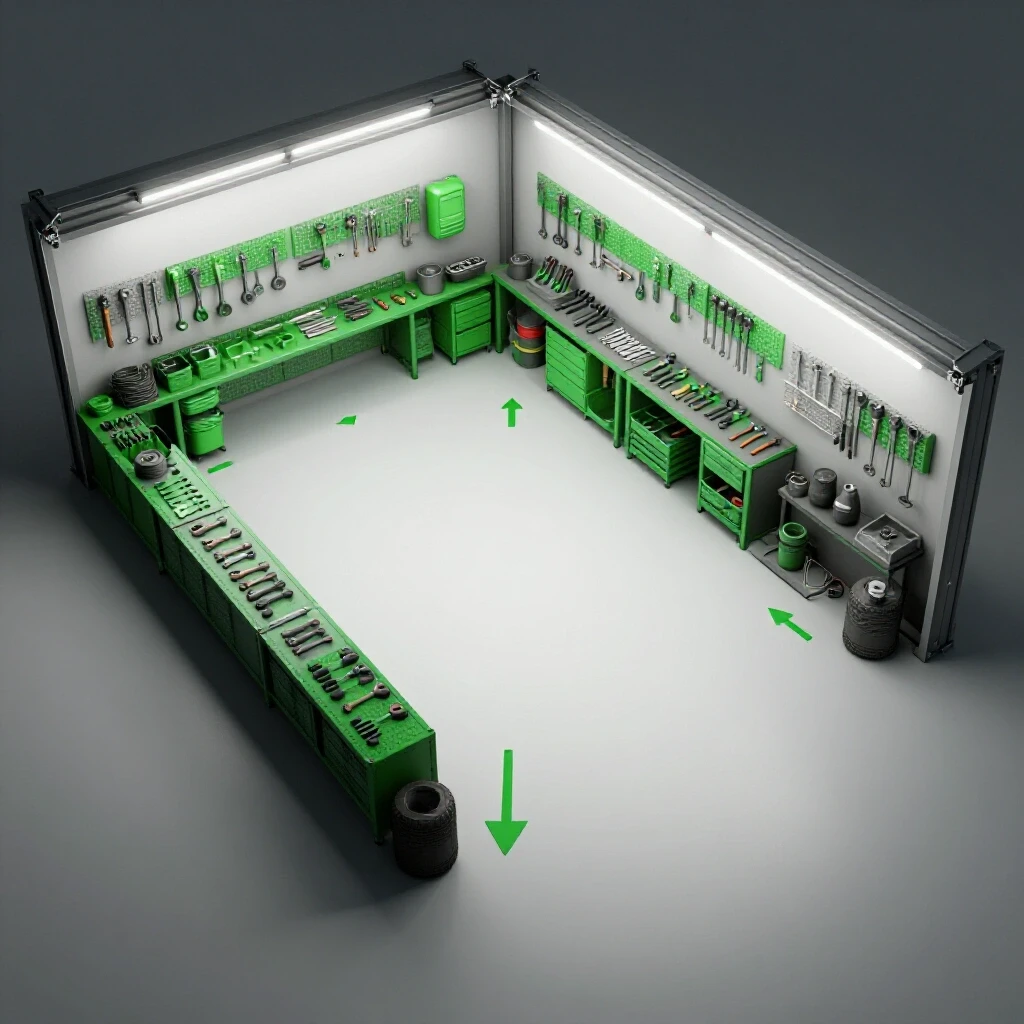
To solve this, I redesigned my shop into “Linear Flow” patterns. Material enters the rear door, moves to the rack, then to the saw, then to the fabrication table, and finally to the shipping area.
- The 5-Foot Rule: Keep all necessary tools for a specific machine within five feet of the operator station.
- Clearance Zones: Ensure a minimum of 3-foot access zones around all machinery for maintenance, as blocked access increases the time (and cost) of repairs.
- Material Handling: Use jib cranes or rolling carts to reduce the time spent waiting for a second person to help lift heavy plates.
By reducing the “motion overhead,” you increase the number of billable hours you can fit into a week. This doesn’t change your monthly rent, but it lowers the “overhead per project” because you are completing more projects in the same amount of time.
Formulating the Total Shop Hourly Rate
The Shop Hourly Rate is the final number that combines all indirect costs (facility, utilities, air systems, and equipment) into a single metric that can be applied to project estimates. This rate ensures that every hour of work performed contributes its fair share toward the shop’s total operating expenses.
To find this number, I sum up all the monthly costs we have discussed: – Monthly Facility Cost (Rent + Insurance) – Monthly Utility Base (Power + Heat) – Monthly Equipment Amortization (Total for all machines) – Monthly Maintenance and Air Systems Fund
I then divide this total by my “Productive Capacity.” This is the number of hours I actually spend working on projects, not the total hours the lights are on. If my total monthly overhead is $4,000 and I work 160 hours, my shop overhead rate is $25 per hour.
| Expense Category | Monthly Cost (Example) | Hourly Allocation (160 hrs) |
|---|---|---|
| Facility (Rent/Ins) | $1,600 | $10.00 |
| Utilities (Power/Gas) | $400 | $2.50 |
| Machine Amortization | $1,200 | $7.50 |
| Maintenance/Filtration | $800 | $5.00 |
| Total Overhead Rate | $4,000 | $25.00/hr |
This $25 per hour is the “burden” that must be added to my labor rate. If I want to earn $50 per hour for my skill, I must charge $75 per hour to ensure the shop’s expenses are covered. Using this systematic approach transformed my business from a stressful struggle into a predictable, professional operation.
Frequently Asked Questions
How do I account for overhead if I work out of a shop I own outright? Even if you don’t pay rent, your shop has a “market value” cost. You should calculate overhead based on what it would cost to rent a similar space. This covers property taxes, building insurance, and future maintenance like roof repairs. Additionally, this allows you to build a “capital reserve” so you can eventually expand or move into a larger commercial space.
Should I include my CNC software subscriptions in my project overhead? Yes. Any recurring cost required to keep the shop operational is overhead. Software for CAD/CAM or nesting is a digital tool, much like a physical press brake. Total the annual subscription costs and divide them by your yearly billable hours to include them in your hourly rate.
How does shop layout specifically affect my overhead costs? Layout affects the “efficiency” of your overhead. You pay for your shop’s square footage whether you are moving material or welding. If a poor layout doubles the time it takes to move a sheet of steel to the plasma table, you are effectively paying double the “facility overhead” for that specific task. A tight, linear flow maximizes the value of every dollar spent on rent.
What is the best way to track utility overhead for a single high-draw machine? You can use a basic power logger or look at the machine’s “Duty Cycle” and “Full Load Amps” (FLA) rating. For example, if a welder draws 50 amps at a 60% duty cycle, you can estimate its kWH usage. However, for most shops, it is simpler to track the total shop utility increase when that machine is in heavy use and average it across your monthly billable hours.
How often should I recalculate my overhead rates? I recommend a “Quarterly Review.” Utility rates fluctuate with the seasons, and you may add new tools or change your layout. By checking your numbers every three months, you can ensure your project pricing remains accurate and that you aren’t losing money to “bracket creep” as your shop grows.
Is 3-phase power always more expensive in terms of overhead? Not necessarily. While the initial setup of a phase converter or a utility drop is high, 3-phase motors are generally more efficient than single-phase motors. Over the long term, running industrial-grade 3-phase equipment can actually lower your utility overhead per unit of work produced because the motors run cooler and last longer.
What is “static pressure,” and why does it matter for my shop’s costs? Static pressure is the resistance your dust collector faces when pulling air through ducts and filters. High static pressure (caused by small pipes or clogged filters) makes the fan work harder, drawing more electricity and shortening the motor’s life. Monitoring this helps keep your air system overhead predictable and prevents expensive emergency motor replacements.
How do I handle overhead for a project that sits in the shop for weeks waiting for parts? This is “Floor Space Overhead.” If a large project is taking up a 200-square-foot bay but no work is being done on it, it is still “consuming” that space’s rent. Professional shops often include a “storage fee” or ensure the project’s total overhead allocation accounts for the total time it occupies the floor, not just the active labor hours.
Does automation like a CNC table always lower my overhead? Automation usually increases your “Fixed Overhead” (higher equipment costs, software, and power) but lowers your “Variable Overhead” per part by increasing speed. The goal is to ensure your throughput is high enough that the machine’s cost is spread over many parts, eventually lowering the total cost per project.
What is the biggest mistake shop owners make when calculating these costs? The most common mistake is failing to account for “Non-Billable Time.” If you only divide your costs by a 40-hour work week, but you only spend 20 hours actually “on the clock” for projects (with the rest spent cleaning, quoting, or maintenance), your overhead rate will be 50% too low. Always calculate based on actual productive hours.
(This article was written by one of our staff writers, Edward Sinclair. Visit our Meet the Team page to learn more about the author and their expertise.)