How to Choose High-Output LED Lighting for Garage Shops (Fix)
I have spent 17 years in my shop tearing down everything from 1950s bridge mills to modern inverter welders. One thing I have learned is that you cannot work on what you cannot see. Many fabricators spend thousands on a high-end lathe but then try to light their workspace with cheap, plastic shop lights from a big-box store. This is a mistake. Just as a flimsy machine frame ruins your tolerances, poor workshop illumination ruins your ability to see layout lines, weld puddles, and surface finishes. When I evaluate shop equipment, I look past the paint and the marketing stickers. I want to see the heat sinks, the driver quality, and the structural rigidity of the housing.
Choosing high-output illumination for a garage-scale metalworking space requires a mechanical mindset. You are not just buying a “bulb.” You are investing in a piece of shop infrastructure that must survive grinding dust, vibration, and long duty cycles. In my experience, the difference between a professional-grade fixture and a consumer-grade toy comes down to how the unit handles heat and electrical stress. Let’s look at how to strip away the marketing hype and choose lighting that actually performs in a real-world fabrication environment.
Why Heavy-Duty Housings Matter for Shop Illumination
The physical construction of a light fixture is its foundation, much like the cast iron bed of a lathe. In a shop where you are grinding, welding, and moving heavy stock, a thin plastic housing will not last.
High-output LEDs generate a significant amount of heat at the diode level. If that heat is not moved away quickly, the light will dim over time or the internal electronics will fail. I prefer fixtures with extruded aluminum housings. Aluminum acts as a giant heat sink. It draws heat away from the sensitive LED chips and dissipates it into the air. When you hold a fixture, it should feel substantial. If it flexes in your hand, it will likely warp or crack under the thermal stress of 10-hour workdays.
Thermal Management and Diode Lifespan
Thermal management is the ability of a fixture to keep its internal components cool during operation. This is critical because heat is the primary enemy of LED longevity.
In my teardowns of budget lights, I often find that the LED chips are mounted on thin tape rather than being bolted to a metal plate. Professional fixtures use “Metal Core Printed Circuit Boards” (MCPCB). These boards transfer heat directly to the outer aluminum shell. I look for fixtures with deep fins on the back. These fins increase the surface area, allowing for better cooling without needing loud, failure-prone fans. A well-cooled LED can maintain its brightness for 50,000 hours, whereas a poorly cooled one might lose 30% of its output in just one year.
| Housing Material | Heat Dissipation | Durability | Best Use Case |
|---|---|---|---|
| Extruded Aluminum | Excellent | High | Heavy grinding and welding zones |
| Stamped Steel | Moderate | Medium | General assembly areas |
| Polycarbonate (Plastic) | Poor | Low | Storage areas only |
Calculating Luminous Flux for Precision Metalwork
Luminous flux is the total amount of visible light emitted by a source, measured in lumens. For a fabrication shop, you need a high density of light to see fine details.
I don’t look at “wattage equivalents” because they are often misleading. Instead, I focus on “delivered lumens” and how they translate to foot-candles on my workbench. A foot-candle is a measurement of how much light actually hits a surface. For general shop work, 50 to 75 foot-candles is enough. However, for precision tasks like reading a micrometer or inspecting a TIG weld, I aim for 100 foot-candles or more. In a standard 20×20 foot garage with 10-foot ceilings, you generally need about 30,000 to 40,000 total lumens to achieve professional visibility.
Spacing and Beam Angles for Uniform Coverage
The way light is distributed is just as important as how much light is produced. You want to avoid “hot spots” and deep shadows.
Most high-output shop lights have a beam angle of 120 degrees. This is a wide spread that works well for ceilings between 8 and 12 feet. If you mount lights too far apart, you get shadows between the fixtures. I use a 1:1 ratio as a rule of thumb. If your lights are 10 feet off the floor, space them about 10 feet apart. This ensures the light patterns overlap. Overlapping light fills in the shadows caused by your body or your machinery, which is vital when you are leaning over a saw or a drill press.
- Target Lumens: 80–100 lumens per square foot for fabrication.
- Mounting Height: 8–12 feet for most garage shops.
- Overlap: Ensure beam patterns intersect at waist height.
- Reflectivity: Light-colored walls help bounce light into dark corners.
The Role of Color Rendering Index in Welding and Inspection
The Color Rendering Index (CRI) measures how accurately a light source reveals the true colors of an object. For a fabricator, this is not about aesthetics; it is about safety and accuracy.
A low CRI light (below 70) makes everything look gray or yellow. This makes it very hard to see the “heat tint” on stainless steel or the difference between a clean weld and one with hidden oxidation. I always look for a CRI of 80 or higher. When I am TIG welding, a high CRI allows me to see the subtle color changes in the puddle. It also helps when identifying different metal types or checking for rust and scale during material prep.
Color Temperature and Eye Fatigue
Color temperature is measured in Kelvin (K). It describes whether the light looks “warm” (yellow) or “cool” (blue).
In a shop environment, I find that 5000K is the sweet spot. This is often called “Daylight.” It provides a crisp, white light that keeps you alert and makes it easier to focus on fine lines. Avoid 3000K (too yellow) because it can make the shop feel dim. Also, avoid 6500K (too blue) because it can cause significant eye strain over several hours. A 5000K light with a CRI of 85 is my personal benchmark for a professional metalworking environment.
| CRI Rating | Visual Accuracy | Impact on Fabrication |
|---|---|---|
| 90+ | Excellent | Best for final inspection and color matching |
| 80-89 | Good | Standard for precision machining and welding |
| 70-79 | Fair | Acceptable for rough cutting and storage |
| Below 70 | Poor | Dangerous for detail work; causes eye fatigue |
Assessing Electrical Driver Quality and Power Factors
The driver is the “engine” of the LED fixture. It converts the 120V or 240V AC power from your wall into the DC power the LEDs need.
I have seen many cheap lights fail not because the LEDs burned out, but because the driver died. A high-quality driver will have a “Power Factor” (PF) of 0.9 or higher. This means it uses electricity efficiently. I also look for “flicker-free” drivers. Cheap drivers pulse the light at a frequency that can be invisible to the eye but causes headaches. Even worse, in a shop with rotating machinery like a lathe, a flickering light can create a “stroboscopic effect.” This makes a spinning chuck look like it is standing still, which is a major safety hazard.
Circuit Compatibility and Interference
High-output LEDs can sometimes create Radio Frequency Interference (RFI). This can mess with digital readouts (DROs) on your mills or the radio in your shop.
When I install new lighting, I check if the fixtures are shielded. I also prefer fixtures that can run on both 120V and 240V. Running your lights on a 240V circuit can reduce the current draw (amperage), which leaves more “room” on your 120V circuits for power tools like grinders or saws. Always ensure your lighting is on a separate circuit from high-draw machinery to avoid dimming when a motor starts up.
- Check Power Factor: Look for >0.90 on the spec sheet.
- Verify Voltage: Ensure compatibility with your shop’s wiring (120V vs 240V).
- Test for RFI: Turn on the lights and check for interference on your DRO or radio.
- Flicker Test: Use your phone camera in slow-motion mode to see if the light pulses.
IP Ratings and Resistance to Shop Contaminants
A garage shop is a dirty place. Between metal dust from grinding and coolant mist from a saw, your lights are under constant attack.
Ingress Protection (IP) ratings tell you how well a fixture is sealed. An IP65 rating means the light is “dust-tight” and can handle splashes of water or oil. In my shop, I don’t use anything less than IP65 for fixtures mounted directly over work zones. Metal dust is conductive. If it gets inside a poorly sealed light, it can short out the circuit board. A sealed fixture is much easier to maintain; you can simply wipe the lens down with a damp cloth without worrying about ruining the electronics.
Vibration Tolerance and Mechanical Mounting
If you have a large air compressor or a power hammer, your shop vibrates. This vibration can shake components loose in cheap lighting fixtures.
I look for lights with “solid-state” construction, meaning there are no loose wires or flimsy brackets. The mounting hardware should be heavy-duty steel. I prefer “U-brackets” or “Y-toggle” cables over simple plastic clips. When a light is mounted 10 feet up, you don’t want it vibrating loose and falling onto your project—or your head.
| IP Rating | Protection Level | Shop Environment Suitability |
|---|---|---|
| IP20 | No protection against liquids | Not recommended for fabrication areas |
| IP54 | Protected against dust and splashes | Good for general assembly and clean areas |
| IP65 | Dust-tight and water-jet protected | Ideal for grinding, welding, and machining |
| IP67 | Submersible | Overkill for most garage shops |
Planning Your Layout for Maximum Visibility
Before you start drilling holes in your ceiling, you need a plan. I like to map out my shop based on “work zones.”
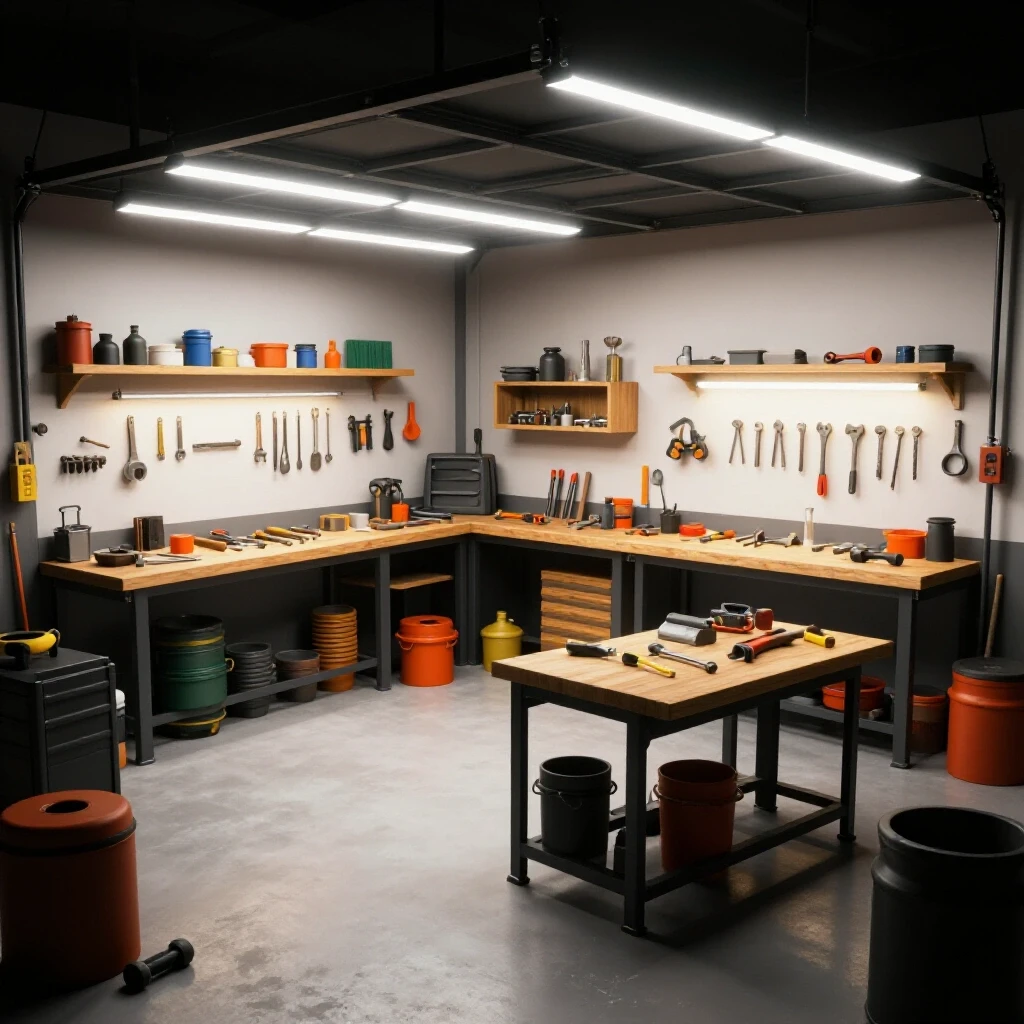
Your main workbench and your primary machines (lathe, mill, welding table) need dedicated “task lighting.” This is in addition to the “ambient lighting” that fills the rest of the room. I often install a row of high-output fixtures directly over the front edge of my workbenches. This positions the light so it shines on the work without my head casting a shadow. For a standard two-car garage, I typically recommend six to eight 4-foot linear fixtures or four high-bay “UFO” style lights, depending on the ceiling height.
Overcoming Low Ceiling Obstacles
Many garage shops have 8-foot ceilings, which creates a challenge for high-output lights. If the light is too concentrated, it will be blinding.
In low-ceiling environments, I use “frosted” or “milky” lenses instead of clear ones. Clear lenses provide more raw lumens, but they create intense glare on shiny metal surfaces. A frosted lens diffuses the light, making it much softer on the eyes while still providing plenty of brightness. If your ceiling is 12 feet or higher, you can use clear lenses and “UFO” style high-bays to punch the light all the way down to the floor.
- Zone 1: General Ambient. Provides safe movement throughout the shop.
- Zone 2: Task Specific. High-intensity light over the workbench and welder.
- Zone 3: Machine Specific. Dedicated lights for the drill press and saw.
- Shadow Management. Place lights to the left and right of your main standing position.
Maintenance and Long-Term Performance
Maintenance on LED fixtures is minimal, but it is not zero. In a metal shop, the biggest issue is “lumen depreciation” caused by dust buildup.
Every six months, I take a microfiber cloth and wipe down the lenses of my fixtures. You would be surprised how much light you lose to a thin layer of grinding dust. I also do a visual inspection of the housings to check for any signs of heat stress, like discolored plastic or warped metal. If a fixture starts to flicker, I replace the driver immediately rather than waiting for it to fail completely. Keeping a log of when you installed each fixture helps you track their performance over the years.
Identifying Quality Beyond the Brand Name
Don’t get caught up in brand wars. I have seen “no-name” industrial fixtures outperform “name-brand” consumer lights because the industrial units used better components.
When you are researching, look for the “LM-79” and “LM-80” reports. These are standardized tests that prove how much light a fixture actually produces and how long the LEDs will last. If a manufacturer cannot provide these reports, they are likely guessing at their specs. Also, check the warranty. A company that offers a 5-year warranty on a shop light is usually confident in their thermal management and driver quality.
- Check for Certifications: Look for UL, ETL, or DLC listings for safety and efficiency.
- Verify Warranty: 5 years is the industry standard for pro-grade LEDs.
- Read the LM-80 Report: This confirms the diode’s lifespan under heat.
- Inspect the Lens: Look for high-impact polycarbonate or tempered glass.
Summary of Selection Benchmarks
Choosing the right illumination is about matching the tool to the task. For a serious fabricator, a light is a tool. It needs to be rugged, efficient, and accurate. By focusing on aluminum construction, high CRI, and proper IP ratings, you can create a workspace that is safer and more productive.
Avoid the temptation to buy the cheapest option available. In the world of shop equipment, you usually get exactly what you pay for. A high-quality LED system will pay for itself in reduced eye strain, better weld quality, and fewer mistakes. Start with a solid plan, prioritize heat dissipation, and ensure your electrical system can handle the load.
Frequently Asked Questions
What is the best color temperature for a metalworking shop?
For most fabrication and machining tasks, 5000K (Daylight) is the best choice. It provides a crisp, white light that improves contrast and makes it easier to see layout marks on steel. It also helps prevent the drowsiness that can occur under warmer 3000K lighting.
How many lumens do I need for a 20×20 garage shop?
For a professional-grade fabrication space, you should aim for 30,000 to 40,000 total delivered lumens. This provides roughly 75 to 100 foot-candles of light on your work surfaces, which is the standard for precision manual work.
Why does CRI matter when I am welding?
CRI (Color Rendering Index) determines how accurately you see colors. A CRI of 80 or higher allows you to see the “heat tint” or “rainbow” colors on a weld, which indicates the heat input and shielding gas effectiveness. Low CRI light can hide these details, leading to poor weld quality.
Can I run high-output LEDs on the same circuit as my welder?
It is not recommended. Welders and large motors create electrical “noise” and voltage drops when they start. This can cause LEDs to flicker or can even damage the sensitive driver electronics over time. Always try to put your lighting on a dedicated circuit.
What is the difference between an IP65 and an IP20 rating?
An IP20 rating offers no protection against dust or liquids, making it unsuitable for a shop environment. An IP65 rating means the fixture is completely sealed against dust and can withstand low-pressure water jets, which is essential for surviving grinding dust and coolant mist.
Do LED lights cause interference with Digital Readouts (DRO)?
Cheap LED drivers can emit electromagnetic interference (EMI) that disrupts the signals in DROs or CNC controllers. High-quality fixtures use shielded drivers and are tested for EMI compliance (FCC Part 15) to prevent this issue.
How high should I mount my shop lights?
In most garage shops, a mounting height of 8 to 12 feet is ideal. If your ceilings are lower than 8 feet, you should use diffused (frosted) lenses to prevent glare. If they are higher than 12 feet, you may need “high-bay” fixtures with narrower beam angles to push the light down.
Are “UFO” high-bay lights better than linear shop lights?
It depends on your ceiling height. UFO lights are excellent for concentrated light from 12 feet or higher. Linear fixtures (4-foot or 8-foot) are generally better for 8- to 10-foot ceilings because they distribute the light more evenly over a workbench.
How can I tell if an LED light is flickering?
You can perform a simple “shutter test” by looking at the light through your smartphone’s camera in slow-motion video mode. If you see dark bands moving across the screen, the light is flickering. This can cause eye strain and safety hazards around rotating machinery.
Is aluminum really better than plastic for a light housing?
Yes. Aluminum is a superior heat conductor. High-output LEDs generate heat that must be dissipated to prevent the diodes from burning out prematurely. Plastic acts as an insulator, trapping heat inside and shortening the life of the electronics.
What should I do if my shop has a lot of vibration?
Choose fixtures with solid-state components and heavy-duty mounting hardware. Avoid lights with “plug-and-play” bulbs that can vibrate loose in their sockets. Integrated LED fixtures, where the diodes are hard-mounted to the frame, are much more vibration-resistant.
Do I need frosted or clear lenses?
Clear lenses allow for maximum light output but can create harsh reflections on shiny metal. Frosted lenses reduce total output slightly but diffuse the light, which eliminates glare and makes it easier to work on reflective surfaces like aluminum or stainless steel.
(This article was written by one of our staff writers, Steven Brooks. Visit our Meet the Team page to learn more about the author and their expertise.)