How to Set Up Safe Metal Grinding Dust Collection (Guide)
I have spent 17 years in industrial maintenance and fabrication shops. I have seen what happens when a shop owner tries to save a few dollars by using a standard woodworking vacuum on a high-speed metal grinder. Usually, it ends with a melted hose, a ruined motor, or a small fire in the collection bin. My background in maintaining heavy machinery has taught me that marketing labels mean very little compared to the physical construction of the tool. When you are dealing with hot, abrasive metallic particulates, you cannot rely on “pro-sumer” gear designed for sawdust.
Choosing the right equipment for managing workshop air quality requires looking past the shiny paint. You need to understand the mechanical reality of airflow, filtration ratings, and fire suppression. In my shop, I evaluate every piece of gear based on its motor design, the gauge of the steel used in its housing, and the actual efficiency of its filters. This guide will help you navigate those technical choices so you can build a system that works without falling for the hype of over-priced, under-performing units.
Evaluating Machinery Materials for High-Heat Particulate Capture
This section covers the physical properties of the materials used in extraction systems and why certain metals and coatings are required for safety. Choosing the right housing and ductwork prevents structural failures caused by the abrasive nature of metal shavings and the heat they carry.
In my experience, the biggest mistake people make is using PVC or light plastics for their ducting. Metal grinding creates sparks that can reach temperatures over 2,000 degrees Fahrenheit. When these hit plastic, they melt the surface or create static charges that can lead to a dust explosion. For a reliable setup, you must use galvanized steel or stainless steel ductwork. The smooth interior of a metal pipe reduces friction, which helps maintain the air velocity needed to keep heavy metal dust from settling in the lines.
When looking at the extraction unit itself, I check the thickness of the cabinet. A thin-gauge sheet metal box will vibrate and eventually crack at the seams under the stress of a high-powered fan. I prefer units with at least 14-gauge steel construction. This thickness provides the structural dampening needed to keep noise levels down and ensures the unit can handle the physical impact of larger metal shards that might get pulled into the stream.
| Ducting Material | Heat Resistance | Static Dissipation | Durability |
|---|---|---|---|
| Galvanized Steel | Excellent | Natural Grounding | High |
| Stainless Steel | Superior | Natural Grounding | Very High |
| PVC (Plastic) | Poor (Dangerous) | High Static Build-up | Low |
| Aluminum Flex | Moderate | Good | Moderate |
Assessing Motor Design and Static Pressure Capabilities
This part explains how the motor and impeller work together to move air against the resistance of filters and ductwork. Understanding the difference between CFM and static pressure is vital for selecting a motor that won’t burn out under load.
Most buyers look at the Cubic Feet per Minute (CFM) rating on a box and think more is always better. However, in metalworking, Static Pressure (SP) is just as important. Static pressure is the motor’s ability to overcome resistance. Metal dust is heavy. If your motor has a high CFM but low static pressure, the moment you attach a filter or a long hose, the airflow will drop to nearly nothing. I look for motors with a “flat” fan curve, meaning they maintain their performance even as the filter gets dirty.
I always recommend Totally Enclosed Fan Cooled (TEFC) motors. These motors are sealed from the outside environment. In a grinding environment, the air is filled with conductive metallic dust. If you use an open-frame motor, that dust will get sucked into the motor windings, causing a short circuit or a fire. A TEFC motor uses an external fan to blow air over the cooling fins, keeping the internals clean and extending the bearing life significantly.
- CFM (Cubic Feet per Minute): The volume of air moved.
- Static Pressure (SP): The “suction” force measured in inches of water.
- Impeller: The spinning blade that moves the air; aluminum is preferred for spark resistance.
Filtration Media and Managing Sub-Micron Metallic Swarf
This section defines the different types of filters used to trap fine dust and explains why standard shop filters often fail in metalworking applications. We will look at MERV ratings and the importance of surface loading versus depth loading.
Metal grinding produces a mix of large sparks and microscopic “swarf.” If your filter is too coarse, the fine dust goes right back into your lungs. If it is too fine but lacks surface area, it will clog in minutes. I look for filters with a MERV 15 or higher rating for metalwork. These are designed to catch particles as small as 0.3 microns. Interestingly, many budget filters use “depth loading,” where dust gets trapped inside the fibers. For metal, you want “surface loading” filters, often coated with a PTFE (Teflon) membrane. This allows the dust to drop off into the collection bin when you pulse the filter with air.
I once tore down a “high-end” extractor that was losing suction after only a month of use. The issue wasn’t the motor; it was a cheap cellulose filter that had absorbed moisture and bonded with the metal dust, turning into a solid brick. Switching to a spun-bond polyester filter solved the problem. It cost more upfront, but it lasted ten times longer and kept the airflow consistent.
| Filter Rating | Particle Size Captured | Common Use |
|---|---|---|
| MERV 8 | 3.0 – 10.0 microns | General shop air |
| MERV 11 | 1.0 – 3.0 microns | Fine sawdust |
| MERV 15 | 0.3 – 1.0 microns | Metal grinding/fumes |
| HEPA | 0.3 microns (99.97%) | Critical air cleaning |
The Physics of Spark Containment and Fire Prevention
This part discusses the mechanical barriers required to cool down hot embers before they reach the flammable filter media. It covers the design of spark traps and why they are a non-negotiable part of a safe system.
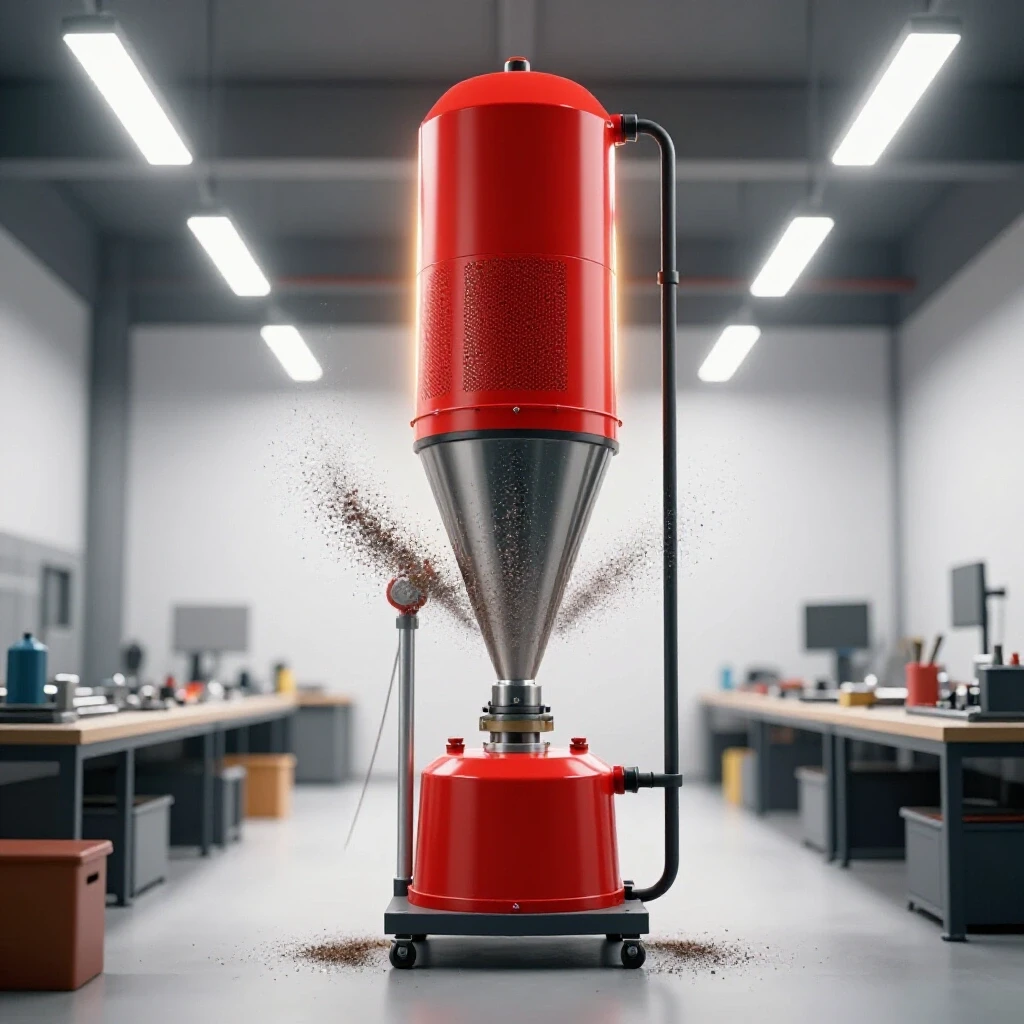
You cannot pull grinding sparks directly into a paper or polyester filter. Even “fire-retardant” filters will eventually catch fire if enough hot metal hits them. A spark trap is a mechanical device that forces the air to change direction rapidly. Because metal sparks are heavier than air, their momentum carries them into the walls of the trap, where they lose heat and drop out of the airstream. I prefer “cyclonic” spark traps. They use centrifugal force to spin the heavy sparks against the outer wall of a steel canister.
Another option is a water-bath baffle. This forces the air to bubble through or pass over a surface of water. While very effective at putting out sparks, these systems require more maintenance to prevent sludge buildup and rust. For most mid-sized shops, a well-designed dry spark trap made of heavy-gauge steel is the most practical choice. It has no moving parts to fail and provides a high level of safety for a one-time investment.
Measuring System Performance and Airflow Velocity
This section explains how to verify that your setup is actually working using basic diagnostic tools. We will cover the minimum air speeds required to keep metal dust moving through your pipes.
Once you have your machinery in place, you need to test it. I use a handheld anemometer to measure the air velocity at the hood. For metal dust, you need a minimum velocity of 4,000 feet per minute (FPM) inside the ductwork. If the air moves slower than this, the heavy metal particles will settle in the bottom of your horizontal pipes. Over time, this creates a “slug” of dust that restricts airflow and creates a fire hazard.
I also install a simple Magnehelic gauge on the filter housing. This measures the pressure drop across the filters. When the gauge shows a high pressure drop, I know it is time to clean or replace the filters. This takes the guesswork out of maintenance. Instead of waiting for the air to feel “weak,” you have a data-driven benchmark that tells you exactly when the system is underperforming.
- Check Velocity: Ensure at least 4,000 FPM at the intake hood.
- Monitor Pressure: Use a manometer to track filter health.
- Inspect Seals: Use a smoke pen to find air leaks around doors and joints.
- Test Grounding: Use a multimeter to ensure the ducting is properly grounded to the machine frame.
Why Heavy Castings and Rigid Frames Matter for Extraction
This part discusses the structural integrity of the extraction machinery and how vibration can lead to premature failure of electrical and mechanical components.
When I evaluate a standalone extractor, I look at the base. Is it a thin stamped-steel frame with tiny casters, or is it a heavy, welded structure? Vibration is the enemy of any motorized tool. If the fan is poorly balanced or the housing is flimsy, the vibration will eventually loosen electrical connections and wear out the motor bearings. I’ve seen cheap units literally walk across the floor because the fan was so out of balance.
A heavy frame acts as a dampener. In my shop, I often bolt my extraction units to the floor or mount them on heavy-duty vibration pads. This not only makes the shop quieter but also protects the sensitive electronics in the variable frequency drive (VFD) if the unit has one. A VFD allows you to adjust the motor speed to match the tool you are using, which can save a significant amount of electricity and reduce wear on the motor.
Maintenance Cycles and the True Cost of Consumables
This section breaks down the long-term financial reality of running an air filtration system. It focuses on filter life, bearing lubrication, and the cost of replacement parts.
The purchase price of the machine is only the beginning. You need to look at the cost of replacement filters. Some brands use proprietary filter sizes that cost three times more than standard industrial sizes. I always check if I can buy “off-the-shelf” filters from a local industrial supplier before I commit to a brand. If the manufacturer is the only source for parts, you are at their mercy for pricing and availability.
Bearing maintenance is another factor. High-speed fans put a lot of stress on motor bearings. I look for motors with “greasable” bearings rather than “sealed-for-life” units. Sealed bearings are convenient, but they eventually dry out. Being able to add a few drops of high-quality grease every 500 hours of operation can make a motor last 20 years instead of five.
- Filter Life: Expect 1,000 to 2,000 hours for high-quality PTFE filters.
- Bearing Lube: Check every 6 months for heavy-use shops.
- Gasket Inspection: Replace rubber seals annually to prevent suction loss.
Choosing Between a Centralized System and Point-of-Use Units
This part evaluates the pros and cons of building a large ductwork network versus having individual extraction units for each grinder.
A centralized system uses one large motor and a network of pipes to service the whole shop. The advantage is that you only have one machine to maintain, and the noise is usually located in a separate room or outside. However, the ducting must be perfectly engineered. If you open too many gates at once, the air velocity drops, and dust settles in the pipes. If you only use one tool, the large motor is wasting energy.
Point-of-use units are smaller extractors dedicated to a single machine. These are much easier to set up and are often more efficient for small to mid-sized shops. Because the hose is short, you don’t lose as much suction to friction. My personal preference for a growing shop is a “modular” approach—high-quality individual units for the primary grinders and a smaller general-purpose air cleaner for the ambient room air. This provides redundancy; if one unit goes down for maintenance, the rest of the shop can keep working.
Identifying Quality in Variable Frequency Drives and Controls
This section explains the electronics that manage the motor speed and how to tell a high-quality controller from a cheap one that will fail in a dusty environment.
Modern extractors often use Variable Frequency Drives (VFDs) to control air volume. A VFD changes the frequency of the electricity going to the motor, allowing it to spin faster or slower. This is great for fine-tuning your suction. However, VFDs are sensitive to heat and dust. A high-quality VFD will be housed in a NEMA 4 or NEMA 12 rated enclosure, which is dust-tight.
I’ve seen budget extractors with the VFD mounted right on the side of the machine with no protection. Metal dust gets into the cooling fan of the drive, shorts out the circuit board, and kills the machine. When you are shopping, look for a controller that is either remotely mounted away from the dust or fully sealed. Also, check for “back-EMF” protection, which prevents the motor from damaging the electronics if it is forced to stop suddenly.
- Enclosure Rating: Look for NEMA 12 or better for dust protection.
- Cooling: Ensure the drive has an adequate heat sink or filtered cooling fan.
- User Interface: Digital readouts for Hertz (Hz) and Amperage help monitor motor load.
Final Inspection Checklist for New Machinery
This section provides a step-by-step process for verifying the build quality of an extraction unit before you put it into service.
When a new machine arrives in my shop, I don’t just plug it in. I perform a “teardown” inspection. First, I check the fan balance. I spin the impeller by hand (with the power off) to see if it wobbles or rubs against the housing. Even a tiny bit of runout at 3,450 RPM will turn into a destructive vibration. Next, I check the electrical connections. It is common for wires to vibrate loose during shipping.
I also inspect the filter seals. If there is even a 1/16th-inch gap around the filter, the air will take the path of least resistance, bypassing the filter entirely. I often use a bead of high-quality silicone or a thicker foam gasket to ensure a perfect seal. These small adjustments can double the effective life of your motor and keep your shop air much cleaner.
- Impeller Runout: Should be less than 0.005 inches.
- Electrical Tightness: Check all terminal blocks.
- Seal Integrity: Use a light test inside the cabinet to look for leaks.
- Motor Temperature: Run for 30 minutes and check with an IR thermometer; it shouldn’t exceed the nameplate rating.
Choosing the right equipment for managing metal dust is a matter of looking at the mechanical fundamentals. Ignore the marketing photos of clean, shiny shops. Instead, look at the gauge of the steel, the rating of the motor, and the efficiency of the filtration media. By focusing on these structural and mechanical details, you can invest in a system that provides a safe working environment for years to come. Start by evaluating your most used grinder and sizing a dedicated, spark-resistant unit for it. Once you see the difference in air quality and machine cleanliness, you will understand why the “cheap” option is often the most expensive one in the long run.
Frequently Asked Questions
Can I use a standard shop vacuum for metal grinding? No. Standard shop vacuums are not designed for hot sparks or conductive metallic dust. The filters can easily catch fire, and the open-frame motors can short out when metal dust enters the windings. You need a dedicated extractor with a spark trap and a TEFC motor.
What is the “4,000 FPM rule” and why does it matter? The 4,000 Feet Per Minute (FPM) rule is the minimum air velocity required to keep heavy metal dust suspended in a horizontal duct. If the air moves slower than this, the dust will settle in the pipe, causing clogs and potential fire hazards.
Why is PVC ducting considered dangerous for metal dust? PVC is an insulator that allows static electricity to build up as dust moves through it. In a metalworking environment, this static can discharge as a spark, potentially igniting the dust. Furthermore, hot metal sparks can melt or burn through PVC walls quickly.
How often should I replace my filters? This depends on your workload and the type of filter. If you use a Magnehelic gauge, replace the filter when the pressure drop increases by 2 or 3 inches of water over the “clean” reading. Without a gauge, inspect filters every 3 months for signs of blinding or damage.
What is a spark trap and do I really need one? A spark trap is a mechanical device that uses direction changes or centrifugal force to cool down and drop out hot sparks before they reach your filters. If you are doing any high-speed grinding or belt sanding on steel, a spark trap is essential for fire prevention.
Does a higher CFM rating mean better suction? Not necessarily. CFM is the volume of air, but Static Pressure (SP) is the “strength” of the pull. For metal grinding, you need high static pressure to pull air through restrictive filters and long hoses. A high-CFM motor with low static pressure will fail as soon as the filter starts to get dirty.
What is the benefit of a PTFE-coated filter? PTFE (Teflon) coatings create a slick surface on the filter media. This allows dust to stay on the surface rather than getting embedded in the fibers. It makes the filter much easier to clean and helps maintain a consistent airflow over a longer period.
Are water-bath collectors better than dry collectors? Water-bath collectors are excellent for total spark extinguishment and are often used for reactive metals like aluminum. However, they are more expensive, create a messy “sludge” that must be disposed of, and can lead to humidity and rust issues in the shop if not managed correctly.
How do I know if my motor is TEFC? Check the nameplate on the motor. It will be labeled “TEFC” (Totally Enclosed Fan Cooled). Visually, these motors have no open vents into the internal windings and usually have cooling fins on the outside of the cast iron or aluminum frame.
Can I vent my metal dust collector outside? Yes, venting outside is the safest way to ensure no fine dust is recirculated. However, this can be expensive in terms of heating or cooling your shop, as you are pumping your conditioned air out of the building. If you vent outside, you still need a spark trap to prevent starting a fire outdoors.
What is the difference between MERV 11 and MERV 15? MERV 15 filters are significantly more efficient at capturing sub-micron particles (0.3 to 1.0 microns). Since metal grinding creates a lot of very fine, hazardous dust, a MERV 15 or higher is the industrial standard for safe indoor air.
Should I buy a centralized system or individual units? For most small to mid-sized shops, individual “point-of-use” units are more practical. They are easier to install, more energy-efficient for single-tool use, and provide redundancy if one unit needs repair. Centralized systems are better for large-scale production environments.
(This article was written by one of our staff writers, Steven Brooks. Visit our Meet the Team page to learn more about the author and their expertise.)