Slip Roll vs Hand Bending Sheet Metal Curves (Comparison)
After 17 years in industrial maintenance and fabrication, I have learned that the most expensive tool is the one that sits idle because it cannot do the job. I have spent thousands of hours diagnosing mechanical failures, from shattered cast-iron housings to seized bearings. When you are standing in your shop deciding how to shape a radius in a piece of 16-gauge steel, you are not just choosing a tool. You are choosing between mechanical consistency and manual finesse.
I remember a project early in my career involving a set of custom motorcycle fenders. I tried to form them by hand using a sandbag and a plastic mallet. I spent three days fighting the metal, only to end up with a surface that looked like the surface of the moon. I eventually bought a mechanical rolling machine, and the same task took twenty minutes. However, that machine had its own issues. The rollers were slightly out of round, leaving a faint “thump” in the metal every few inches. That experience taught me that understanding the guts of your equipment is more important than the paint job on the outside.
Evaluating the Structural Integrity of Forming Equipment
Choosing the right method for creating arcs depends heavily on the frame of the tool you use. A machine is only as good as its ability to resist flexing when the metal pushes back. If the frame twists under load, your curves will come out tapered or uneven.
Why Heavy Castings Matter for Mechanical Rigidity
Cast iron is the gold standard for workshop machinery because it absorbs vibration and resists twisting. In a mechanical roller, the side plates hold the rollers in alignment. If these plates are made of thin, stamped steel, they will bow outward when you tighten the rollers onto a sheet of metal. This bowing causes the rollers to lose parallel alignment, resulting in a “coning” effect where one side of the cylinder is tighter than the other.
When I inspect a new machine, I look for “gray iron” castings. This material has a high carbon content that acts as a natural dampener. If you tap the frame with a wrench and it rings like a bell, it is likely a lower-grade steel or thin casting. A dull “thud” indicates a dense, high-quality casting that will stay true under the pressure of a heavy-duty forming task.
The Trade-offs of Welded Steel Frames
Welded steel frames are common in budget-friendly equipment. While steel is strong, it lacks the dampening properties of cast iron. Steel frames are also prone to internal stresses from the welding process. Over time, these stresses can cause the frame to “creep” or warp, especially if the tool is stored in a shop with high temperature swings. If you choose a steel-framed tool, ensure the plate thickness is at least 1/2 inch for light-duty work to prevent torsional twisting.
Mechanical Rolling vs. Manual Shaping Physics
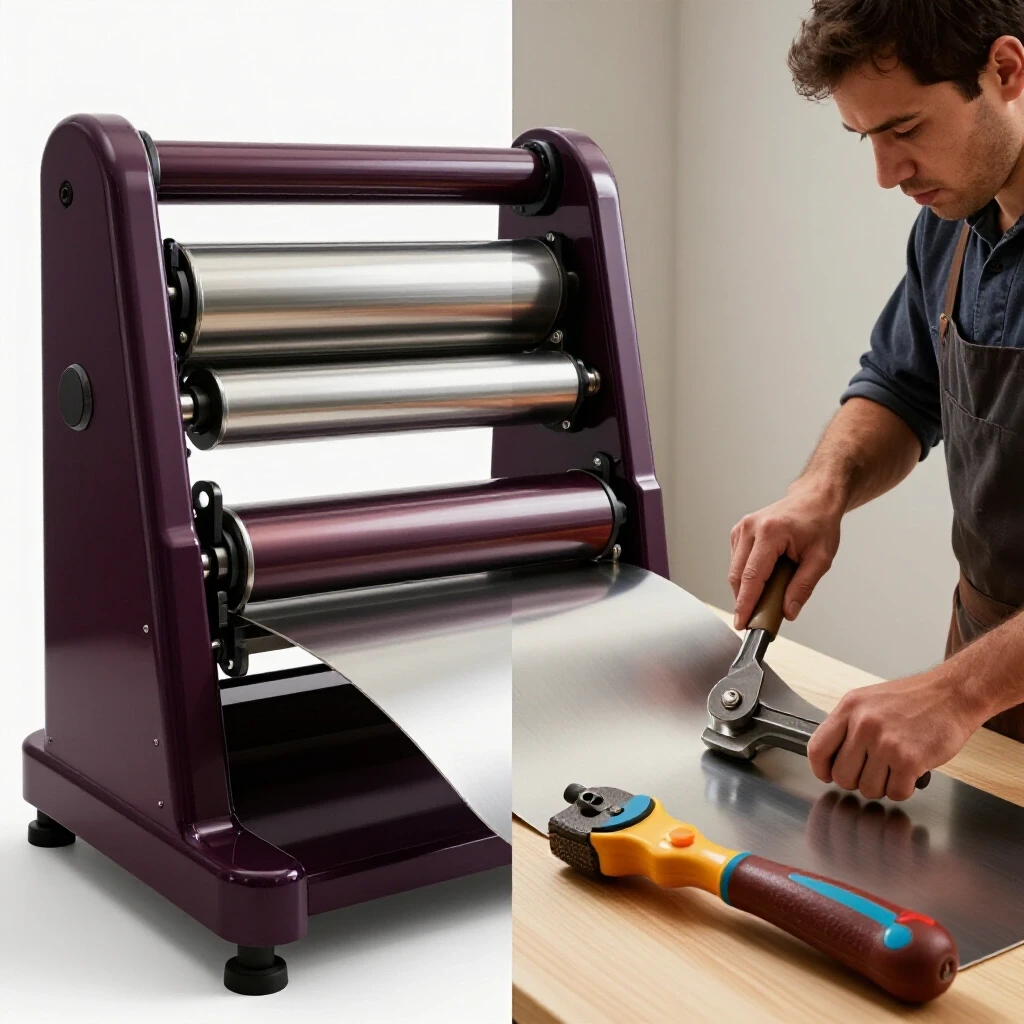
The way you apply force to the metal determines the quality of the final curve. Mechanical rollers use three points of contact to create a continuous arc. Hand-bending, on the other hand, relies on incremental pressure at specific points. Both have their place, but the physics of each process dictates the limits of what you can achieve.
Understanding Three-Roll Geometry
A mechanical roller typically uses two fixed rollers and one adjustable “pinch” roller. As the metal passes through, the pinch roller forces the sheet to deflect. This creates a uniform radius across the entire length of the piece. The consistency of this radius depends on the “Total Indicated Runout” (TIR) of the rollers. TIR is a measurement of how much a cylindrical part wobbles as it rotates.
In my shop, I aim for a TIR of less than 0.002 inches. If your rollers have a higher runout, the machine will apply uneven pressure as it turns. This results in “chatter marks” or flat spots in your curve. You can test this by placing a dial indicator against the roller and spinning it by hand. If the needle jumps more than a few thousandths, the machine will never produce a perfect cylinder.
The Mechanics of Manual Incremental Bending
Manual bending involves using a brake, a pipe, or a specialized forming stake to create a curve. You are essentially making a series of very small, closely spaced bends. While this allows for complex, non-linear shapes that a machine cannot handle, it is incredibly difficult to keep the radius consistent.
The biggest challenge here is “springback.” When you bend metal, it wants to return to its original shape. With a mechanical roller, the continuous pressure helps set the grain of the metal more evenly. When bending by hand, you have to over-bend each section slightly. If your over-bending is not identical at every point, the curve will look segmented rather than smooth.
| Feature | Mechanical Rolling | Hand-Bending |
|---|---|---|
| Consistency | High (Mechanical) | Low (Operator Dependent) |
| Speed | Fast for long runs | Slow and methodical |
| Setup Time | Moderate (Adjustment) | Low (Direct) |
| Versatility | Limited to cylinders/arcs | High (Custom shapes) |
| Max Thickness | Limited by machine HP | Limited by physical strength |
Measuring Precision and Tolerances in Workshop Tools
Precision is not just about the final product; it is about the repeatability of the tool. If you are making four matching legs for a table, you need a method that produces the same result every time. This is where mechanical systems usually outperform manual labor, provided the internal components are up to the task.
Assessing Spindle and Bearing Quality
The rollers in a shaping machine are supported by bearings. In cheaper models, these are often simple bronze bushings. While bushings are durable, they can develop “slop” or play over time. If you can move the roller up and down by hand, the bearings are worn or poorly fitted.
I prefer sealed ball bearings or tapered roller bearings for my equipment. These designs handle “radial loads”—the pressure pushing straight against the roller—much better than bushings. A high-quality bearing should have a lifespan of over 10,000 hours if kept clean. If you hear a grinding or high-pitched squeal during operation, the bearings are likely failing, which will lead to uneven pressure on your metal.
Using Radius Gauges for Manual Accuracy
If you are working by hand, precision comes from your measurement tools. I never trust my eyes to judge a curve. Instead, I use a set of radius gauges—templates cut to specific diameters. By holding the gauge against the metal as I work, I can see exactly where the curve is too flat or too sharp.
For those choosing between these methods, consider the “allowable tolerance” of your project. If you are building a structural tank that must be air-tight, the 0.005-inch precision of a well-maintained mechanical roller is necessary. If you are making a decorative garden ornament, the 1/16-inch variance of a hand-bent curve is perfectly acceptable.
The Impact of Material Stress and Torsional Stiffness
Metal has a “memory.” When you form it, you are rearranging its internal structure. The method you choose affects how much stress you put on the material and how the tool holds up under that stress.
Torsional Stiffness in Machine Frames
Torsional stiffness is the ability of a structure to resist being twisted. In a rolling machine, the pressure of the metal tries to twist the two side frames in opposite directions. If the machine lacks stiffness, the rollers will “skew.”
You can check for this by measuring the gap between the rollers at both ends. Use a feeler gauge to ensure the gap is identical within 0.001 inches. If one side is wider, the machine is flexing. This is why I avoid tools with “bolt-together” frames. A solid, one-piece casting or a fully boxed and welded frame provides the stiffness needed for heavy 14-gauge or 12-gauge sheet metal.
Managing Grain Direction and Work Hardening
When you bend metal manually, you often hit it with a mallet or pull it over a sharp edge. This can cause “work hardening,” where the metal becomes brittle and difficult to shape further. Mechanical rolling is more “sympathetic” to the metal. It applies pressure gradually across a larger surface area, which reduces the risk of cracking the material.
If you are working with aluminum or stainless steel, work hardening is a major concern. These materials “stiffen” quickly. A mechanical roller allows you to achieve the desired shape in fewer passes, which keeps the metal more ductile and easier to finish.
Maintenance and Long-Term Ownership Costs
A tool is an investment, and like any investment, it requires upkeep. The cost of a tool isn’t just the sticker price; it’s the time and money spent keeping it in working order.
Lubrication Requirements for Mechanical Systems
Mechanical rollers have several moving parts that require regular lubrication. I follow a strict schedule: 1. Daily: Wipe down rollers with a light oil to prevent rust. 2. Weekly: Grease the main drive gears and bearing blocks. 3. Monthly: Check the tension on drive chains or belts.
Neglecting these steps leads to “galling,” where metal from the rollers transfers onto your workpiece. Once a roller is galled, it will leave a scratch on every piece of metal you run through it. Repairing a galled roller requires professional grinding, which can cost as much as a new entry-level machine.
The “Consumables” of Hand-Bending
While hand-bending tools have fewer moving parts, they still have “consumables.” Mallet faces wear down, sandbags leak, and forming stakes can become dented or scarred. If you use a wooden form to shape your metal, that form will eventually compress and lose its shape. You must factor in the time it takes to rebuild these jigs and fixtures when calculating the true cost of manual forming.
Decision Matrix: Selecting the Right Tool for Your Workload
To help you decide, I have developed a simple checklist based on my years of repairing and using these tools. Do not let marketing hype about “industrial capacity” sway you. Look at your actual daily needs.
5-Step Inspection for Mechanical Rolling Machines
- Check the Weight: A heavier machine almost always indicates better castings and more rigidity.
- Measure the Rollers: Use a micrometer to check for taper. The rollers should be the same diameter at the ends and the center within 0.001 inches.
- Inspect the Gears: Open the side cover. Look for “induction hardened” steel gears. Plastic or soft brass gears will strip under heavy loads.
- Test the Adjustment: The pinch roller should move smoothly. If it binds or feels “gritty,” the lead screws are likely poorly machined.
- Verify the Footprint: Ensure the machine’s base is wide enough to prevent tipping when a long sheet of metal is fed through it.
When to Stick with Manual Methods
Manual forming is the better choice if: – You only need to make a curve once every few months. – Your project involves “compound curves” (metal that curves in two directions at once). – You are working in a very tight space where a large machine won’t fit. – You are working with extremely thin foil or very soft metals like copper that might be crushed by mechanical rollers.
Final Thoughts on Machinery Investment
In my 17 years of maintenance, I have seen many shop owners buy the cheapest machine available, only to spend more money “fixing” it than they would have spent on a quality tool in the first place. Conversely, I’ve seen people buy massive industrial machines for hobby work that they never fully utilize.
The key is to look past the brand name. Examine the thickness of the steel, the quality of the bearings, and the precision of the rollers. Whether you choose the mechanical route or the manual path, your success depends on the tool’s ability to remain rigid and your ability to maintain it.
Frequently Asked Questions
What is the maximum thickness a manual roller can handle?
Most entry-level mechanical rollers are rated for 20-gauge to 16-gauge mild steel. Trying to roll anything thicker will likely flex the frame or strip the gears. For manual hand-bending, your limit is usually 18-gauge unless you use a long-handled brake or a heavy-duty torch to heat the metal.
How do I fix a “coned” cylinder coming off a roller?
Coning happens when the rollers are not parallel. Check the adjustment screws on both sides of the machine. Use a caliper to ensure the distance between the top and bottom rollers is identical on the left and right sides. Even a 0.010-inch difference can cause significant coning over a 24-inch wide sheet.
Can I roll stainless steel on a standard machine?
Yes, but remember that stainless steel is much harder than mild steel. A machine rated for 16-gauge mild steel can usually only handle 20-gauge or 22-gauge stainless. Also, ensure the rollers are perfectly clean; any carbon steel dust on the rollers can embed in the stainless and cause it to rust.
What is “springback” and how do I calculate it?
Springback is the tendency of metal to return to its flat shape after being bent. There is no universal formula because it depends on the material’s yield strength and thickness. Generally, you should roll the metal to a slightly tighter radius than your target and let it “spring” out to the correct size.
Why does my mechanical roller leave flat spots at the beginning of the curve?
This is a common issue called “the flat.” Because the rollers need a certain amount of material to “grab” before they start bending, the first inch or two of the sheet often remains flat. To fix this, you can “pre-bend” the leading edge using a mallet or a press brake before feeding it into the roller.
Are digital readouts (DROs) worth it for rolling machines?
If you are doing production work where you need to repeat the same radius exactly, a DRO on the pinch roller adjustment is a lifesaver. It allows you to return to the exact same setting every time. For one-off projects, a simple ruler or a set of radius gauges is usually enough.
How do I know if my bearings are failing?
Look for “weeping” grease, which often looks like black streaks near the bearing blocks. Also, listen for a “rumbling” sound when the machine is running without any metal in it. If the rollers feel “notchy” when you turn them by hand, the bearing races are likely pitted and need replacement.
Can I use a rolling machine to make cones?
Some machines have a “taper attachment” or allow you to offset one side of the rollers. This forces one side of the metal to move faster than the other, creating a cone. However, this puts uneven stress on the machine, so only do this if the tool is specifically designed for it.
What is the best way to clean rusted rollers?
Never use a heavy abrasive like a coarse grinding wheel. Use a fine Scotch-Brite pad and a penetrating oil like WD-40. If the rust is deep, you may need to have the rollers “turned” on a lathe to restore a smooth surface, but this will slightly reduce their diameter and change the machine’s capacity.
Does the diameter of the rollers limit the curve I can make?
Yes. You can never roll a radius smaller than the diameter of the top roller. If you need a 2-inch cylinder, your top roller must be 2 inches or smaller. Conversely, very large radii are easier to achieve on machines with larger rollers because they provide more surface contact and reduce the risk of “kinking” the metal.
(This article was written by one of our staff writers, Steven Brooks. Visit our Meet the Team page to learn more about the author and their expertise.)