How to Organize Metal Raw Stock to Speed Up Cuts (DIY Guide)
When I first moved my fabrication work from a cramped two-car garage into a dedicated shop space, I thought more square footage would solve all my problems. I was wrong. Within six months, I was still tripping over 20-foot lengths of square tubing and spending twenty minutes digging through a pile of plate remnants just to find one clean piece of 10-gauge steel. It wasn’t a space issue; it was a flow issue.
As an operator with two decades in manufacturing, I’ve learned that the most expensive tool in your shop isn’t the CNC plasma table or the TIG welder—it’s the time you spend not using them. When your raw materials are disorganized, your high-end machinery sits idle. My goal is to help you bridge the gap between a hobbyist’s “pile of metal” and a professional’s “material station,” ensuring your workflow is as sharp as your cuts.
Mapping Material Flow to Eliminate Shop Bottlenecks
Material flow is the physical path a piece of metal takes from the moment it arrives at your door to the moment it leaves as a finished product. In an efficient shop, this path is as short and straight as possible.
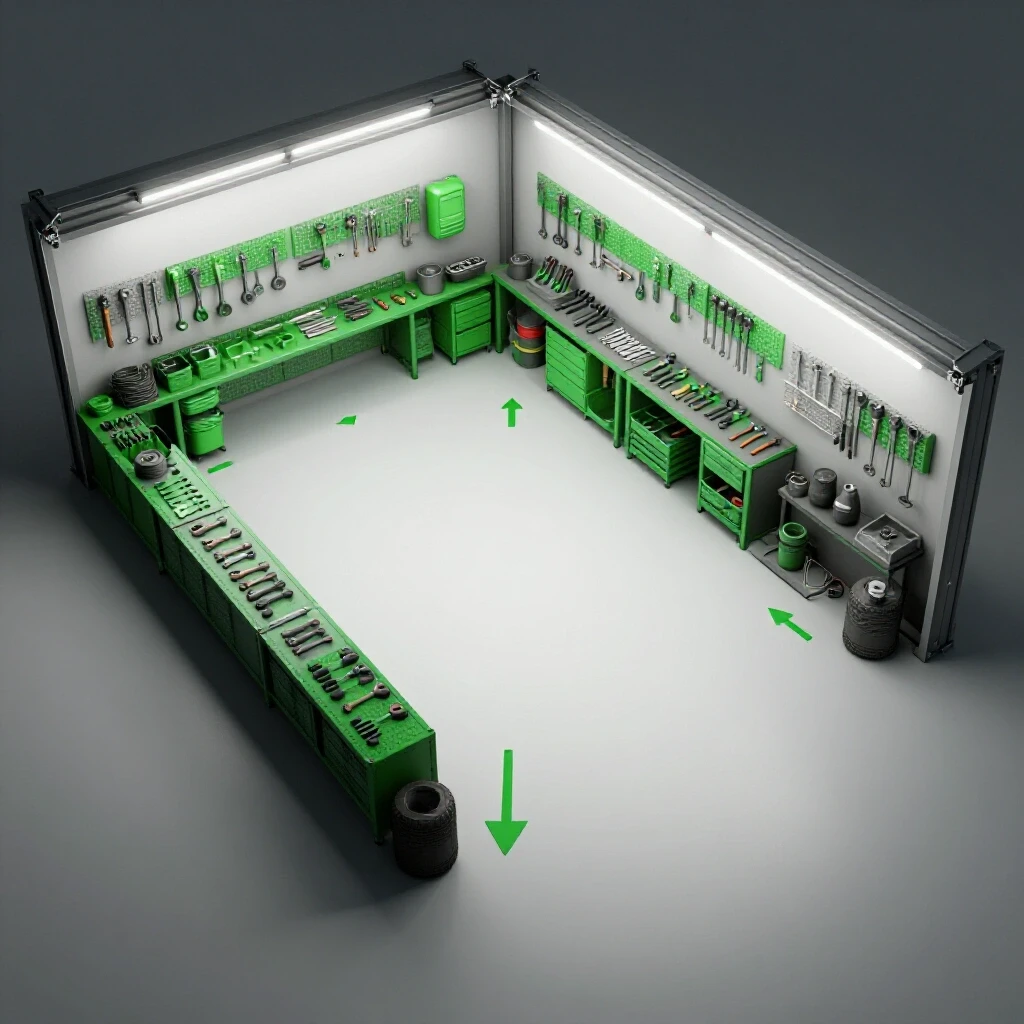
When you analyze your floor plan, you need to identify “travel waste.” This is the distance you carry heavy stock between storage and your first cut. If your rack is at the back of the shop and your cold saw is at the front, you are wasting energy and risking injury every single day. I recommend mapping your shop on a simple grid. Mark your entry point, your storage zone, and your primary cutting station. The distance between these three should be minimal.
In my own shop evolution, I realized that my 3-phase rotary converter and my heavy-duty saws were positioned for electrical convenience rather than workflow. I had to rewire the space to move the cutting station closer to the roll-up door. This change alone reduced my material handling time by nearly 30 percent.
Structural Requirements for High-Density Storage
Floor load rating is the amount of weight your shop floor can safely support per square foot, a critical metric when stacking tons of steel in a small area. Most residential garage slabs are 4 inches thick, which can typically handle about 3,000 to 4,000 PSI, but concentrated loads from heavy racks can cause cracking.
Before you build a massive cantilever rack, you must calculate the “point load” of the feet. If you’re storing three tons of steel on a rack with four small feet, you are putting immense pressure on those specific spots. I suggest using steel spreader plates under your rack feet to distribute that weight.
| Feature | Standard Home Shop | Advanced Fabrication Shop |
|---|---|---|
| Floor Thickness | 3.5 – 4 inches | 6 inches (reinforced) |
| Storage Style | Floor piles / Leaning | Vertical & Cantilever Racks |
| Handling | Manual Lifting | Carts & Jib Cranes |
| Material Access | “Last In, First Out” | Selective Access |
Designing DIY Racks for Long Stock and Remnants
A cantilever rack is a storage system with horizontal arms extending from a vertical column, allowing you to store long bars and tubes without the interference of front uprights. This is the gold standard for metal storage because it allows you to pull a single 20-foot stick from the middle of the stack without moving everything on top of it.
For a DIY build, I prefer using 3-inch square tubing for the uprights and 2-inch tubing for the arms. I angle the arms upward by about 2 to 3 degrees. This slight pitch prevents round stock from rolling off and onto your toes. Building these yourself allows you to customize the spacing between arms. I keep the bottom levels spaced for heavy structural steel and the top levels for lighter aluminum extrusions or conduit.
Vertical Storage for Short Pieces
Vertical storage involves standing shorter pieces of metal upright in a divided bin system. This is often the best solution for pieces under six feet in length because it uses vertical height rather than floor space.
I built a “short bin” using a heavy plywood base reinforced with steel angle. The dividers are made from PVC pipe or smaller steel tubing. By standing my “drops” and remnants vertically, I can see exactly what I have at a glance. No more digging through a horizontal bin of scrap to find a 12-inch piece of flat bar.
Integrating CNC Plasma Workflows into Material Layout
A CNC plasma table setup requires a different storage logic than manual tools because you are dealing with large, heavy sheets rather than long bars. The gantry needs clear access, and the material needs to be stored in a way that minimizes the risk of bending or scratching the plates.
I recommend a vertical plate rack located within the “swing zone” of your plasma table. Storing plates vertically—like records in a crate—makes it much easier to flip through them and select the gauge you need. If you lay plates flat in a stack, the piece you need is invariably at the bottom.
When positioning your CNC table, ensure you have at least a 3-foot access zone around the perimeter. This isn’t just for maintenance; it’s for safety. If a torch gets snagged or a tip-up occurs, you need to be able to reach the emergency stop or the material quickly without climbing over racks.
Powering the Cutting Station: 3-Phase Solutions
A 3-phase power converter is a device that allows you to run industrial-grade machinery, like large cold saws or ironworkers, on standard single-phase residential power. As you scale up, you’ll find that the best deals on heavy-duty cutting equipment are often 3-phase machines.
In my transition, I opted for a Rotary Phase Converter (RPC). An RPC uses a 3-phase motor (the idler) to generate the third leg of power. It’s a robust, reliable solution for a shop where you might be running a saw and a dust collector simultaneously.
- Static Converters: Cheap, but they only provide about 2/3 of the motor’s rated horsepower.
- Rotary Converters: Provide full power and can run multiple machines.
- Variable Frequency Drives (VFDs): Great for single-machine speed control but require individual installation for each tool.
I monitor my phase balance regularly. If the voltages between the three legs vary by more than 5 to 10 percent, it can cause the motors in your saws to overheat. Using a digital multimeter to check these legs under load is a habit every advanced shop owner should develop.
Managing Air Quality at the Source
Dust collection duct design is the science of moving air and debris through a series of pipes to a central filtration unit. Metalworking creates two distinct hazards: heavy grinding dust and toxic welding/plasma fumes.
For a high-volume shop, you need a dust collector capable of at least 1,000 to 2,000 CFM (Cubic Feet per Minute). A standard shop vac won’t cut it when you’re running an abrasive saw or a plasma table. I use a multi-stage cyclone separator. The cyclone drops the heavy chips into a drum before the fine dust reaches the expensive HEPA filters.
Calculating Static Pressure Loss
Static pressure is the resistance the air faces as it moves through your ducts. Every bend, 45-degree elbow, and foot of corrugated hose adds resistance. 1. Keep duct runs as straight as possible. 2. Use smooth-walled metal ducting instead of flexible hose. 3. Use “long radius” elbows to keep air velocity high. 4. Ensure your “transport velocity” (the speed of air in the pipe) stays above 3,500 feet per minute to prevent metal dust from settling and clogging the lines.
Visual Organization and Labeling Systems
You don’t need a complex computer system to track your metal. You need a paint pen and a color code. Professional shops use a standardized color system on the ends of the bars to identify material types at a glance.
- Cold Rolled Steel: Blue
- Hot Rolled Steel: Red
- Aluminum: Green
- Stainless Steel: Yellow
I keep a “color key” posted right on the end of my main rack. When a new shipment of steel arrives, I immediately mark the ends of the bars. This prevents the “mystery metal” syndrome where you accidentally weld stainless with mild steel wire because the two pieces looked identical in the dim light of the storage rack.
I also mark the dimensions on remnants. If I cut a 48-inch piece of 2×2 tubing and have 12 inches left, I write “12” on the end before I put it in the vertical bin. This saves me from pulling out a tape measure every time I need a small brace.
Advanced Handling: Moving the Heavy Stuff
As you move from hobbyist to professional, the weight of your materials will eventually exceed what your back can handle. A single 20-foot stick of 4-inch C-channel weighs about 100 pounds. A 4×8 sheet of 1/4-inch plate weighs nearly 330 pounds.
I’ve integrated several low-cost material handling aids that have saved my joints: 1. Heavy-Duty Carts: I built three matching carts at the exact height of my saw’s infeed table. This allows me to roll the material into place rather than lifting it. 2. Wall-Mounted Jib Crane: Using a simple I-beam and a 1,100-pound electric hoist, I can lift plates off the vertical rack and lay them onto the CNC table solo. 3. Ball Transfers: I mounted ball transfer units on my outfeed tables. This allows me to rotate large sheets or heavy tubes in any direction with minimal effort.
Maintenance and Safety Benchmarks
A clean shop is a fast shop. I’ve implemented a “5S” approach—Sort, Set in order, Shine, Standardize, and Sustain—tailored for fabrication. Every Friday, the last 30 minutes of the shift are dedicated to returning every remnant to its proper bin and wiping down the guide rails on the CNC table.
| Task | Frequency | Metric/Action |
|---|---|---|
| Rack Inspection | Monthly | Check for bowed arms or loose anchors |
| Phase Balance Check | Quarterly | Ensure legs are within 5% voltage |
| Dust Filter Cleaning | Weekly | Pulse-clean or blow out HEPA filters |
| Material Audit | Bi-Annually | Clear out “dead” scrap that hasn’t been touched |
One rookie mistake I see often is letting the “scrap pile” grow until it consumes a corner of the shop. If a piece of metal is too small to be used for a gusset or a tab, it goes into the recycling bin immediately. Space is too valuable to store trash.
Designing the Future: Software and Planning
While this guide focuses on physical organization, the way you plan your cuts also impacts speed. For my CNC plasma work, I use nesting software. Nesting is the process of arranging parts on a sheet of metal to minimize waste.
By using simple CAD/CAM integrations, I can see exactly how much of a sheet I’ll use before I ever spark the torch. This allows me to plan my “drops” (the leftover pieces) so they are a usable size for future projects. If I know I have a 12×24 inch remnant coming off the table, I can prep a spot in my vertical bin for it before the cut is even finished.
Step-by-Step Implementation Plan
- Clear the Floor: Remove everything that isn’t bolted down to see your true available space.
- Define the “Cut Zone”: Place your saw and CNC table. Ensure they have the necessary electrical and air hookups.
- Build Your Racks: Construct your cantilever and vertical bins based on your most-used material lengths.
- Establish the Path: Ensure a clear 4-foot wide path from your entry door to your storage and then to your saws.
- Label and Color Code: Buy a set of oil-based paint markers and start marking every stick in the shop.
The transition from a cluttered workspace to an optimized production environment doesn’t happen overnight. It’s a series of deliberate choices. By treating your raw stock as a valuable asset rather than an obstacle, you’ll find that your projects move faster, your stress levels drop, and your shop finally starts performing like the professional space you envisioned.
Frequently Asked Questions
How do I determine if my floor can handle a heavy steel rack? Most standard garage floors are 4 inches thick. You can estimate the weight of your steel (approx. 490 lbs per cubic foot) and compare it to the square footage of the rack’s base. If you are concerned, use large steel “feet” or spreader plates to distribute the weight across more surface area.
Is vertical or horizontal storage better for a small shop? Vertical storage is superior for remnants and short pieces (under 6-8 feet) because it saves floor space. Horizontal cantilever racks are necessary for full 20-foot lengths to prevent the material from bowing or becoming a safety hazard.
What is the best way to move heavy 4×8 steel sheets alone? A vertical plate rack combined with a simple shop crane or a DIY jib crane is the safest method. You can also use a “plate dolly” which allows you to roll the sheet on its edge, significantly reducing the physical effort required.
How much airflow do I really need for a CNC plasma table? For effective fume extraction on a 4×4 or 4×8 table, you should aim for at least 1,000 to 1,500 CFM at the source. This usually requires a 2HP to 3HP industrial dust collector with a high-quality filter.
Can I run a 3-phase cold saw on a 220V single-phase outlet? Not directly. You will need a phase converter (Rotary or Digital) or a VFD. A VFD is often the cheapest way to run a single machine, but a Rotary Phase Converter is better if you plan to add more 3-phase tools later.
How do I prevent rust on my stored raw steel? Keep your metal off the concrete floor, as moisture wicks through the slab. A light coating of WD-40 or a dedicated rust preventative spray can help, but the best solution is maintaining a climate-controlled environment with low humidity.
What is “transport velocity” in dust collection? This is the speed of the air inside your pipes. For metal dust, you need at least 3,500 to 4,000 FPM (Feet Per Minute) to keep the heavy particles moving. If the velocity drops, the dust will settle in the pipes and create a fire hazard.
Why should I color-code my steel? Many alloys look identical. Cold-rolled and hot-rolled steel have different welding and machining properties. Color coding the ends of the bars ensures you always grab the right material, even if the mill markings have worn off.
What is a “remnant” versus “scrap”? A remnant (or “drop”) is a piece of material large enough to be used for a future part, typically anything over 6 inches. Scrap is anything smaller that should be recycled to keep your workspace clear.
How often should I maintain my CNC plasma table? Daily: Clean the slats and wipe the rails. Weekly: Check the air filters and drain the compressor moisture traps. Monthly: Check the belt tension and square the gantry.
Does a rotary phase converter use a lot of electricity? An RPC does consume some power just to keep the idler motor spinning, but modern ones are relatively efficient. It is usually more cost-effective than paying the utility company to drop a dedicated 3-phase line to a residential or small commercial building.
How wide should my shop aisles be? For a shop handling 20-foot material, your main “thoroughfare” should be at least 4 feet wide. This allows you to carry or cart material without hitting machines or walls. Around CNC equipment, a 3-foot “clear zone” is recommended for safety.
(This article was written by one of our staff writers, Edward Sinclair. Visit our Meet the Team page to learn more about the author and their expertise.)