Valuation Guide for Selling Small Custom Welding Shops (Tips)
When I first started my fabrication business sixteen years ago, I spent more time thinking about weld penetration than I did about my balance sheet. Like many of you, I transitioned from a hobbyist to a side-hustler, taking on small repair jobs and custom gate builds for neighbors. It took a painful loss on a large trailer repair for me to realize that a workshop is more than just a collection of tools. It is a financial entity. Whether you are looking to scale up or eventually hand over the keys to a new owner, understanding the true economic value of your operation is the only way to ensure your years of sweat equity actually pay off.
The challenge for most small shop owners is that our value is often locked away in disorganized receipts and “gut-feeling” pricing. When it comes time to determine what a small metalworking business is worth, a potential buyer does not just look at your welder. They look at your systems, your profit margins, and your ability to prove that the shop can make money without you standing at the bench.
Establishing a Baseline for Business Worth through Shop Rates
A shop rate is the total hourly cost required to keep your doors open while generating a sustainable profit. It includes your labor, utilities, rent, and all fixed expenses that exist regardless of whether you strike an arc that day.
To determine if your business has value beyond its physical assets, you must first master your hourly rate. I often see side-hustlers charge $40 an hour because it sounds like a lot compared to a day job. However, once you factor in electricity, insurance, and shop consumables, that $40 might actually be a net loss. A healthy shop rate for a one-person operation usually falls between $65 and $120 per hour, depending on your overhead. If your records show you consistently bill at this level and remain profitable, your business becomes an attractive asset rather than just a used tool sale.
Why Hidden Consumables Bleed Small Shop Profits
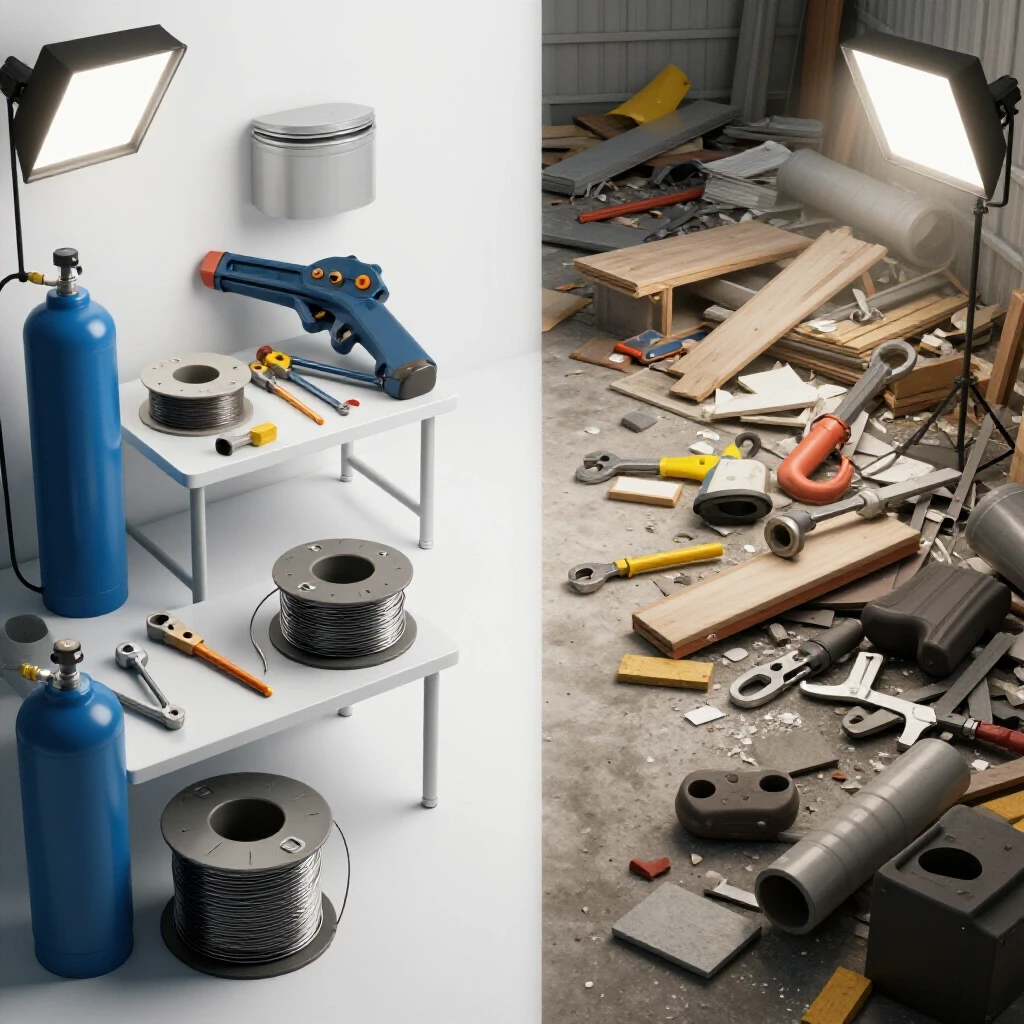
Consumables are items used up during fabrication, such as shielding gas, welding wire, flap discs, and saw blades. Failing to track these leads to inaccurate financial records and a lower perceived value of the business.
I recommend a “consumable burden factor” for every job. In my consulting work, I found that most small shops lose 10% to 15% of their gross profit simply because they forget to charge for the “small stuff.” If you use a $15 flap disc and half a bottle of argon on a project, those costs must be captured.
| Consumable Item | Typical Unit Cost | Estimated Job Usage | Recovery Strategy |
|---|---|---|---|
| 75/25 Argon/CO2 | $60 per tank exchange | 15% per project | Flat fee per arc hour |
| .035 MIG Wire | $2.50 per lb | 2 lbs per project | 20% markup on weight |
| Flap Discs (4.5″) | $4.00 each | 2 discs per project | Line item on quote |
| Electricity | $0.12 per kWh | 10 kWh per project | Included in shop rate |
Auditing Equipment and Calculating Machinery Depreciation
Equipment depreciation tracks how tools lose value over time due to wear and obsolescence. An accurate inventory audit is essential for determining the fair market price of your physical assets.
When I sold my first shop’s assets, I had to reconcile the difference between what I paid for my TIG welder and what it was actually worth after four years of use. Most fabrication equipment follows a five-to-seven-year depreciation cycle. If you bought a $5,000 multi-process welder three years ago, its “book value” might only be $2,500 today, even if it works perfectly. Keeping a simple spreadsheet of purchase dates, initial costs, and current market values helps you avoid overestimating your shop’s worth.
Calculating Realistic Payback Periods for New Tools
A tool ROI (Return on Investment) calculation determines how many billable hours a piece of equipment must work before it pays for itself. This is a critical metric for any buyer looking at your shop’s efficiency.
Before I upgraded to a CNC plasma table, I tracked how much I was spending on outsourced cutting. By bringing that work in-house, the machine paid for itself in fourteen months. For a side-hustle, a payback period of eighteen to twenty-four months is generally considered a sound investment. If you can show a buyer that your equipment is already “paid for” by the work it has produced, the shop’s financial story becomes much more compelling.
- Initial Investment: $8,000 (e.g., a high-end ironworker).
- Monthly Savings/Earnings: $400 (labor hours saved or new work).
- Payback Period: 20 months.
- Depreciation Rate: 15% annually.
Measuring the Financial Health of a Fabrication Side-Hustle
Financial health is measured by consistent cash flow and documented profit margins. A buyer looks for evidence that the shop earns more than it spends through organized fabrication job costing.
I suggest using a simple “Post-Job Reconciliation” sheet. After a project is finished, compare your initial quote to the actual costs. Did you use more material than expected? Did the welding take three hours longer than the estimate? If your actual costs are consistently within 5% to 10% of your estimates, your shop is a well-oiled machine. This level of predictability is exactly what adds a premium to the price when you decide to move on.
The Importance of Small Metal Shop Pricing Models
Pricing models vary, but most successful small shops use a “Cost-Plus” approach. This involves taking your raw material cost, adding a markup (usually 20% to 50%), and then adding your total shop hours multiplied by your hourly rate.
- Material Markup: Covers the time spent sourcing, picking up, and storing metal.
- Shop Rate: Covers overhead and your specialized skill.
- Profit Margin: An additional 10% to 20% on top of everything else to provide for business growth.
Assessing the Value of Repeat Customers and Local Reputation
Goodwill represents the likelihood of future revenue from existing clients and is the intangible value beyond the physical tools in the shop. It is often the hardest part of a small business to quantify but the most valuable.
In my experience, a shop with a list of twenty repeat commercial clients is worth significantly more than a shop that relies on one-off Craigslist ads. If you can show a history of recurring work—such as a local contractor who orders ten sets of brackets every month—you have a “transferable” income stream. This stability reduces the risk for a new owner and justifies a higher valuation for the operation.
Practical Steps for Accurate Financial Tracking
To prepare your shop for an eventual transition or just to run it more profitably today, you need a digital paper trail. Relying on a shoebox of receipts will not help you when you need to prove your shop’s efficiency.
- Invoicing Software: Use platforms like QuickBooks, FreshBooks, or Wave to track every dollar coming in and going out.
- Material Trackers: Maintain a spreadsheet of current steel prices from your local suppliers to ensure your quotes stay current with market fluctuations.
- Digital Estimation Tools: Build a template that automatically adds your shop rate and consumable burden so you never under-quote a job again.
- Workflow Management: Even a simple Trello board or a physical whiteboard showing project stages can demonstrate to a buyer that you have a repeatable process.
Building a profitable fabrication business is about more than just laying a clean bead. It is about understanding the “shop math” that keeps the lights on. By tracking your consumables, managing your equipment depreciation, and proving your profit margins, you turn your workshop from a hobby into a valuable asset.
FAQ
How do I determine my shop’s hourly rate? Calculate all annual shop expenses, including rent, utilities, insurance, and tool maintenance. Divide this total by the number of billable hours you work in a year. Then, add your desired hourly wage and a 10-20% profit margin to find your final rate.
What is a “consumable burden” and why does it matter? A consumable burden is a percentage added to a job’s cost to cover items like gas, wire, and abrasives. It matters because these small costs can easily eat up 15% of your profit if they aren’t explicitly factored into your pricing.
How much should I mark up raw materials? Most small shops mark up materials by 20% to 50%. This covers the time spent ordering, transporting, and handling the metal, as well as the cost of carrying inventory.
How do I calculate the value of my used welding equipment? Look at the current market price for similar used models and subtract value based on the condition and age of your specific unit. Most professional fabrication tools lose about 15-20% of their value annually until they reach a “floor” price.
Is my business worth more if I have a specialized niche? Yes. A shop that specializes in a specific area, like stainless steel sanitary welding or custom aluminum boat repair, often commands a higher value because the specialized skills and equipment create a barrier to entry for competitors.
What documentation do I need to prove my shop is profitable? You should keep at least two to three years of clean profit and loss (P&L) statements, a detailed equipment inventory, and a list of recurring clients with their historical spend.
Should I include my own labor in the shop’s valuation? A buyer will want to know how much it costs to replace you. If the shop only makes money because you work for free, the business has little value. You must account for a fair market wage for the operator in your financial records.
How often should I update my equipment inventory? I recommend doing a full equipment and tool audit once a year. This allows you to update depreciation schedules and identify tools that are no longer providing a positive return on investment.
(This article was written by one of our staff writers, Michael Hargrove. Visit our Meet the Team page to learn more about the author and their expertise.)