How to Choose Long-Lasting Plasma Cutter Nozzles (DIY Guide)
I remember the first time I realized my side-hustle was actually losing money. I had spent six hours cutting a complex decorative gate for a local client. I felt proud of the work, but when I looked at my workbench, I saw a pile of five ruined copper nozzles. I had priced the job based on a flat hourly rate I pulled out of thin air, never accounting for the fact that I was burning through ten dollars of consumables every hour. That was the day I stopped being a hobbyist and started being a business owner.
In my sixteen years of metalworking, I have learned that the difference between a profitable shop and a failing one often comes down to the small things you can hold in your hand. For those of us running small-batch fabrication shops, the copper or hafnium-tipped orifices at the end of our plasma torches are more than just parts. They are the primary variable in our fabrication job costing. If you don’t understand how to make these parts last, you will never be able to price your work with confidence.
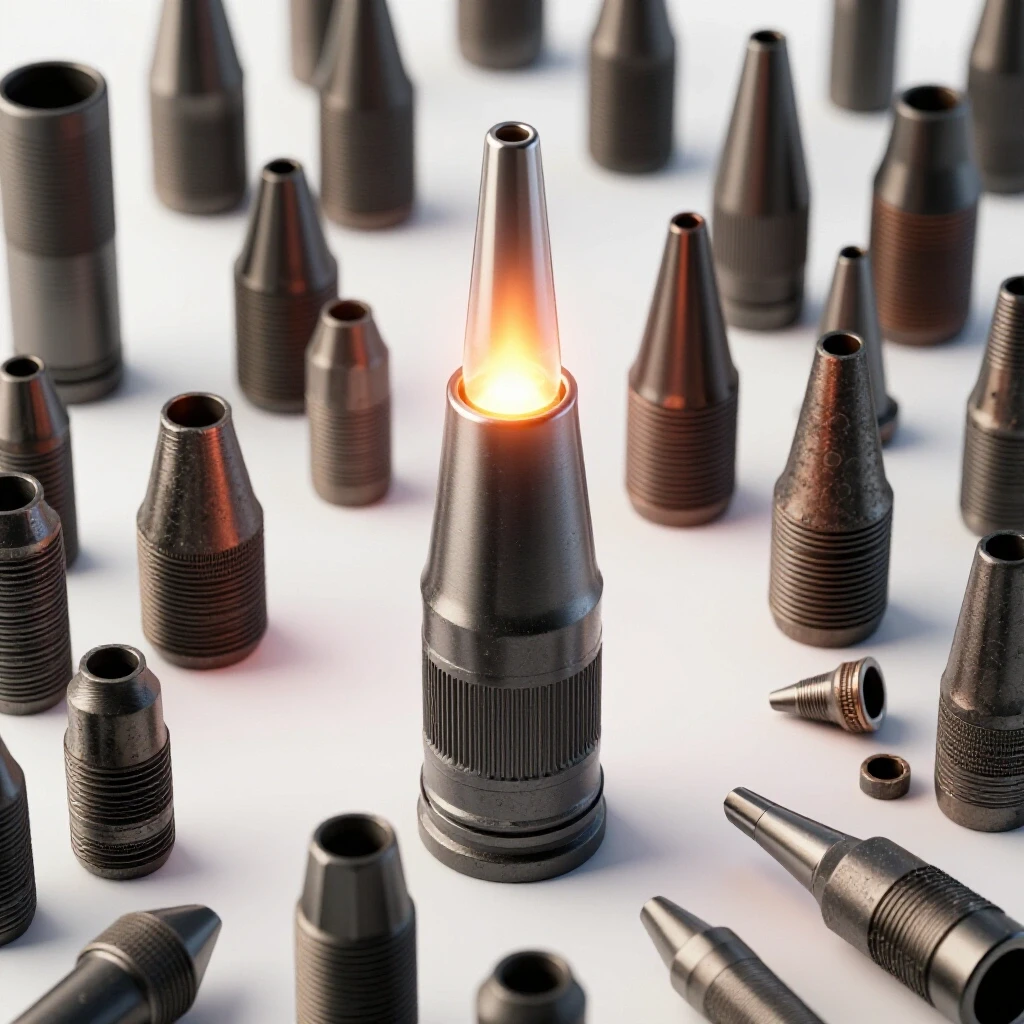
Why Consumable Longevity Dictates Your Fabrication Job Costing
Fabrication job costing is the process of totaling all expenses associated with a specific project to ensure the final price covers costs and generates a profit. It includes labor, materials, and the “burden” of supplies that wear out during the process.
When you are starting a side-hustle metalworking business, it is easy to focus on the big numbers like the cost of a sheet of steel. However, the true profit-killer is the “consumable burden.” This is the cost of the items that disappear as you work, such as shielding gas, grinding wheels, and plasma nozzles. If you are replacing a nozzle every twenty feet of cutting because of poor technique or incorrect settings, your cost per foot of cut skyrockets.
In a professional environment, we look at the “linear foot cost.” This is the total cost of electricity, gas, and nozzle wear divided by the total distance cut. If a nozzle costs fifteen dollars and lasts for five hundred feet, your cost is three cents per foot. If it only lasts fifty feet because you chose the wrong amperage or maintained an improper standoff, that cost jumps to thirty cents per foot. On a large project, that ten-fold increase can wipe out your entire take-home pay.
Building a Foundation: Calculating Your Hourly Shop Rate
A shop hourly rate is the total dollar amount you must charge per hour to cover all business expenses and pay yourself a fair wage. It is the baseline for every quote you send to a customer.
Most small shop owners I consult with pick a number like $50 or $75 an hour because it “feels right.” This is a dangerous way to run a business. To find your real rate, you must account for overhead—the costs of keeping the lights on regardless of whether you are cutting metal. This includes rent, insurance, electricity, and the depreciation of your equipment.
The Breakdown of a $85/Hour Shop Rate
| Expense Category | Hourly Allocation | Description |
|---|---|---|
| Labor (Your Pay) | $40.00 | The actual wage you want to earn. |
| Shop Overhead | $15.00 | Utilities, rent, and insurance. |
| Tool Depreciation | $10.00 | Saving for the next machine upgrade. |
| Consumable Burden | $12.00 | Nozzles, gas, and abrasives. |
| Profit Margin | $8.00 | Money for business growth and risk. |
By allocating $12.00 per hour specifically for consumables, you create a buffer. If you learn how to extend the life of your copper tips through better technique, that $12.00 becomes extra profit. If you are careless, you end up paying for those parts out of your own $40.00 hourly wage.
Mapping Machinery Amortization and Tool ROI
Machine amortization is the practice of spreading the cost of an expensive tool over its expected lifespan to understand its daily or hourly cost. It helps you determine the return on investment (ROI) for new equipment.
If you spend $2,500 on a high-quality plasma cutter, you shouldn’t view that as a $2,500 loss today. Instead, assume the machine will last for 2,000 hours of arc time over five years. That means the machine costs you $1.25 for every hour it is running.
When you consider an upgrade to a more efficient system, you must ask: “Will this new machine help my consumables last longer?” Often, a more expensive power supply provides a cleaner arc and better gas flow control. If an upgrade doubles the life of your nozzles, the $1.25 hourly cost of the machine might save you $5.00 an hour in copper tips. That is a clear, data-driven reason to invest in better equipment.
The Physics of Preservation: How to Extend the Life of Your Plasma Tips
The service life of a plasma nozzle is governed by how well you manage the heat and the flow of ionized gas through the small orifice. Matching the orifice diameter to your amperage is the first step in ensuring longevity.
Many side-hustlers make the mistake of using a high-amperage nozzle for low-amperage work. If you use a 60-amp nozzle to cut thin sheet metal at 20 amps, the arc will not be properly constricted. This leads to a “lazy” arc that can wander and erode the sides of the copper orifice. Conversely, pushing 60 amps through a 40-amp nozzle will cause “double-arcing,” where the arc strikes the nozzle itself, instantly destroying the part.
Key Factors for Nozzle Longevity
- Standoff Distance: Maintaining a consistent gap (usually 1/16″ to 1/8″) between the tip and the metal prevents molten metal from splashing back into the orifice.
- Air Quality: Moisture or oil in your compressed air line will contaminate the plasma gas. This causes the hafnium insert to blow out prematurely.
- Piercing Technique: Never start a cut directly over the metal if you can help it. Start at the edge or use a “rolling start” to ensure the sparks fly away from the torch.
Interestingly, I have found that shop owners who invest in a high-quality air dryer often see their consumable life triple. If a dryer costs $400 and saves you $200 a year in nozzles, the payback period is only two years. This is the kind of shop math that separates the professionals from the hobbyists.
Why Hidden Consumables Bleed Small Shop Profits
Small metal shop pricing often fails because of “leakage.” This happens when you use more supplies than you estimated. If you quoted a job for two nozzles but ended up using six, that is a hidden cost that eats your margin.
One of the most common reasons for excessive wear is poor gas pressure management. If your air pressure is too low, the arc will not be cooled effectively, and the nozzle will melt. If it is too high, it can extinguish the arc or cause turbulent flow that wears the orifice unevenly. I always recommend using a dedicated pressure gauge right at the back of the machine to ensure you are getting the exact PSI required by the manufacturer.
Formulating a Real Material Markup for Small Metal Shop Pricing
A material markup is a percentage added to the raw cost of metal and supplies to cover the time spent sourcing, transporting, and managing inventory.
In my experience, a 20% to 50% markup is standard for small shops. If a sheet of steel costs $100, you should charge the customer at least $120. This covers your gas to the steel yard and the time spent unloading the truck. However, you should also apply this markup to your consumables.
Material and Consumable Markup Levels
| Job Complexity | Material Markup | Consumable Markup |
|---|---|---|
| Simple Straight Cuts | 20% | 10% |
| Intricate Decorative Work | 35% | 25% |
| High-Precision Industrial | 50% | 40% |
Decorative work requires more frequent starts and stops. Every time the arc fires, a tiny amount of the hafnium insert is vaporized. Therefore, jobs with many “pierces” should have a higher consumable markup than a job with one long, continuous cut.
Building a Custom Job Quote Using Linear-Foot Baselines
To build an accurate quote, you need to know how fast you can cut and how much it costs per foot. I use a “linear-foot baseline” to simplify this.
First, time yourself cutting twelve inches of your most common material, such as 1/4″ mild steel. Note the amperage used and the condition of the nozzle before and after. If you can cut 20 inches per minute, you know that a project with 100 feet of cutting will take exactly one hour of “trigger time.”
However, you must also factor in “fit-up” and “handling” time. Usually, for every minute of cutting, there are three minutes of setup. So, that 100-foot cut actually represents four hours of shop time.
Sample Quote Calculation:
- Labor: 4 hours x $85/hr = $340.00
- Materials: 1 sheet of steel = $150.00
- Markup (30% on materials): $45.00
- Consumable Surcharge (15% of labor): $51.00
- Total Quote: $586.00
If you simply charged $50 an hour for four hours and the cost of the steel ($200 + $150 = $350), you would be leaving $236 on the table. That is the difference between a side-hustle and a sustainable business.
Tracking Consumable Usage for Better ROI Calculators
You cannot manage what you do not measure. I suggest keeping a simple logbook next to your plasma cutter. Every time you change a nozzle, write down the date and the project you were working on.
Over time, this data becomes your most valuable business asset. You will start to see patterns. Perhaps a certain brand of metal has a coating that ruins your tips faster. Or maybe you notice that your nozzles last longer in the winter when the air is naturally drier.
Digital Tools for Tracking and Invoicing
- QuickBooks or FreshBooks: Great for tracking overall shop expenses and material purchases.
- Excel or Google Sheets: The best tool for creating your own metal business ROI calculators.
- Evernote: Useful for taking photos of nozzle wear patterns to compare against your logs.
- Wave Invoicing: A free option for sending professional quotes that include your calculated markups.
By using these tools, you move away from “guesstimating” and toward “calculating.” This builds confidence when you are talking to customers. When a client asks why your price is higher than the guy down the street, you can explain your process and the quality of your consumables with data.
Analyzing Post-Job Profits and Cost Variance
Job cost variance is the difference between what you thought a project would cost and what it actually cost. After every major project, you should perform a “post-mortem” analysis.
Did you use more nozzles than expected? Why? Was the metal rusty, requiring more cleaning time and causing more “blowback” into the torch? Did you forget to factor in the time it took to change the gas cylinder?
If your variance is consistently high, it means your shop rate is too low or your estimating model is flawed. I once found that my “small” jobs were actually my least profitable because the setup time was the same as the “large” jobs, but I wasn’t charging a “minimum shop fee.” Adding a $75 minimum fee for any job ensured that even a five-minute cut covered the overhead of turning on the machines.
Sourcing Strategies for Small Shops
Bulk sourcing is a great way to improve your margins, but only if you are buying the right parts. For a side-hustler, buying 100 nozzles at once can save 30% per unit. However, that is $500 or more tied up in inventory that isn’t sitting in your bank account.
I recommend the “Three-Month Rule.” Only buy in bulk if you are certain you will use those parts within the next three months. This keeps your cash flow liquid while still capturing some wholesale savings. Also, be wary of “ultra-cheap” off-brand consumables. In my testing, these often have inconsistent orifice diameters, which can lead to poor cut quality and more time spent grinding—which costs you more in labor than you saved on the part.
Practical Next Steps for Your Fabrication Business
Mastering the economics of your shop takes time, but you can start today with these three steps:
- Audit your air system: Install a moisture trap or a dedicated air dryer. This is the single most effective way to protect your copper tips and ensure they last as long as possible.
- Calculate your true overhead: Spend an hour with your bank statements. Add up your rent, power, and insurance for the last year. Divide that by the number of hours you actually spent working in the shop. That is your hourly overhead burden.
- Start a “Consumable Log”: Tape a piece of paper to your plasma cutter. Mark every time you swap a nozzle. Note the material thickness and the amperage.
By focusing on these small, measurable details, you will transform your workshop from a hobby that costs money into a business that makes it. Profitability isn’t about the big “score” on one job; it’s about the cents you save on every inch of metal you cut.
FAQ: Maximizing Shop Efficiency and Consumable Life
How do I know when a plasma nozzle is actually “spent”? A nozzle needs replacement when the circular orifice becomes oval-shaped or if there is visible “pitting” inside the tip. You will notice the arc starts to “trail” or the cut becomes angled rather than square. If you see green or black soot around the tip, that is a sign of severe overheating or contamination.
Is it better to use a drag shield or a standoff guide? For most side-hustlers, a standoff guide is better for nozzle life. Dragging the nozzle directly on the metal increases the heat and the chance of “double-arcing.” A standoff guide maintains the perfect gap, which protects the copper orifice from molten splash-back.
How does “pierce height” affect my consumable costs? The pierce is the most violent part of the cut. If the torch is too close when the arc fires, molten metal will shoot straight into the nozzle. Starting the pierce slightly higher than your cutting height (about double the distance) can significantly extend the life of your tips.
Why does my plasma cutter keep “blowing” tips on thin metal? This is often caused by using too much amperage for the nozzle size. If you are cutting 16-gauge steel, you should be using a lower-amperage nozzle (like a 20A or 30A tip) and dialing your machine back. Using a 60A tip on thin metal causes a wide, turbulent arc that wears the nozzle unevenly.
What is the “consumable burden factor” and how do I use it? The consumable burden factor is a percentage added to your labor rate to cover supplies. For most small fab shops, this is between 10% and 15%. If your labor rate is $80, you add $8 to $12 per hour to cover the cost of nozzles, gas, and electricity.
Can I clean or “refurbish” old plasma nozzles? Generally, no. Once the copper orifice is deformed or the hafnium insert is pitted deeper than 1/16 of an inch, the physics of the plasma arc are compromised. Trying to “clean” them with a file usually makes the orifice larger, which reduces cut quality and increases dross.
How much should I mark up the cost of replacement parts to the customer? I recommend a 25% to 50% markup on consumables. This covers your time for ordering, the shipping costs, and the “risk” of a part failing mid-job. If a nozzle costs you $10, the customer should be charged $12.50 to $15.00 as part of the job’s material cost.
What is the most common mistake when setting gas pressure? The most common mistake is setting the pressure while the air is not flowing. You must set the PSI on your regulator while the gas is actively moving through the torch. Static pressure is always higher than flowing pressure, and it’s the flowing pressure that determines the cooling and arc constriction.
How do I calculate the ROI on a new air filtration system? Track your nozzle usage for one month without the filter. Then, install the filter and track it for the next month. If you went from using 20 nozzles down to 10, and nozzles cost $15 each, you saved $150 in one month. If the filter cost $300, your ROI is achieved in just two months.
Should I charge for “trigger time” or “shop time”? Always charge for “shop time.” Trigger time is only a small fraction of the job. You must charge for the time spent cleaning the metal, setting up the guides, changing consumables, and the post-cut cleanup. A good rule of thumb is that for every 10 minutes of cutting, there are 20-30 minutes of associated shop labor.
(This article was written by one of our staff writers, Michael Hargrove. Visit our Meet the Team page to learn more about the author and their expertise.)