How to Replace a Broken Lathe Headstock Brass Gear (DIY Fix)
When a machine goes silent in the middle of a paid job, the air in a small shop changes instantly. I remember the first time a brass gear in my lathe’s headstock sheared its teeth. I was finishing a set of custom bushings for a local client, and the sudden lack of spindle drive felt like money evaporating. For a side-hustler or a small shop owner, a broken gear isn’t just a mechanical failure; it is a financial bottleneck that tests your ability to manage overhead and maintenance costs.
In my 16 years of running and consulting for small manufacturing businesses, I have learned that the “hobbyist” mindset often overlooks the true cost of these moments. If you spend eight hours fixing your own equipment, did that repair cost you nothing, or did it cost you $800 in lost billable time? To run a profitable shop, you must treat your own machinery maintenance with the same financial rigor you apply to a customer’s fabrication project.
This guide focuses on the economic and practical realities of restoring a lathe’s drive function by fabricating a replacement brass component. We will move through the process of measuring the damage, selecting materials, and calculating the impact on your shop’s bottom line.
Establishing a Realistic Shop Hourly Rate for Machinery Repairs
A shop hourly rate is the total dollar amount you must charge per hour to cover all business expenses while generating a sustainable profit. It is the foundation of every quote you send and every internal repair you perform.
Most small shop owners I consult with start by picking a number that “feels right,” often around $30 or $40 an hour. This is a trap. Once you factor in shop rent, insurance, electricity, and the eventual replacement of your tools, that $40 is likely a net loss. In a professional side-hustle environment, your rate should typically fall between $65 and $120 per hour, depending on your local market and specific overhead.
When your lathe goes down, you are your own client. If the repair takes five hours and your shop rate is $80, that repair has an internal cost of $400. Understanding this helps you decide if a DIY fix is a smart business move or a distraction from higher-paying work.
The Components of a Professional Shop Rate
To find your true number, you must look at three specific categories:
- Fixed Overhead: These are costs that exist even if the machines never turn on. This includes shop rent or a portion of your mortgage, business insurance, and software subscriptions for invoicing or CAD.
- Variable Costs: These fluctuate based on activity. Think of your electricity bill, heating, and basic shop supplies like rags and floor cleaner.
- Labor and Profit: This is what you pay yourself for your skill, plus a margin that stays in the business bank account for future growth.
| Expense Category | Monthly Cost (Example) | Hourly Impact (100 billable hours/mo) |
|---|---|---|
| Rent/Mortgage | $800 | $8.00 |
| Utilities & Heat | $250 | $2.50 |
| Insurance & Fees | $150 | $1.50 |
| Consumables Base | $100 | $1.00 |
| Desired Labor Pay | $5,000 | $50.00 |
| Business Profit (15%) | $945 | $9.45 |
| Total Shop Rate | $7,245 | $72.45 |
Calculating the True Cost of Fabricating Replacement Components
The true cost of a repair includes the raw material price, the wear on your cutting tools, and the time spent on precision measurement and execution. In the case of a sheared spindle gear, the material choice is critical for both mechanical function and budget.
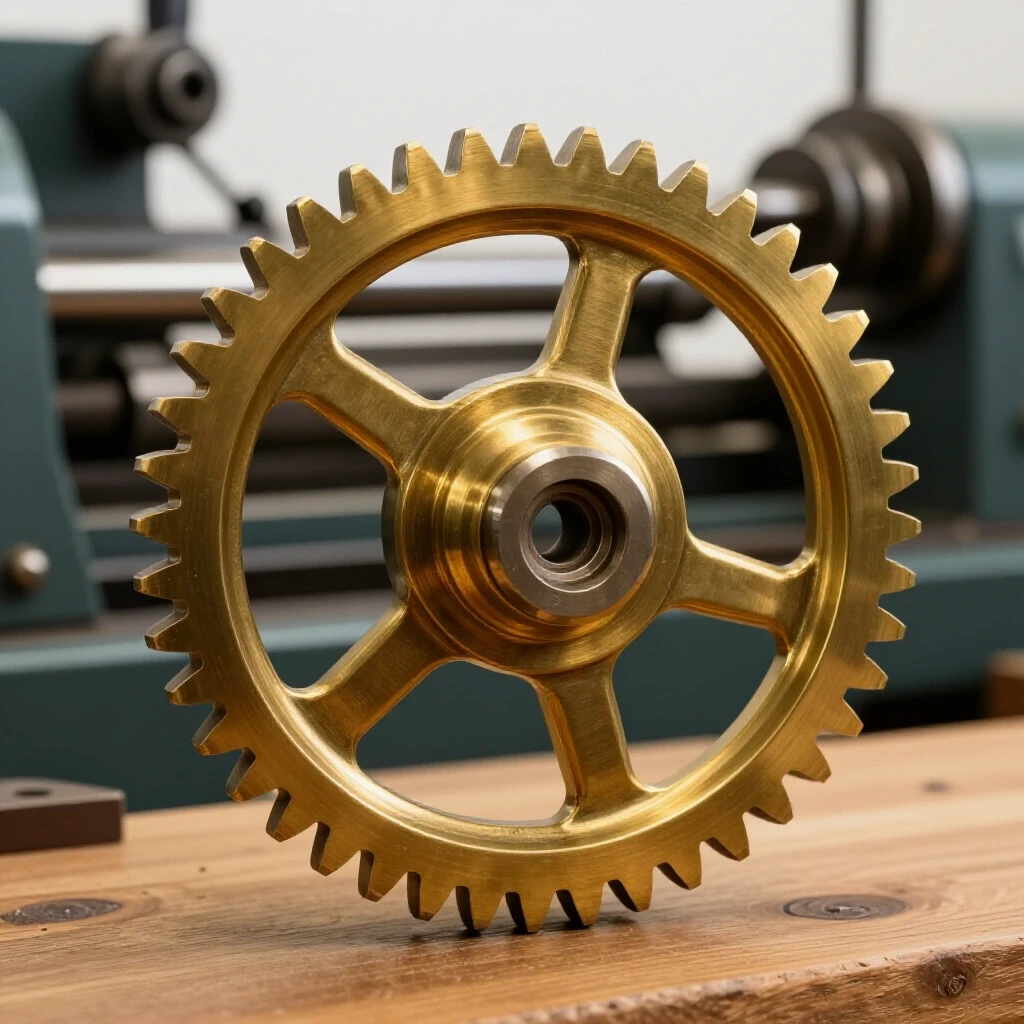
Brass is frequently used in headstock gears because it acts as a mechanical fuse. It is intended to fail before the more expensive steel gears or the motor itself are damaged. When you begin the repair, the first step is a meticulous measurement of the damaged part. You need to determine the tooth count, the outside diameter, and the pressure angle.
If you miscalculate these dimensions, you will waste expensive brass stock and hours of labor. I always recommend using a “scrap-first” approach for complex geometries. Turn a piece of inexpensive aluminum or even hard plastic to the correct diameter and test the fit before cutting into your high-grade brass.
Sourcing Brass Stock and Managing Material Markup
For headstock components, C360 Free-Cutting Brass is the industry standard. It machines beautifully and offers the right balance of strength and lubricity. However, brass is a “red metal,” and its price fluctuates significantly with the commodities market.
When purchasing material for a side-hustle project, never charge yourself or a client the “shelf price.” You must include a material markup, typically 15% to 30%. This covers the time you spent ordering the metal, the shipping costs, and the risk of a mistake during machining.
- Check local scrap yards for “drops” (short leftover pieces) to save 50% or more on material costs.
- Always buy 10-20% more material than you think you need to account for parting-off and work-holding.
- Keep a log of current brass prices per inch to speed up future job estimations.
Tracking Tooling and Consumable Expenses During Spindle Drive Restoration
Consumables are the hidden “leak” in most small shop budgets. These are items like layout fluid, specialized cutters, and lubricants that are used up during a project. If you don’t track them, they will quietly eat your profit.
For a gear fabrication task, you might need a specific involute gear cutter. If that cutter costs $60 and you only use it for this one repair, that $60 must be added to the job cost. You cannot spread that cost across other jobs if the tool is specialized. This is a common mistake that leads to inaccurate job costing.
In my consulting work, I suggest a “Consumable Burden Factor.” This is a flat percentage added to every job to cover things like electricity, grease, and small drill bits. For most small shops, a 5% to 8% burden on top of the labor and material cost is a safe baseline.
Essential Items for the Repair Process
- Precision Calipers and Micrometers: For verifying the pitch diameter and bore size.
- Involute Gear Cutters: Sized specifically for the module or diametral pitch of your lathe.
- High-Pressure Gear Grease: To ensure the new part meshes smoothly with the steel counter-gears.
- Mandrel or Work-holding: Often, you will need to fabricate a custom mandrel to hold the brass blank securely.
Analyzing ROI and Amortization on Primary Shop Equipment
Amortization is the process of spreading the cost of a large investment, like a lathe, over its useful life. If you bought a lathe for $5,000 and expect it to last 10 years, it “costs” you $500 a year plus maintenance.
When a major component like a headstock gear breaks, you have to look at the Return on Investment (ROI) of the fix. If the lathe is an older model and the repair will cost $600 in parts and labor, but the machine is only worth $1,200, you are at a crossroads. However, for most side-hustlers, the ability to perform a DIY fix is what keeps the business viable.
Repairing the machine yourself preserves your capital. Instead of spending $5,000 on a new lathe, you spend $100 on brass and a few hours of your time. The “profit” here is the $4,900 in capital you didn’t have to spend.
Machine Depreciation and Maintenance Logs
I highly recommend keeping a maintenance log for every major tool. This serves two purposes. First, it helps you track how much you are spending on a specific machine, which tells you when it’s time to upgrade. Second, if you ever sell the machine, a documented history of repairs—like a newly fabricated brass drive gear—increases the resale value.
- Document the date of the repair.
- Record the specific brass alloy used.
- Note the number of hours the machine had run prior to the failure (if equipped with a tachometer or hour meter).
Building a Job Quote for Internal Maintenance and External Fabrication
Whether you are fixing your own gear or quoting a fabrication job for a neighbor, you need a repeatable system. A professional quote prevents “scope creep” and ensures you aren’t working for free.
A solid estimate should include the “Big Four”: Materials, Labor, Consumables, and Markup. For an internal repair, this exercise is about discipline. It forces you to realize that being a “handyman” for your own shop has a price tag.
The “Quick-Quote” Formula for Small Fabrication Tasks
- (Material Cost x 1.3 markup) = Material Total
- (Estimated Hours x Shop Rate) = Labor Total
- (Labor Total x 0.05) = Consumable Burden
- Material Total + Labor Total + Consumable Burden = Final Quote
Interestingly, many small shop owners find that once they use this formula, their prices increase by 20% or more. This is usually the moment they actually start making money instead of just “staying busy.”
Why Hidden Consumables Bleed Small Shop Profits
I once worked with a welder who couldn’t figure out why he was broke at the end of the month despite being busy. We looked at his “hidden” costs. He wasn’t charging for grinding discs, shielding gas, or the electricity to run his compressor. He was losing nearly $12 an hour to these “invisible” expenses.
In the context of a lathe repair, hidden costs include the layout dye used to mark the gear teeth, the specialized oil for the headstock, and even the electricity used during the hours of machining. While it seems trivial to track a few squirts of oil, these costs add up over a year of operation.
To combat this, I suggest a simple “Consumable Tracking Sheet” taped to the wall near your primary machines. Every time you open a new box of inserts or a new bottle of cutting fluid, mark it down. At the end of the month, you will have a clear picture of your “burn rate.”
Sourcing Strategies for Small-Batch Metalworking
One of the biggest hurdles for the 35–55-year-old side-hustler is the supply chain. Large metal distributors often have “minimum order” requirements of $250 or more. This makes buying a single 3-inch piece of brass for a gear repair very expensive due to “small order fees.”
To stay profitable, you must be strategic. Building a relationship with a local full-scale machine shop can be a goldmine. They often have bins of “remnants”—pieces of high-quality brass or steel that are too small for their CNC runs but perfect for your manual lathe repairs.
- Join local machining forums or Facebook groups to find “metal hauls” from retiring machinists.
- Standardize your materials. If you can use the same brass alloy for multiple types of jobs, buy it in longer bars to reduce the price per inch.
- Always ask for a “will-call” pickup to avoid the massive shipping surcharges on heavy metal stock.
Post-Job Profit Analysis: Was the Repair Worth It?
After the new brass gear is installed, the headstock is buttoned up, and the spindle is spinning smoothly, you must perform a post-job reconciliation. This is the “debrief” of your financial performance.
Compare your estimated time to your actual time. If you thought the repair would take three hours but it took six, why? Did you spend two hours looking for a tool? Did you have to restart because of a measurement error? This data is the most valuable asset in your shop. It allows you to bid more accurately on the next job.
If your “internal cost” for the repair was $500, but a replacement part from the manufacturer (if available) was $150, you need to evaluate if your DIY approach was truly the best business decision. Often, the DIY fix is necessary because the part is discontinued, but you should always know the numbers.
Key Metrics for Post-Job Review
- Labor Variance: The difference between estimated and actual hours.
- Material Waste: The percentage of raw stock that ended up as chips.
- Tooling Life: Did the repair dull a specialized cutter that now needs sharpening?
Practical Tools for Shop Management and Estimation
Managing the finances of a small metal shop has become much easier with modern software. You no longer need a complex accounting degree to track your ROI and job costs.
- Invoicing Software (e.g., Wave or QuickBooks): Essential for professional-looking quotes and tracking tax-deductible expenses.
- Spreadsheet Templates: Create a simple Excel or Google Sheets file for “Gear Math” and “Job Estimating.”
- Digital Calipers with Data Output: If you do a lot of repair work, these can send measurements directly to your computer to avoid manual entry errors.
- Inventory Apps: Simple apps can help you track your stock of brass, steel, and common fasteners so you don’t have to stop work to go to the hardware store.
Moving Toward a More Profitable Workshop
The transition from hobbyist to side-hustler is defined by how you value your time and equipment. Replacing a broken headstock component is a masterclass in shop management. It requires precision in the physical world and discipline in the financial world.
By establishing a firm shop rate, tracking every consumable, and analyzing your machine’s depreciation, you turn a mechanical failure into a business strength. You aren’t just a person with a lathe; you are a manufacturing business owner who understands that every turn of the spindle has a cost and a value.
Your next step is to look at your most used machine and calculate its current “hourly burden.” Knowing exactly what it costs to pull the handle will change the way you look at every quote you write.
Frequently Asked Questions
Why is brass used for headstock gears instead of steel?
Brass is used as a “sacrificial” material. In the event of a crash or a major overload, the brass teeth will shear off first. This protects the much more expensive steel gears in the drivetrain and prevents the motor from burning out. From a business perspective, replacing a $40 piece of brass is much better than replacing a $1,000 motor.
How do I determine the “Pressure Angle” of my broken gear?
The pressure angle (usually 14.5 or 20 degrees) determines the shape of the tooth. You can often identify it by using a gear pitch gauge or by comparing the broken gear to known standards. Using the wrong pressure angle will cause excessive noise, vibration, and rapid wear, leading to another costly repair.
Is it always cheaper to make a replacement part myself?
Not necessarily. When you factor in your shop rate and the cost of specialized tooling (like an involute cutter), it can sometimes be more expensive than buying a part. However, for older or imported lathes, parts may be unavailable or take weeks to ship. In those cases, the “cost” of the machine being down outweighs the high price of a DIY fix.
What is the best way to track “hidden” costs like electricity?
For a small shop, trying to meter every outlet is overkill. Instead, take your total monthly shop power bill and divide it by the number of hours you worked that month. This gives you an “energy cost per hour.” Add this to your overhead calculation to ensure it is covered in your shop rate.
How do I calculate “Material Markup” for a small piece of brass?
If a piece of brass costs you $20 including shipping, a 30% markup would bring the “job cost” to $26. This extra $6 covers your time spent sourcing the material and helps build a “buffer” for when you eventually have a piece of scrap.
What should I do if I miscalculate the gear dimensions?
Stop immediately. Do not try to “make it work” by filing the teeth. A poorly meshing gear will vibrate and eventually damage the mating steel gears. Treat the wasted brass as a “tuition cost” for your shop’s education, update your notes, and start over with a fresh piece of stock.
How often should I update my shop hourly rate?
You should review your rate at least once a year or whenever a major expense changes (like a rent increase or a new equipment purchase). Keeping an eye on your local competitors’ rates can also help ensure you stay competitive while remaining profitable.
Can I use a different alloy if I can’t find C360 brass?
While other bronzes or brasses exist, C360 is preferred for its “free-machining” properties. Using a tougher alloy like Aluminum Bronze might make the gear “too strong,” meaning it won’t act as a mechanical fuse anymore. This could lead to a more expensive failure elsewhere in the lathe.
How do I account for the time spent researching the repair?
Research time is “Non-Billable Overhead.” You shouldn’t charge a client for the time it takes you to learn a basic skill, but you should factor that time into your overall business plan. The more you learn, the faster your future repairs will be, which increases your effective hourly rate.
What is the most common mistake in job costing for small shops?
Underestimating “Floor-to-Floor” time. This is the total time from when you pick up the raw material to when the finished part is cleaned and installed. Most people only count the time the machine is actually cutting, forgetting about setup, tool changes, and cleanup.
(This article was written by one of our staff writers, Michael Hargrove. Visit our Meet the Team page to learn more about the author and their expertise.)