How to Build an Efficient Metal Fabrication Routine (Guide)
Twenty years ago, I realized my shop was a trap. I was spending more time moving heavy steel sheets and hunting for a specific grinding disc than I was actually welding. My background in manufacturing operations told me I had a bottleneck, but my cramped garage layout was the culprit. Transitioning from a hobbyist setup to a professional-grade workspace requires more than just buying faster tools; it demands a total rethink of how work moves through your space.
The stress of scaling a fabrication business often comes from the friction between high-output goals and low-efficiency environments. You might find yourself tripping over scrap while trying to reach a machine that isn’t powered correctly. To fix this, we have to look at the shop as a single machine. Every step you take and every minute spent on setup is a cost that eats your margins. By applying systematic layout changes and upgrading your infrastructure, you can turn a chaotic workspace into a streamlined production cell.
Mapping Material Travel Paths and Floor Load Capacities
A material travel path is the specific route a piece of metal takes from the moment it enters your shop until it leaves as a finished product. Mapping this prevents “back-tracking,” which is when a part moves back and forth across the shop, creating traffic jams and wasted energy.
In my early days, I made the mistake of placing my raw material rack at the back of the shop because it was “out of the way.” This meant every 20-foot stick of tubing had to be carried past every other machine twice. Now, I advocate for a linear or U-shaped flow. You want your material to enter near your primary cutting station, move to fabrication, and exit near the finishing area.
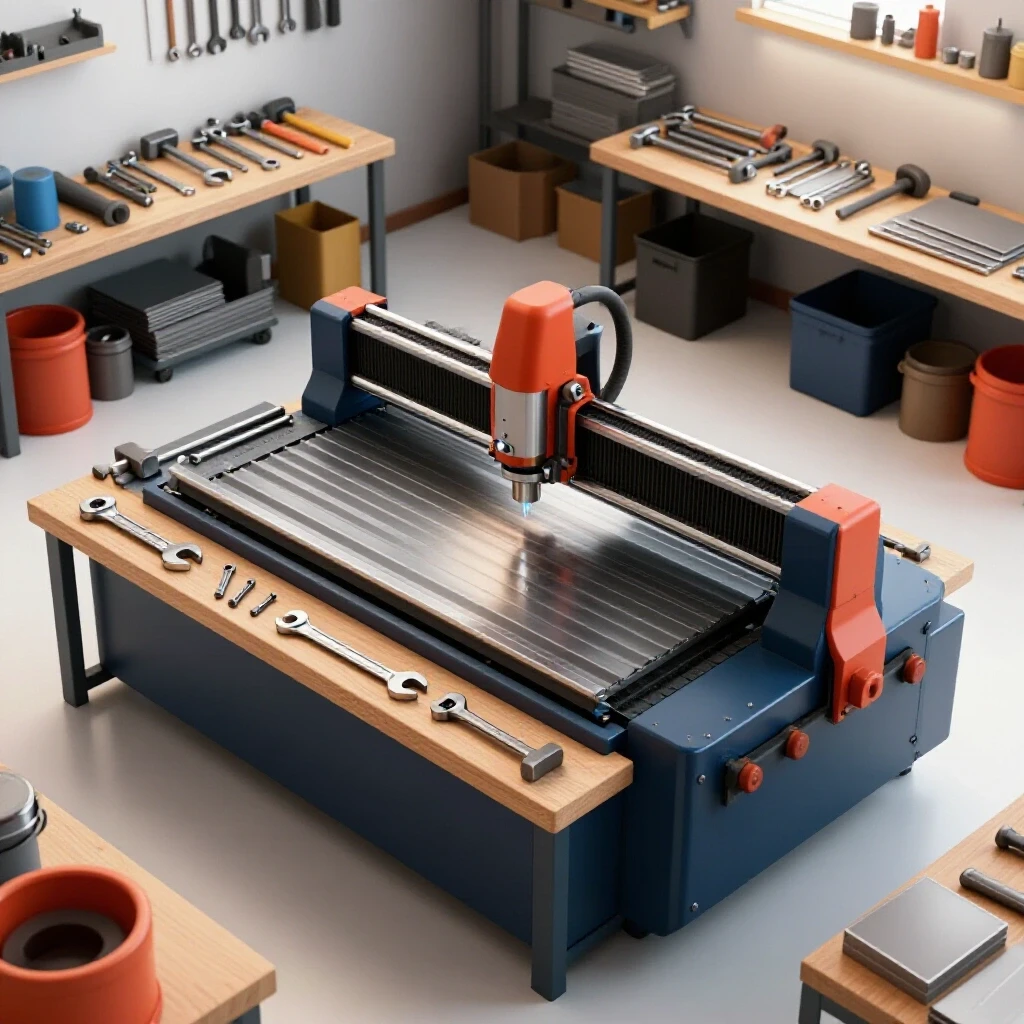
Before you bolt down heavy machinery like a CNC plasma table, you must verify your floor load rating. This is the amount of weight your concrete slab can support per square foot. Standard residential garage floors are often 4 inches thick, which can support about 3,000 to 4,000 PSI. However, concentrated loads from heavy gantry systems or large material racks can cause cracking if the weight isn’t distributed.
| Layout Type | Movement Pattern | Best Use Case | Efficiency Rating |
|---|---|---|---|
| Linear Flow | Straight line from In to Out | Long, narrow shops | High |
| U-Shape | Entry and Exit on same side | Wide shops with one large door | Very High |
| Island Layout | Central work zone, peripheral tools | Small, square shops | Moderate |
| Cellular | Specialized tool groupings | High-volume repeat parts | Maximum |
Key Takeaway: Minimize the distance raw material travels. If you are moving a part more than 10 feet between sequential operations, your layout is costing you money.
Optimizing Shop Power with 3-Phase Conversion Systems
A 3-phase power converter is a device that transforms standard residential single-phase electricity into the three-wire power required by industrial-grade motors and welders. Most high-output fabrication tools are designed for 3-phase because it is more efficient and provides smoother power delivery for heavy starts.
When I upgraded to a professional-grade ironworker, I faced a common hurdle: the local utility wanted $15,000 to bring 3-phase power to my building. Instead, I integrated a Rotary Phase Converter (RPC). An RPC uses a “idler motor” to generate the third leg of electricity. It is a reliable, cost-effective way to run industrial machinery in a home-based or light commercial setting.
You must also consider your total electrical load. The National Electrical Code (NEC) suggests that your continuous load should not exceed 80% of your circuit breaker’s rating. If you run a CNC plasma table, an air compressor, and a dust collector simultaneously, you are likely pulling over 60 amps. Balancing these loads across your sub-panel is critical to prevent nuisance trips during a production run.
- Static Phase Converters: Best for single-speed motors; cheapest but reduces tool power by 1/3.
- Rotary Phase Converters (RPC): Best for shops with multiple machines; provides 100% power.
- Variable Frequency Drives (VFD): Best for single machines where speed control is needed.
- Digital Phase Converters: The most efficient and quietest option, though the most expensive.
Key Takeaway: Don’t let power limitations dictate your tool quality. A rotary converter is often the most flexible investment for a growing fabrication routine.
Designing High-Volume Clean Air Filtration and Fume Extraction
Air quality management involves using fans and filters to remove metal dust and welding fumes from the breathing zone of the operator. In a high-output shop, “opening the door” is not a viable strategy for managing the fine particulates generated by grinding and plasma cutting.
I learned this the hard way after a week of heavy production left a layer of fine black dust on every surface in my shop—including inside my expensive electronics. To prevent this, you need a system measured in Cubic Feet per Minute (CFM). CFM is the volume of air a fan can move. For a standard fabrication cell, you should aim for at least 1,000 to 1,200 CFM at the source of the dust.
Static pressure loss is another critical concept. This is the resistance created by the friction of air moving through your ducts. Every 90-degree bend in your ductwork significantly reduces your actual suction. Use smooth-walled metal ducts instead of flexible ribbed hoses to keep your air velocity high enough to transport heavy metal dust without it settling in the pipes.
| Tool Type | Recommended CFM | Duct Diameter | Filtration Level |
|---|---|---|---|
| Welding Station | 400 – 600 | 4 – 6 inches | HEPA / Carbon |
| Grinding Bench | 800 – 1,000 | 6 inches | Cyclone Pre-filter |
| CNC Plasma Table | 1,500 – 2,500 | 8 – 10 inches | Water Table or Downdraft |
| General Shop Air | 2,000+ | N/A | Ambient Ceiling Units |
Key Takeaway: Source capture is always more efficient than ambient cleaning. Pull the fumes away before they disperse into the shop air.
Integrating CNC Plasma into Daily Production Cycles
Integrating a CNC plasma table involves moving from manual cutting to an automated gantry system that follows digital paths. This transition is often the biggest hurdle for experienced fabricators because it changes the “rhythm” of the shop. You are no longer just a welder; you are a machine operator and a file manager.
When I first installed my gantry, I struggled with “downtime.” I would finish a cut and then spend twenty minutes figuring out what to do next. To build an efficient routine, you must separate the “office work” from the “shop work.” Prepare your cut files (CAD/CAM) the night before. Your shop time should be strictly for loading material, monitoring the torch, and unloading parts.
Machine leveling is a step many skip, but it is vital. A CNC table that is not perfectly level will suffer from “gantry rack,” where the two sides of the machine fall out of sync. This leads to parts that aren’t square. Use a precision machinist level and check your table every few months, especially if your shop floor is subject to temperature swings.
- Material Staging: Keep a week’s worth of sheets within reach of the table’s loading side.
- Consumable Management: Maintain a log of “pierce counts” to know when to change your nozzle before cut quality drops.
- Slag Management: Schedule a weekly “clean out” for your water table or downdraft tray to prevent buildup that can interfere with the torch height control.
Key Takeaway: Automation only saves time if the machine stays running. Treat your CNC table like a dedicated employee that needs a clear schedule.
Organizing Work Zones to Reduce Setup Friction
Work zoning is the practice of grouping all tools, fasteners, and safety gear required for a specific task in one location. This is a core lean manufacturing principle. If you have to walk across the shop to get a square every time you go to the welding table, you are wasting hours every month.
I use “shadow boards” for my primary zones. A shadow board has a painted outline for every tool. If a tool is missing, I know instantly. This prevents the “search and rescue” missions that derail a productive afternoon. In my welding zone, I keep my clamps, magnets, and pliers within arm’s reach of the table.
Consider the “3-foot rule” for machine spacing. You should have at least 3 feet of clear space around every major tool for maintenance and safe operation. This boundary ensures that you can move freely without bumping into hot metal or moving parts. It also makes it easier to clean the shop at the end of the day, which is a vital part of a professional routine.
- The Welding Zone: Welder, gas bottle, clamps, grounding blocks, and PPE.
- The Cold Zone: Saw, ironworker, and drill press (no sparks allowed here).
- The Tech Zone: CNC controller, computer, and clean storage for delicate instruments.
- The Finishing Zone: Grinders, sanders, and deburring tools with dedicated dust extraction.
Key Takeaway: A place for everything means everything stays in its place. Reduce the “mental load” of finding tools so you can focus on the fabrication.
Tracking Metrics for Continuous Improvement
You cannot improve what you do not measure. In a professional shop, we look at throughput—the rate at which your shop produces finished goods over a specific period. If you want to scale, you need to know how long a standard project takes from start to finish.
I keep a simple log next to my main workbench. I track how much time I spend on layout, cutting, assembly, and finishing. After a month, the data usually reveals a surprise. For me, it was finishing. I realized I was spending 40% of my time grinding welds. This led me to invest in a better pulse welder that reduced spatter, instantly increasing my overall shop capacity.
Another metric is “consumable cost per project.” Tracking how many grinding discs or how much plasma gas you use helps you price your work accurately. If you are scaling up, these small costs become significant. Amortizing your equipment—calculating the cost of a machine over its expected lifespan—also helps you understand when an upgrade will actually pay for itself.
Key Takeaway: Use data, not feelings, to decide on your next shop upgrade. If a tool doesn’t save you time or improve quality, it’s just a hobby purchase.
Establishing a Sustainable Shop Maintenance Routine
The most efficient shops aren’t just the ones with the best tools; they are the ones that actually work every time you flip the switch. Machine downtime is the ultimate productivity killer. A systematic maintenance routine ensures that your 3-phase converters, CNC rails, and air compressors are ready for high-volume tasks.
I follow a “First 15, Last 15” rule. The first 15 minutes of the day are for checking fluid levels, draining moisture from air lines, and wiping down CNC rails. The last 15 minutes are for clearing the floor and returning tools to their zones. This prevents the “Friday afternoon disaster” where the shop is so messy you can’t work, and you spend your weekend cleaning instead of resting or planning.
- Daily: Drain air compressor tanks (moisture ruins plasma consumables).
- Weekly: Vacuum electronics cabinets and check belt tensions on saws.
- Monthly: Inspect electrical connections in your phase converter for heat discoloration.
- Quarterly: Deep clean the CNC water table and re-square the gantry.
Key Takeaway: Maintenance is a proactive investment in your shop’s uptime. A broken machine produces zero profit.
Frequently Asked Questions
How much space do I really need for a CNC plasma table? While the table itself might be 4×4 or 5×10 feet, you need at least 3 feet of clearance on three sides for loading material and maintenance. Additionally, factor in space for the plasma power supply and the air compressor. A 12×15 foot dedicated zone is usually the minimum for a 4×4 table.
Can I run a 3-phase welder on a 240V single-phase dryer outlet? Technically, no. You need a phase converter. While some modern inverters can handle various voltages, true 3-phase equipment requires three “hot” legs of power. Attempting to “cheat” this can damage the sensitive electronics in your welder or the motor in your saw.
Why is my dust collector losing suction even with a clean filter? This is usually due to static pressure loss in your ductwork. If you have used long runs of flexible hose or have too many 90-degree elbows, the air friction is too high. Switching to smooth metal pipe and using 45-degree “Y” junctions instead of “T” junctions will significantly improve airflow.
Is a water table or a downdraft table better for CNC plasma? Water tables are cheaper and easier to maintain for small shops as they trap most dust in the water. However, they can cause “splash back” on the bottom of parts. Downdraft tables provide cleaner cuts and keep the shop drier but require a very high-CFM fan (2,000+) and expensive ducting to the outdoors.
How do I know if my shop floor can handle a heavy ironworker? Most 4-inch concrete slabs can handle the static weight. The issue is vibration and “point loading.” If the machine has small feet, use steel “spreader plates” (1-inch thick) under the feet to distribute the weight across a larger surface area of the concrete.
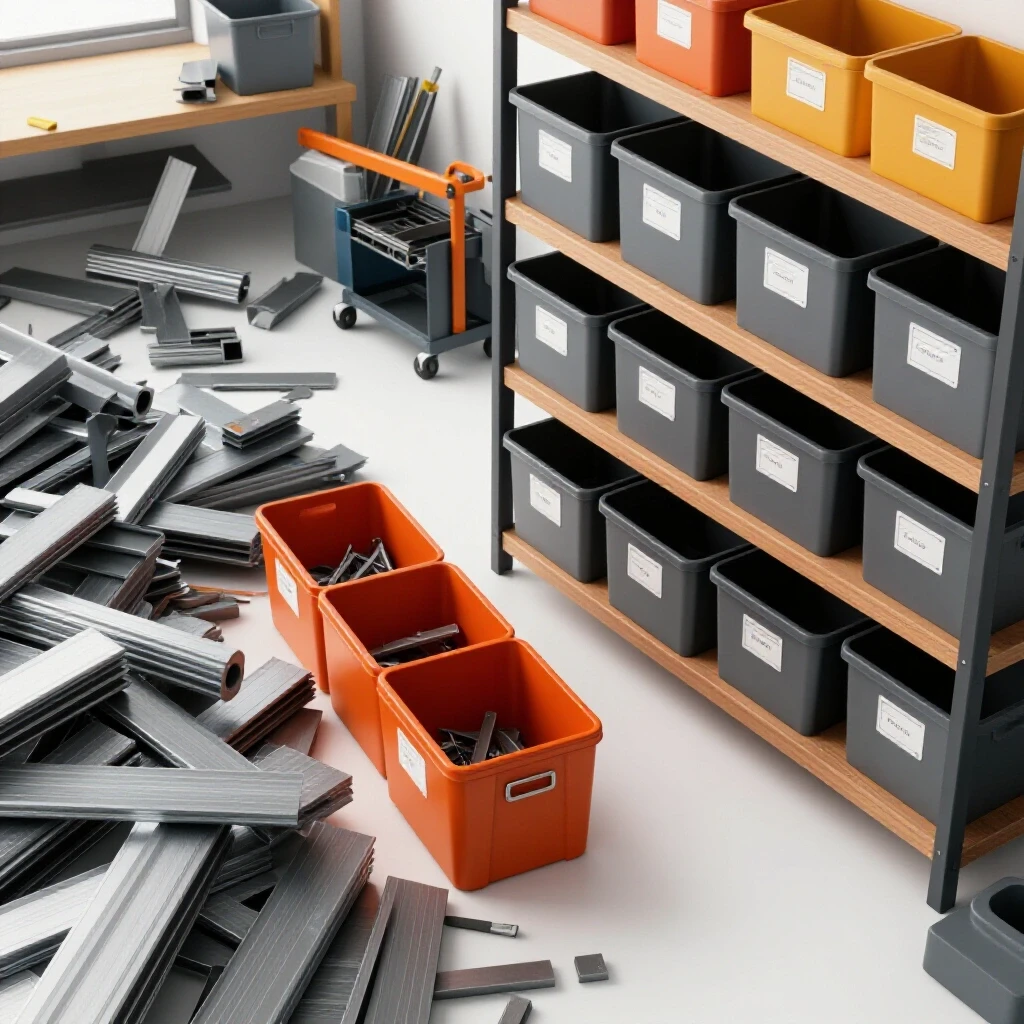
What is the best way to manage scrap metal in a small shop? Organize by material type and shape (e.g., “Aluminum Sheet,” “Steel Tubing”). Use vertical racks for long stock to save floor space. For small off-cuts, use labeled bins. If a piece is smaller than 6 inches and you haven’t used that size in a month, recycle it. Clutter is the enemy of a fast routine.
How often should I replace the filters in my ambient air cleaner? In a high-production shop, check them monthly. If you can see dust buildup on the outer pre-filter, it’s time to clean or replace it. A clogged filter makes the motor work harder and moves less air, defeating the purpose of having the system.
Do I really need a Rotary Phase Converter, or is a Static one enough? If you are running a machine with a motor that needs to start under load (like an air compressor or a large lathe), a static converter will often fail or provide only 60% of the rated horsepower. For a professional fabrication routine, a Rotary Phase Converter is the gold standard for reliability.
What is the “First 15, Last 15” rule? It is a habit where you spend the first 15 minutes of your workday on machine maintenance and the last 15 minutes on shop cleanup. This ensures your equipment is always ready and your workspace stays safe and organized, preventing “cleanup burnout” at the end of the week.
How do I reduce the learning curve when moving to CNC? Separate the “learning” from the “doing.” Don’t try to learn the software while you have a deadline on a customer project. Spend your evenings on a laptop in the house learning the CAD/CAM side, so when you are in the shop, you are just executing the physical routine.
(This article was written by one of our staff writers, Edward Sinclair. Visit our Meet the Team page to learn more about the author and their expertise.)