How to Choose Between Manual and CNC Mills for DIY (Decision)
I remember standing in my first shop, looking at a pile of aluminum blocks and a stack of unpaid bills. I had just spent three days manually squaring up parts for a client, only to realize that after factoring in my electricity and tooling, I had earned about four dollars an hour. That was the moment I stopped being a hobbyist and started being a business owner. My 16 years in metalworking taught me that the most expensive tool in the shop isn’t the one that costs the most to buy; it’s the one that costs the most to run without a plan.
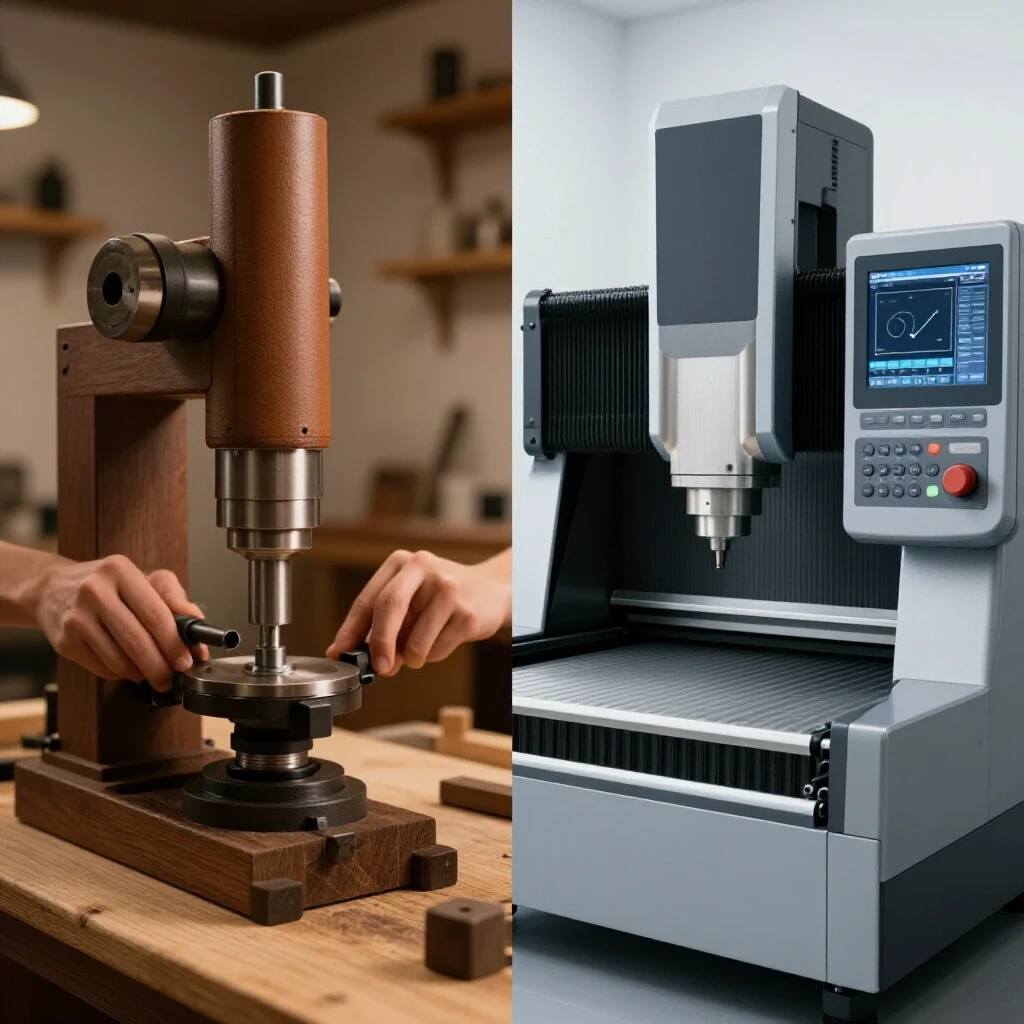
When you transition from a hobby to a side business, your perspective on equipment has to shift. You are no longer just buying a tool to make things; you are investing in a machine to generate a return. Whether you choose to move handles yourself or let a computer do the work, every second that machine runs must be accounted for in your pricing. If you cannot track your costs, you cannot sustain a business.
The Financial Foundation of Small Shop Milling
Establishing a solid financial base requires understanding that every hour spent in the shop has a literal price tag. This foundation involves calculating your total operating costs, including rent, utilities, and insurance, then dividing those by your billable hours to find a baseline. Without this number, you are simply guessing at your profitability.
Determining Your True Shop Hourly Rate
Your shop hourly rate is the total amount of money you must charge per hour to cover all expenses and provide a fair profit. It includes your personal wage, shop overhead, and a “buffer” for unexpected costs. For most small fabrication businesses, this rate typically falls between $65 and $120 per hour.
To find your rate, list every monthly expense you have, even the small ones. If your shop is in your garage, you still need to account for a portion of your mortgage or rent and the increased power bill. If you ignore these “hidden” costs, you are subsidizing your customers’ projects with your own personal income.
- Labor Rate: What would you have to pay someone else to do this work? (Example: $30/hr)
- Overhead Rate: Total monthly bills divided by billable hours. (Example: $15/hr)
- Profit Margin: The extra amount used to grow the business. (Example: 20% or $10/hr)
- Total Rate: The sum of these three factors. (Example: $55/hr minimum)
Factoring in Machine Amortization and Tooling Costs
Machine amortization is the process of spreading the cost of a piece of equipment over its expected useful life. Instead of viewing a $5,000 purchase as a one-time loss, you treat it as a recurring expense that each job must help pay back. This ensures you have funds to replace the machine when it wears out.
I typically use a five-year depreciation cycle for most shop equipment. If a machine costs $6,000 and you plan to use it for 1,000 hours a year, that machine costs you $1.20 for every hour it runs, just to pay for itself. Tooling, such as end mills and drills, should be tracked separately as consumables because they wear out much faster than the machine.
Evaluating Production Speed and Labor Burdens
Labor burden represents the total cost of an employee’s time, or your own, including the time spent not making chips. In a manual environment, you are the motor, which means your physical presence is required for every cut. In an automated setup, the labor burden changes from physical operation to digital preparation and monitoring.
The Hidden Costs of Manual Operation
Manual metal removal requires constant physical input, which limits your ability to perform other tasks while the machine is running. While the initial investment is often lower, the “cost of labor” is much higher because you cannot walk away to quote another job or pack a finished order. This lack of multitasking can create a bottleneck in a growing side business.
Interestingly, many shop owners forget to account for “fatigue error.” After four hours of turning handwheels, your precision often drops. A single ruined part on a manual machine can erase an entire day’s profit, especially if the material was expensive. This risk is a major hidden cost that rarely shows up on a spreadsheet until it is too late.
- Setup Time: Often faster on manual machines for simple, one-off parts.
- Operator Focus: Requires 100% of your attention during the cut.
- Versatility: Great for quick repairs or modifying existing parts.
- Scalability: Very difficult to increase output without hiring more people.
Programming and Setup Time in Automated Systems
Automated milling shifts the workload from the shop floor to the computer desk, requiring a different set of skills and time allocations. While the machine can run parts while you do other things, you must invest significant time upfront in digital planning and toolpath creation. This “front-loaded” time must be billed to the customer just like machine time.
For a single part, automated systems are often slower and more expensive due to this programming time. However, for a batch of ten or twenty parts, the efficiency grows rapidly. I have found that the “break-even point” where automation becomes more profitable than manual work usually occurs when you have to make more than three identical, complex components.
Pricing for Profitability in Small-Batch Fabrication
Accurate pricing is the difference between a successful business and an expensive hobby. You must account for every variable, from the raw material to the electricity used by the lights. Small shop owners often fail because they price based on what they “think” a job is worth rather than what it actually costs to produce.
Consumable Tracking and Material Markup
Consumables are items like coolants, lubricants, sandpaper, and cutting tools that are used up during a job. I recommend applying a 10% to 15% consumable burden to every quote to ensure these small costs don’t eat your profit. Material markup is an additional fee added to the cost of raw metal to cover the time spent sourcing and transporting it.
| Item Category | Typical Markup/Burden | Purpose |
|---|---|---|
| Raw Material | 20% – 35% | Covers ordering, pickup, and storage. |
| End Mills/Drills | 10% of Job Total | Replaces worn-out cutting edges. |
| Fluids/Coolant | 2% of Job Total | Covers evaporation and disposal. |
| Shipping/Freight | 10% – 15% | Covers packaging materials and drop-off time. |
Real-World ROI Timelines for Equipment Upgrades
Return on Investment (ROI) is a measurement of how long it takes for a machine to pay for itself through the profits it generates. To calculate this, you subtract the operating costs from the revenue generated by that specific machine. If a new machine saves you 10 hours a week at a $60/hr shop rate, it saves you $600 a week.
In my experience, a healthy ROI for a side-hustle machine is 18 to 24 months. If the math shows it will take five years to pay back the tool, you are likely buying more machine than your current client base can support. Always look at your existing order history before making a large purchase; don’t buy a machine for work you “hope” to get.
Strategic Decision Framework for Machine Upgrades
Deciding which direction to take your shop requires a cold, hard look at your current workflow and your long-term goals. If your work consists of simple brackets and repair work, the physical control of a manual machine is often superior. If you are designing custom products or doing repeat production, the consistency of a computer-controlled system is vital.
When to Fabricate In-House vs. Outsource
Sometimes the most profitable decision is to not do the work yourself. If a job requires a level of precision or a speed that your current equipment cannot handle efficiently, outsourcing to a larger shop can save your margins. You can still charge a “management fee” or markup on the outsourced parts without the stress of running the machine.
- Analyze the Complexity: Does the part require complex curves or high repeatability?
- Check the Capacity: Is your shop already backed up with higher-paying work?
- Compare the Cost: Will an outside shop’s price plus your markup be cheaper than your own labor?
- Evaluate the Risk: If you break a tool or ruin the material, can your budget handle the hit?
Practical Tools for Shop Management
Managing the numbers is easier when you use the right digital tools to track your progress. You don’t need expensive enterprise software; a few simple apps and spreadsheets can keep your shop in the black.
- QuickBooks or FreshBooks: Essential for professional invoicing and tracking tax-deductible expenses.
- Excel or Google Sheets: Build a custom “Job Estimator” that totals your material, labor, and overhead automatically.
- Toggl Track: A simple, free timer to track exactly how long you spend on each phase of a project.
- Inventory Log: A basic list of your current metal stock so you don’t over-order for new jobs.
Conclusion: Making the Final Call
Choosing between manual and automated milling is not about which machine is “better” in a vacuum. It is about which machine fits your specific business model and your financial goals. If you enjoy the tactile process and handle mostly repair or one-off jobs, the lower overhead of a manual machine is a safe, profitable bet. If you want to scale your production and step away from the handles to focus on business growth, automation is the path forward.
Whichever path you choose, remember that the math doesn’t lie. Track your time, account for your overhead, and never be afraid to charge what your skills are worth. A well-managed shop is a profitable shop, regardless of how the spindles turn.
Frequently Asked Questions
How do I know if I’m ready for a CNC mill? You are ready when you have repeat orders for the same part or when your manual labor time is preventing you from taking on more work. If you spend more than 10 hours a week doing repetitive manual tasks, the time saved by automation will likely cover the monthly payment of a machine.
What is the biggest hidden cost in a small machine shop? Electricity and climate control are often underestimated. Running a high-horsepower spindle and a phase converter can significantly spike a residential power bill. Additionally, maintaining a rust-free environment through heating or dehumidification is a constant, year-round expense.
Should I charge customers for programming time? Yes, absolutely. Programming is a highly skilled task that takes time away from other billable work. Most shops charge their standard hourly rate for programming, though some offer a slightly lower “bench rate” for office work.
How much should I mark up raw materials? A standard markup is 20% to 35%. This covers the time you spend researching prices, driving to the metal yard, and the risk of the material being damaged during the fabrication process. Never sell material at your cost.
Is it better to buy a used manual mill or a new entry-level CNC? A used manual mill often holds its value better and has lower depreciation. However, a new entry-level CNC comes with a warranty and modern features. If your business depends on “up-time,” the reliability of a newer machine often outweighs the cost savings of a used one.
How do I calculate my “Shop Burden” percentage? Add up all annual non-material costs (rent, power, insurance, tool replacement). Divide that by the total number of hours you worked in the shop. If your costs are $10,000 and you worked 1,000 hours, your burden is $10 per hour.
What is the “scrap factor” in job bidding? The scrap factor is an extra 3% to 5% added to your material estimate to account for mistakes or “drops” (leftover pieces that are too small to use). This ensures that a single mistake doesn’t turn a profitable job into a loss.
Can I run a CNC mill on a standard 110v home circuit? Some smaller, “benchtop” mills can, but most professional-grade machines require 220v single-phase or three-phase power. Upgrading your shop’s electrical panel is a significant upfront cost that must be factored into your ROI calculation.
How often should I update my shop hourly rate? You should review your rate at least once a year or whenever a major expense changes, such as a rent increase or a significant rise in utility costs. In times of high inflation, checking every six months is safer.
What is the best way to track consumable usage? Keep a simple logbook or spreadsheet near your tooling cabinet. Every time you open a new pack of end mills or a gallon of coolant, mark it down. At the end of the month, compare these costs to your total revenue to see if your 10% burden is accurate.
(This article was written by one of our staff writers, Michael Hargrove. Visit our Meet the Team page to learn more about the author and their expertise.)