How to Divide a Garage Workshop into Clean Zones (DIY Guide)
When I first moved my fabrication work into a garage two decades ago, I thought I could just roll machines in and start cutting. I quickly learned that a single grinding spark can travel twenty feet and land right on a sensitive CNC controller. That one mistake cost me a week of downtime and a few hundred dollars in replacement boards. Over the years, I have shifted my focus from just having the right tools to mastering the physical flow of the shop. Scaling a home-based business means moving away from a cluttered hobby space and toward a layout that respects the physics of manufacturing.
The stress of scaling often comes from the feeling that you have run out of room. In reality, most advanced fabricators have enough space; they just have a layout that fights them. When you mix heavy welding fumes with precision electronics or allow metal shavings to migrate into your assembly area, you create bottlenecks. My goal is to help you reorganize your workspace into functional cells that protect your equipment and your health.
Mapping Workflow Paths to Eliminate Production Bottlenecks
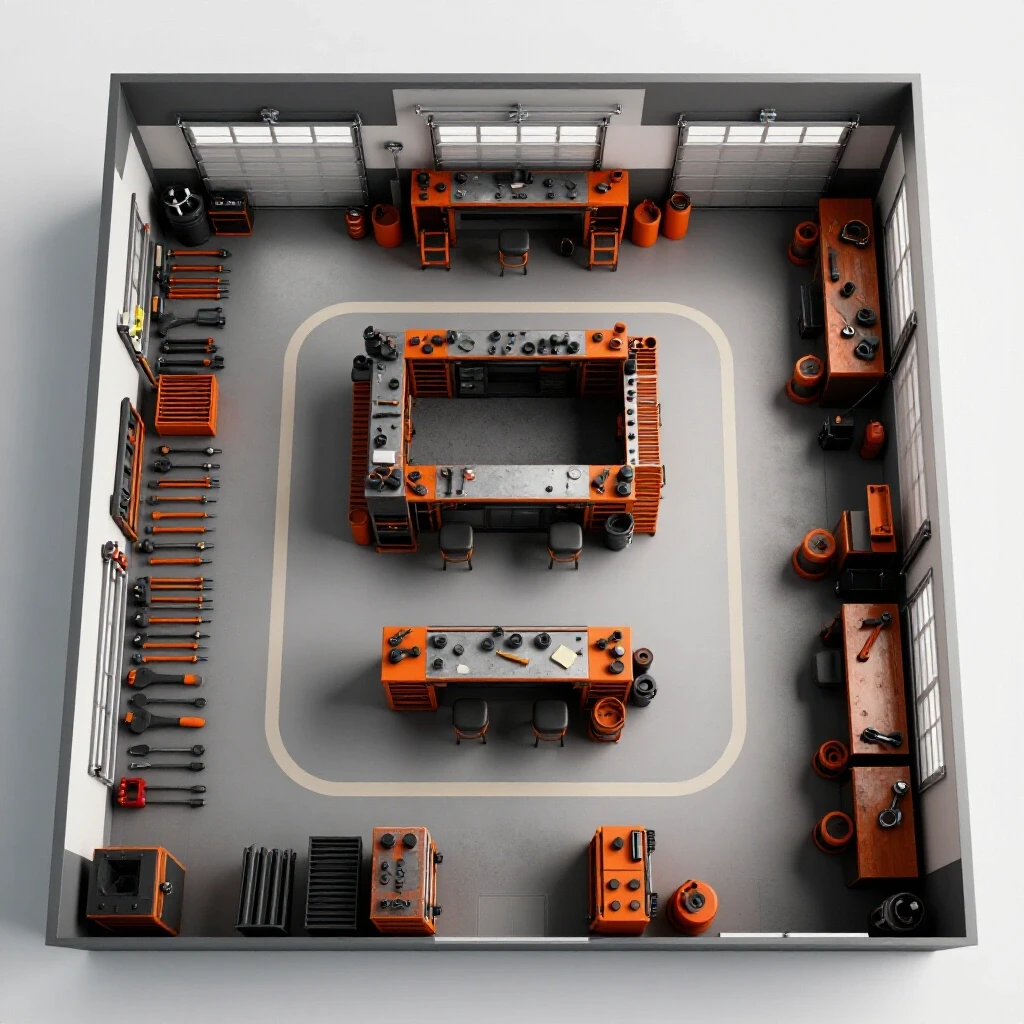
Workflow mapping is the process of drawing the physical path a piece of material takes from the moment it enters your shop until it leaves as a finished product. In lean manufacturing, we often use a “spaghetti diagram” to visualize this. If your drawing looks like a tangled mess of lines, your shop is inefficient. You are likely wasting time and energy moving heavy steel back and forth across the same floor space.
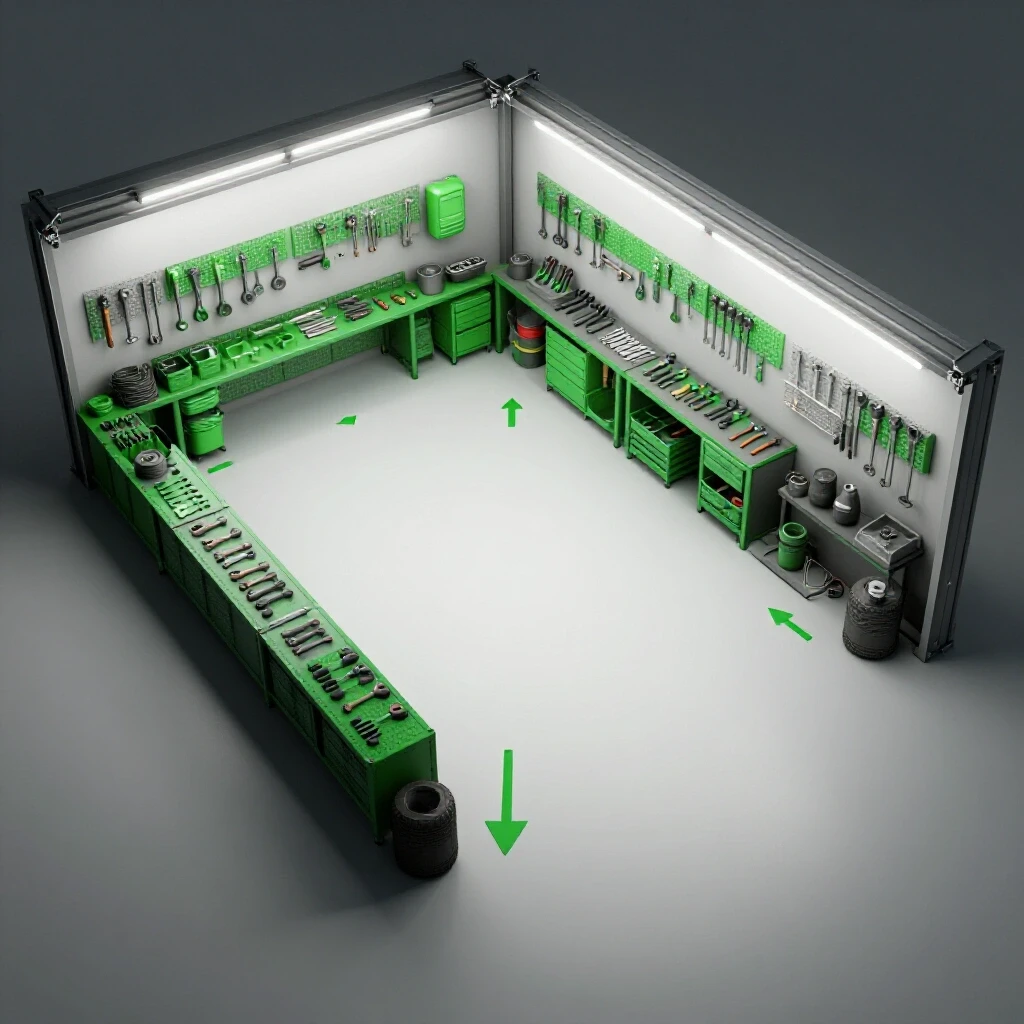
To fix this, you need to establish a linear or U-shaped flow. In a linear flow, raw material enters at one end, moves through cutting and welding, and exits through finishing. In a U-shape, the entrance and exit are near each other, which works well for smaller garage footprints. The key is to ensure that “dirty” processes, like abrasive grinding, never cross paths with “clean” processes, like final inspection or CAD design.
- Raw Material Storage: Place heavy racks near the largest door to minimize lifting.
- The Cutting Station: Keep your horizontal bandsaw or cold saw within five feet of the material rack.
- The Hot Zone: Group your welding table and plasma cutter together to centralize fume extraction.
- The Precision Zone: Place your CNC mill or lathe as far from the welding area as possible.
- The Finishing Station: Use a dedicated corner for painting or coating to prevent overspray from hitting machines.
| Layout Type | Best For | Primary Benefit | Main Drawback |
|---|---|---|---|
| Linear Flow | Long, narrow shops | Minimal material handling | Requires two exit points |
| U-Shaped Flow | Standard garages | Centralized loading/unloading | Can become crowded in the center |
| Cell-Based | High-variety shops | Maximum flexibility | Harder to manage dust spread |
Creating Physical Barriers to Control Grinding Debris and Sparks
Physical barriers are the most effective way to prevent cross-contamination between different types of metalwork. In a small shop, permanent walls are often too restrictive. I prefer using modular, movable partitions that can be adjusted based on the size of the project. These barriers serve two purposes: they stop high-velocity sparks from reaching flammable materials and they contain fine metal dust within a specific “dirty” zone.
Heavy-duty welding curtains are a staple in my shop. I use 14-mil flame-resistant PVC curtains mounted on rolling tracks or portable frames. These allow me to seal off a welding cell in seconds. For more permanent separation, you can build “pony walls” from steel studs and sheet metal. These walls only need to be four feet high to stop most floor-level debris, while still allowing light and air to move through the upper half of the garage.
- Transparent Curtains: Use amber or dark green tints to protect bystanders from “arc flash,” which is eye damage caused by UV light from welding.
- Mobile Screens: Build frames from 1-inch square tubing with heavy-duty casters to create temporary “grinding booths.”
- Floor Sweeps: Attach rubber gaskets to the bottom of your barriers to prevent metal chips from sliding underneath.
High-Volume Air Quality Management and Fume Extraction
Air quality management is about more than just a box fan in the window. You need to understand CFM, or Cubic Feet per Minute, which measures the volume of air a fan can move. For a standard two-car garage, you should aim to exchange the entire volume of air at least 6 to 8 times per hour. However, the real secret is source capture. This means catching the fumes or dust at the exact point where they are created before they can drift into your clean zones.
I use a two-stage approach. First, I have a high-volume ambient air cleaner hanging from the ceiling to catch fine particles that escape. Second, I use a localized “fume arm” or a downdraft table for welding and grinding. A downdraft table works by pulling air through a perforated work surface, sucking sparks and dust into a filtration bin. This keeps the air clear and prevents the “black nose” syndrome many fabricators face after a long day of grinding.
- Source Capture: Aim for at least 500 to 800 CFM at the tool for effective dust removal.
- Ambient Filtration: Look for units with MERV 11 to MERV 15 filters to catch sub-micron particles.
- Static Pressure: This is the resistance air faces in your ductwork. Use smooth-walled metal ducts instead of flexible ribbed hoses to keep your airflow high.
Optimizing 3-Phase Power Delivery for Heavy Machinery
Most residential garages only have single-phase power, but professional-grade CNC machines and large compressors often require 3-phase power. 3-phase power uses three alternating currents to provide more consistent torque and efficiency for large motors. Since you likely cannot get a 3-phase utility drop at home, you have to create it yourself.
I have found that a Rotary Phase Converter (RPC) is the most reliable DIY solution for a scaling shop. An RPC uses a single-phase motor to spin a 3-phase “idler” motor, which then generates the third leg of power. It is a robust system that can handle the high “inrush” current when a big machine starts up. Alternatively, for single machines like a lathe or mill, you can use a Variable Frequency Drive (VFD). A VFD converts power and allows you to control the speed of the motor, which is a massive upgrade for older manual tools.
- Rotary Phase Converters: Best for running multiple machines or machines with high starting loads.
- Variable Frequency Drives: Best for single-motor speed control; however, they can be sensitive to electrical noise.
- Phase Balancing: You must check the voltage between all three legs. If one leg is significantly higher or lower, it can overheat your motors. Aim for a balance within 5%.
| Converter Type | Cost | Complexity | Best Use Case |
|---|---|---|---|
| Static Converter | Low | Simple | Light-duty motors, low torque |
| Rotary (RPC) | Medium | Moderate | Multiple machines, high torque |
| VFD | Low-Medium | High | Precision speed control, single tool |
Integrating CNC Plasma and Gantry Systems into the Layout
Adding a CNC plasma table is a turning point for any fabrication shop, but it introduces a new set of problems: water, fire, and electromagnetic interference (EMI). A plasma cutter creates a “noisy” electrical environment that can crash your computer or cause the gantry to move erratically. To prevent this, you must treat the CNC area as a distinct zone with its own grounding and shielding.
When I installed my first 4×8 table, I made the mistake of putting the control PC right next to the water tray. The humidity and the “splash” from the torch eventually corroded the ports. Now, I keep the electronics in a pressurized cabinet. A small fan with a filter blows air into the cabinet, creating positive pressure so that dust cannot get inside. I also use shielded cables for all stepper or servo motors to block out EMI from the plasma power source.
- Machine Spacing: Maintain a 3-foot clearance around at least three sides of the CNC table for maintenance and material loading.
- Grounding: Drive a dedicated 8-foot copper ground rod into the earth specifically for the CNC table to bleed off electrical noise.
- Slat Maintenance: Design a routine to flip or replace your table slats every 50 to 100 hours of cutting to maintain accuracy.
Floor Treatments and Visual Zoning for Safety
The floor is the most overlooked part of a workshop layout. In an advanced shop, the floor should tell you where it is safe to walk and where you are entering a “hazard zone.” I use industrial-grade epoxy with a non-slip additive in my assembly areas, but I leave the welding area as bare, polished concrete. Epoxy can peel or burn if hot slag or heavy steel plates are dropped on it constantly.
Visual zoning involves using floor tape or paint to mark out “keep clear” areas. For example, I mark a yellow box around the swing radius of my jib crane and a red box around the electrical panels. This ensures that even when the shop gets busy, I never have to move a pile of scrap just to reset a breaker.
- Load Ratings: Standard garage floors are 4 inches thick. If you are installing a machine over 3,000 lbs, you may need to cut out a section and pour a thicker reinforced pad.
- Anti-Fatigue Mats: Use these only in “clean” assembly zones. In welding zones, they are a fire hazard and trap metal chips.
- Leveling: Use high-quality leveling feet on all CNC equipment. A table that is out of level by even 1/16th of an inch can cause issues with water tray levels and torch height control.
Software Integration and Digital Workflow Management
As you move toward a semi-professional operation, how you manage your data becomes as important as how you manage your steel. A digital workflow starts with CAD (Computer-Aided Design) and moves to CAM (Computer-Aided Manufacturing). I recommend using cloud-based systems so you can design in the “clean” office area and pull the files up on a ruggedized tablet at the machine.
One of the biggest hurdles is the learning curve of “post-processors.” This is the software bridge that turns your drawing into G-code that your specific machine understands. I keep a digital log of “proven” tool paths. When I find the perfect feed rate and voltage for 3/16-inch plate, I save that as a template. This eliminates the “test and fail” cycle that wastes material.
- CAD Design: Use software like Fusion 360 or SolidWorks to create 3D models.
- CAM Nesting: Use nesting software to fit as many parts as possible onto a single sheet of metal to reduce waste.
- Simulation: Always run a “dry run” or software simulation to check for gantry collisions before firing the torch.
- Version Control: Never overwrite your original files. Use a naming convention like “Part_A_V1_Date” to track changes.
Maintaining the Divided Workspace for Long-Term Efficiency
A shop layout is not a “set it and forget it” project. It is a living system. Every six months, I perform a “flow audit.” I look for areas where dust has accumulated or where I find myself walking too far to grab a tool. If I see a path worn into the concrete, I know I have a bottleneck.
Maintenance also applies to your air systems. A clogged filter in your dust collector doesn’t just work poorly; it increases the “static pressure” and can cause the motor to overheat. I keep a simple logbook next to my main air scrubber. Every 100 hours of shop time, the filters get blown out or replaced. This discipline is what separates a professional facility from a hobbyist garage.
- Weekly Deep Clean: Spend the last hour of every Friday blowing down the “clean” zones and vacuuming the “dirty” zones.
- Tool Shadow Boards: Use foam cutouts or silhouettes on your walls so you instantly know if a tool is missing from its zone.
- Scrap Management: Have dedicated bins for steel, aluminum, and stainless. Mixing these can ruin the value of your scrap and cause cross-contamination during welding.
Frequently Asked Questions
How do I prevent grinding dust from ruining my computer electronics? The best DIY method is to use a positive-pressure enclosure. Place your computer or CNC controller inside a cabinet and use a small fan to pull air through a high-quality filter into the box. This creates a higher air pressure inside the cabinet than outside, which physically pushes dust away from the openings.
Is a 3-phase converter safe for a residential garage? Yes, provided it is sized correctly and installed with proper over-current protection (fuses or breakers). A Rotary Phase Converter is generally safer for DIYers than trying to “hack” a motor because it is a self-contained unit designed for this purpose. Always follow the NEC guidelines for wire sizing and grounding.
How much CFM do I really need for a DIY fume extractor? For a single welding station, 500 to 800 CFM is usually enough if the intake is within 12 inches of the arc. If you are trying to clear the air in the whole room, you need to calculate the total volume of your shop (Length x Width x Height) and multiply it by the number of air changes per hour you want (aim for 6 to 8).
Can I use a standard shop vac for my CNC table dust collection? No. Shop vacs are designed for high suction but low volume. For metal dust and fumes, you need high volume (CFM) to move large clouds of particles. A shop vac will clog quickly and lacks the filtration needed for fine metal dust.
What is the best way to separate a welding area without building a wall? Use heavy-duty, flame-resistant welding curtains on a sliding track. This gives you the flexibility to open the space up for large projects while providing a solid UV and spark barrier during normal operation.
How do I stop my CNC plasma from interfering with my shop’s Wi-Fi or electronics? This is caused by Electromagnetic Interference (EMI). You can reduce it by using a “star grounding” system where every component of the CNC table connects to a single ground point. Also, ensure your plasma lead and your computer cables do not run parallel to each other.
Why is my rotary phase converter making a loud humming noise? A loud hum usually indicates a phase imbalance or a loose mounting. Check the voltages between the legs while the converter is running. If the voltages are more than 10% apart, you may need to adjust the capacitors in the control box.
How often should I clean my shop’s air filters? In a high-output shop, you should check your primary filters once a month. If you are doing heavy grinding or plasma cutting, you may need to clean or replace them every 50 to 100 hours of operation.
What is the “3-foot rule” in shop layout? The 3-foot rule suggests leaving at least 36 inches of clear space around any major piece of machinery. This provides enough room for safe operation, maintenance access, and an emergency egress path if something goes wrong.
Is it worth it to paint my garage floor? For a metal fabrication shop, a high-quality epoxy is great for “clean” zones like assembly or shipping. However, in “dirty” zones where you are welding or dropping heavy steel, bare polished concrete is more durable and easier to maintain long-term.
How do I manage long pieces of raw material in a small garage? Use “in-feed” and “out-feed” rollers that are the same height as your saw. You can also install a small “material port” (a small door or flap) in your garage wall to allow long sticks of steel to poke outside temporarily while you cut them.
What is the difference between a stepper motor and a servo motor for CNC? Stepper motors move in fixed “steps” and are cheaper but can lose their position if they hit an obstacle. Servo motors use “closed-loop” feedback to constantly check their position, making them more accurate and faster, but they are more expensive and complex to set up.
(This article was written by one of our staff writers, Edward Sinclair. Visit our Meet the Team page to learn more about the author and their expertise.)