When to Replace Consumable Welding Nozzles and Tips (DIY Fix)
When I first started taking on paid fabrication work in my small shop, I focused almost entirely on the cost of steel. I would look at a project, calculate the linear feet of tubing required, and add a small margin for my time. I quickly learned that this was a recipe for a hobby that cost me money rather than a side-hustle that earned it. The “hidden” costs, like the electricity running the compressor or the box of contact tips I went through on a heavy trailer build, were eating my lunch.
Over 16 years in the metalworking industry, I have realized that the difference between a struggling shop and a profitable one is often found in the “shop math.” It is about understanding that every minute the welder is running, you are consuming more than just wire and gas. You are wearing down your equipment and using up small, essential parts that must be accounted for in your pricing. If you do not track these items, you are essentially paying your customers to let you work for them.
Establishing a True Shop Rate for Small Fabrication Businesses
Setting a true hourly rate requires more than picking a number out of the air. You must account for your mortgage or rent, electricity, insurance, and the time you spend on non-welding tasks. This baseline ensures your side business pays for itself before you even strike an arc.
To find your shop rate, you need to look at your total overhead for the year. This includes everything from your business license and insurance to the heating bill for the shop. If your annual overhead is $6,000 and you plan to work 500 billable hours a year as a side-hustle, your overhead cost is $12 per hour. This does not include your take-home pay or the cost of materials.
Most small shops I consult with aim for a shop rate between $65 and $120 per hour. If you are just starting, you might be tempted to charge $30 an hour because it feels like “good money” compared to a day job. However, once you factor in the wear and tear on your tools and the self-employment taxes, you might find you are making less than minimum wage.
Factoring in Machinery Amortization and Tool ROI
Spreading equipment costs over their useful life ensures the business can afford future upgrades or replacements when tools eventually fail. This accounting practice, known as amortization, prevents a sudden $2,000 equipment failure from wiping out a whole year of profits.
If you buy a high-quality MIG welder for $2,500 and expect it to last five years, it costs the business $500 per year, or about $1 per billable hour if you work 500 hours a year. I recommend creating a simple spreadsheet to track every major tool.
| Equipment Item | Purchase Price | Expected Life (Years) | Annual Cost | Hourly “Rental” Rate |
|---|---|---|---|---|
| MIG Welder | $2,500 | 5 | $500 | $1.00 |
| Ironworker/Press | $4,000 | 10 | $400 | $0.80 |
| Chop Saw | $500 | 2 | $250 | $0.50 |
| Hand Grinders (4) | $400 | 1 | $400 | $0.80 |
| Total Tool Burden | $7,400 | — | $1,550 | $3.10 |
This $3.10 per hour must be added to your shop rate. It is the “rent” your business pays to itself to ensure that when the chop saw dies, the money to replace it is already in the bank.
Why Hidden Consumable Costs Can Erode Your Profit Margins
Small torch components are often overlooked during the bidding process, leading to “profit bleed.” While a single tip is inexpensive, the cumulative cost of nozzles, tips, and liners adds up over a month of production. Tracking these items allows you to apply a realistic burden to every quote.
In a MIG setup, the contact tip and the gas nozzle are the front-line soldiers. They take the brunt of the heat and the spatter. If you are welding dirty or galvanized steel, these parts degrade even faster. I have seen side-hustlers lose 5% of their project margin simply because they didn’t realize they would need to swap out three contact tips and a nozzle during a long production run.
To account for this, I use a “Consumable Burden Factor.” This is a percentage added to the labor or material cost to cover the small things you don’t want to count individually, like wire, shielding gas, and torch parts. For most general fabrication, a 10% to 15% burden on top of the material cost is a safe starting point.
Identifying Wear and Performance Issues in MIG Torch Components
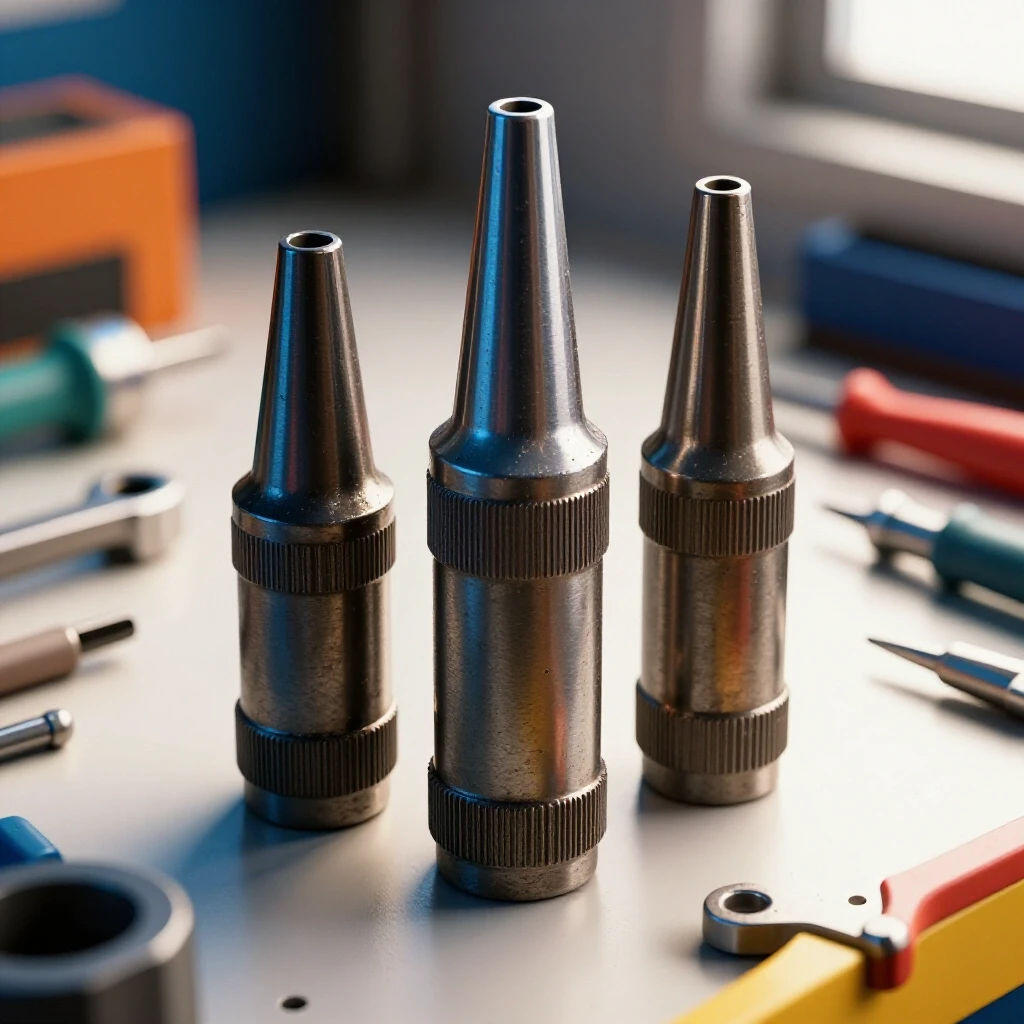
Recognizing when heat and spatter have compromised a tip or nozzle is essential for maintaining weld quality and reducing rework time. Heat and spatter eventually deform these parts, leading to poor gas coverage or wire feeding issues. Replacing them at the right time prevents expensive rework.
When the orifice of a contact tip becomes oval-shaped or “egged out” due to the wire rubbing against it, the electrical contact becomes inconsistent. This leads to an unstable arc and increased spatter. Similarly, if the gas nozzle is clogged with “berries” (spatter), the shielding gas won’t flow smoothly. This causes porosity—tiny holes in your weld—that can force you to grind the whole thing out and start over.
- Visual Check: Look for a build-up of metal inside the nozzle. If it’s more than 25% obstructed, it’s time for a clean or a swap.
- Physical Check: If the wire wiggles excessively inside the contact tip, the hole is worn out.
- Performance Check: If you notice your arc “stuttering” even though your settings are correct, the tip is likely the culprit.
Most hobbyists wait too long to change these parts. In a professional side-hustle, your time is your most valuable asset. If a $2 contact tip saves you 20 minutes of grinding, it is the best investment you can make.
Creating a Reliable Job Costing Model for Metalworking Side-Hustles
A successful bid combines material costs, labor, and a markup for overhead and profit. By using a standardized model, you can avoid the “guessing game” that leads to underpricing. This approach ensures that every project contributes to your shop’s long-term growth and covers all operational expenses.
When I quote a job, I use a “bottom-up” approach. I start with the raw materials, add a markup for sourcing and handling (usually 20-30%), and then add my labor at the shop rate we calculated earlier.
- Raw Materials: Steel, hardware, paint.
- Material Markup: 25% (to cover the time spent at the steel yard).
- Labor: Estimated hours x Shop Rate.
- Consumables: 10% of the material total.
- Profit Margin: 10-20% (this is the money that stays in the business for growth).
Implementing a Consumable Tracking System for Accurate Bidding
Recording the lifespan of torch components helps fabricators predict exactly when they will need to buy new supplies. This data-driven approach removes the guesswork from your inventory management and ensures you always have the parts you need on hand for a big project.
I recommend keeping a simple logbook or a digital note on your phone. Note down when you start a fresh spool of wire and when you put on a new nozzle. Over time, you will see a pattern. For example, you might find that you average 15 hours of arc time per nozzle and 5 hours per contact tip.
Knowing these numbers allows you to bid more accurately. If a job requires 10 hours of welding, you know you need to factor in at least two tips and half the life of a nozzle into that specific job’s cost.
Strategic Sourcing and Inventory Management for Small Shops
Buying supplies one at a time is a fast way to lose money through high unit prices and travel time. Strategic inventory management involves purchasing common items in bulk to reduce the cost per unit. This practice stabilizes your margins and ensures you never have to pause a job.
The “hidden cost” of a $5 trip to the welding supply store is the hour of your time it takes to get there and back. If your shop rate is $80/hour, that contact tip just cost you $85. I always buy my consumables in bulk packs of 10 or 25.
- Bulk Buying: Purchasing 25 tips at once can drop the price per unit by 30-40% compared to buying a 2-pack.
- Standardization: If possible, use the same torch style across multiple machines so you only have to stock one type of nozzle and tip.
- Online Sourcing: Use reputable industrial suppliers rather than big-box stores. The quality is higher, and the prices are usually better when buying in volume.
Post-Job Profit Analysis and Budget Reconciliation
Real growth happens when you compare your estimated costs against what you actually spent. Reviewing the hours worked and the supplies used helps you refine future bids. This reconciliation process is the only way to confirm if your shop rate and material markups are actually generating a profit.
After every major project, I sit down for 15 minutes and look at the numbers. Did I estimate 10 hours but take 14? Why? Was it because I spent two hours cleaning a clogged nozzle or fighting an erratic arc from a worn-out tip?
If you find that you are consistently using more supplies than you quoted, you have two choices: increase your consumable burden percentage or improve your shop’s efficiency. Perhaps a higher-quality anti-spatter spray would extend the life of your nozzles, or maybe you need to be more aggressive about cleaning the steel before you weld.
Practical Benchmarks for Shop Performance
- Consumable Cost Ratio: Should stay between 2% and 5% of your total gross revenue.
- Material Markup: Never go below 20%. You are a shop owner, not a non-profit steel delivery service.
- Rework Rate: Aim for less than 1% of total hours. If you are spending more time grinding than welding, check your torch components.
By treating your shop as a business rather than a hobby, you move from “hoping for a profit” to “planning for a profit.” The small details, like the condition of your welding torch parts, are the indicators of how much you respect your own time and your bottom line.
Frequently Asked Questions
How do I know if a contact tip is causing my wire to “stutter”? If the wire feels like it is vibrating or catching as it leaves the torch, and you have already checked your drive roll tension, the tip is likely worn. An enlarged orifice allows the wire to wander, which disrupts the electrical connection and causes the arc to hunt, resulting in a “stuttering” feel.
Can I just clean a gas nozzle instead of replacing it? Yes, to a point. You can use a pair of welper pliers or a dedicated nozzle reamer to scrape out spatter. However, once the nozzle is physically deformed from heat or the interior coating is gone, spatter will stick much faster. If you find yourself cleaning it every five minutes, it is costing you more in labor than a new nozzle would.
What is the “DIY fix” for a nozzle that is stuck on the torch? Heat causes metal to expand, and spatter can “weld” a nozzle to the gas diffuser. Use a pair of pliers to gently twist the nozzle back and forth while the torch is cool. If it is still stuck, a small amount of penetrating oil can help, but ensure you clean it off completely before welding again to avoid fire hazards and weld contamination.
Is it worth buying “heavy-duty” tips for a small side-hustle? Usually, yes. Heavy-duty tips are often longer or made of harder copper alloys that resist heat better. While they might cost 50% more, they often last twice as long, especially if you are doing long continuous welds on thicker plate.
How does a worn tip affect my shielding gas usage? While the tip itself doesn’t control gas, a worn tip causes more spatter. That spatter builds up inside the nozzle, which then disrupts the “laminar” (smooth) flow of gas. When gas flow is turbulent, it draws in outside air, causing porosity. You might be tempted to turn up your gas flow to compensate, which wastes expensive shielding gas.
Should I charge the customer for every tip I use? Not as a line item. Customers don’t want to see “3 contact tips – $6.00” on an invoice. Instead, include these in your “Shop Supplies” or “Consumable Burden” fee, which is a standard percentage added to the materials or labor.
What is the most common mistake when replacing torch parts? The most common mistake is not tightening the contact tip enough or over-tightening it. It should be snug enough to ensure good electrical contact but not so tight that you strip the threads on the gas diffuser. A loose tip will overheat and fail almost instantly.
How often should I replace the liner inside the torch lead? Liners don’t need to be changed as often as tips, but they are a consumable. If you change your tip and nozzle and still have feeding issues, the liner is likely clogged with dust or metal shavings. For a part-time shop, changing the liner once a year or every 50-100 lbs of wire is a good rule of thumb.
Does using anti-spatter spray actually save money? Yes. A $10 can of anti-spatter spray can extend the life of your nozzles significantly and reduce the time you spend cleaning them. In a shop where your time is billed at $80/hour, saving 15 minutes of cleaning time pays for the can of spray twice over.
How do I track these small costs without spending hours on bookkeeping? Use a “bin system.” When you open the last bag of tips in your drawer, that is your trigger to order more. For job costing, just use a flat percentage (like 10% of material cost) unless the job is exceptionally heavy on welding, in which case you might bump it to 15%.
(This article was written by one of our staff writers, Michael Hargrove. Visit our Meet the Team page to learn more about the author and their expertise.)