Cheap vs Expensive Welding Safety Gear: What is Safer? (Fix)
I remember sitting in my first 400-square-foot shop, staring at a stack of invoices and a pair of scorched leather gloves. I had just finished a railing project that I thought would be a big win. But after I subtracted the material costs and the gas refills, the profit was almost invisible. I realized then that I wasn’t just a fabricator; I was a business owner who didn’t understand his own overhead. One of the biggest leaks in my bucket was how I viewed safety equipment. I treated it as a nuisance expense rather than a strategic investment.
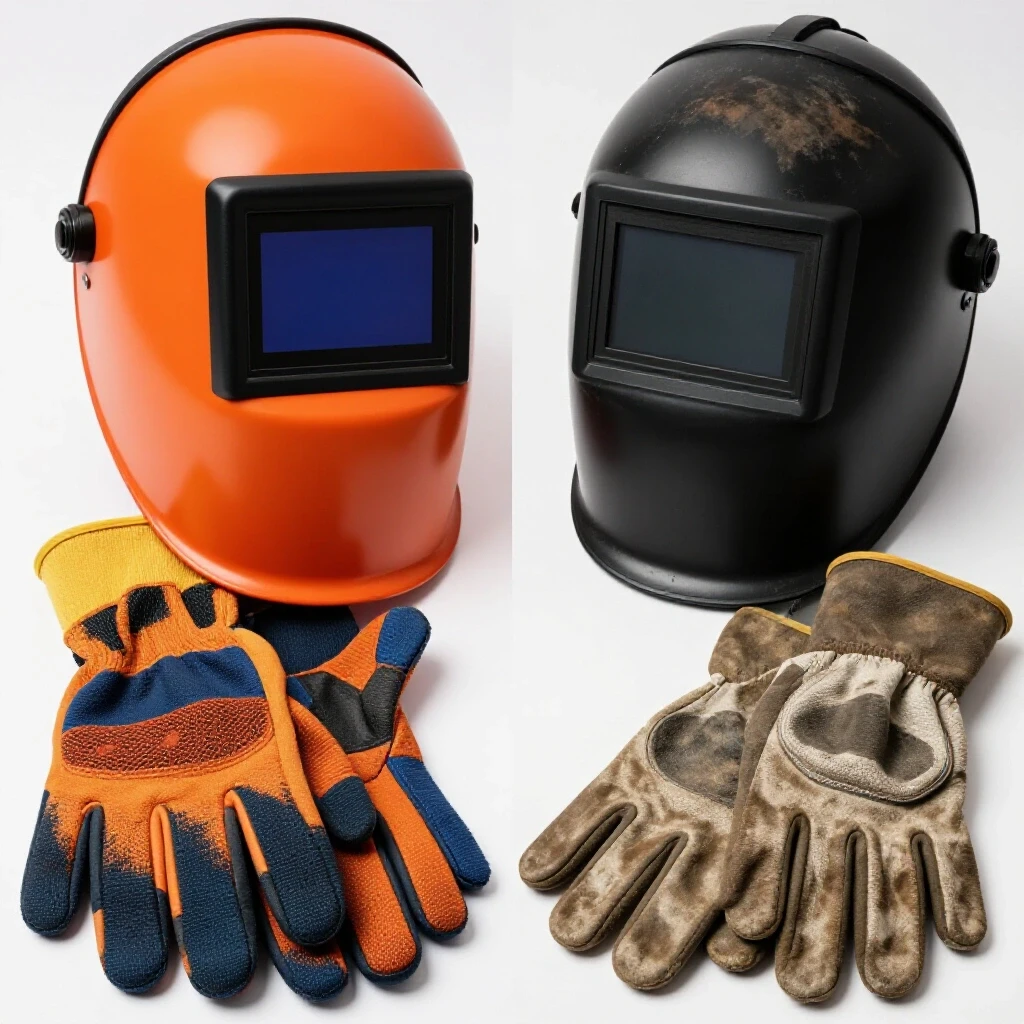
Transitioning from a hobbyist to a professional side-hustler means moving away from “what can I afford today” to “what makes me the most money over the next three years.” In the world of metalworking, your personal protective equipment (PPE) is both a line item on your balance sheet and your primary insurance policy against downtime. If you are managing a small workshop budget, you have likely wondered if a $500 welding helmet is actually safer than a $60 one, or if you are just paying for a brand name.
The reality is that both can be safe, but only one might be profitable. Safety is defined by strict industry standards, but business success is defined by how those standards affect your productivity and long-term health. In this guide, we will break down the financial realities of workshop protection, how to factor these costs into your fabrication job costing, and how to determine the true return on investment for the gear that keeps you in the booth.
Establishing the Economic Foundation of Workshop Safety
A true shop rate is the total hourly cost of keeping your doors open, including rent, utilities, insurance, and equipment wear, plus your desired profit margin.
When you start side-hustle metalworking, you might pick a number like $40 an hour because it sounds better than a retail job. However, most professional small shops need to target a rate between $65 and $120 per hour to remain sustainable. A significant portion of that rate is your “overhead burden.” This includes the safety gear you wear every day. If you buy a cheap welding jacket that falls apart in a month, your overhead per hour increases because you are replacing assets more frequently.
To calculate your shop rate accurately, you must track every penny. I recommend using a simple spreadsheet to list your annual fixed costs. Divide that total by the number of billable hours you realistically work in a year. If you work 10 hours a week on your side business, that is roughly 500 hours a year. If your fixed costs are $5,000, your overhead is already $10 per hour before you even strike an arc.
- Fixed Overhead: Rent, insurance, and annual certifications.
- Variable Overhead: Electricity, grinding wheels, and PPE replacement.
- Labor Rate: What you pay yourself for the actual fabrication time.
- Profit Margin: The extra 10-20% you tack on to grow the business.
Why PPE is a Consumable Burden in Small Metal Shop Pricing
A consumable burden is the percentage of a project’s cost attributed to items that get used up, like welding wire, shielding gas, and safety gear.
Many shop owners forget that gloves, clear plastic lens covers, and earplugs are consumables. They aren’t one-time purchases. In my experience, a high-volume shop might go through a pair of TIG gloves every two weeks. If those gloves cost $25, and you don’t factor them into your small metal shop pricing, you are essentially paying $1.25 per hour just to protect your hands. Over a year, these “small” costs can eat thousands of dollars in potential profit if they aren’t tracked and billed correctly.
Analyzing the ROI of Entry-Level vs. Premium Protection
Return on Investment (ROI) in a workshop context is a calculation of how much money a tool or piece of gear saves you over its lifespan compared to its initial cost.
When comparing a budget-friendly auto-darkening helmet to a high-end professional model, the safety floor is usually the same. Both must meet ANSI Z87.1 standards to be sold as safety eye protection in the United States. This means both will block harmful UV and IR radiation. The “fix” for your budget isn’t necessarily about buying the most expensive item; it is about buying the item that offers the best ROI through durability and clarity.
A $60 helmet might have two sensors and a slightly greenish tint. A $450 helmet might have four sensors, a “true color” lens, and a larger viewing area. If the expensive helmet allows you to see the puddle more clearly, you will make fewer mistakes. Fewer mistakes mean less time spent grinding out bad welds. If you save just 10 minutes of rework per week at a $75/hour shop rate, the expensive helmet pays for itself in less than a year.
Tool ROI Timelines for Safety Equipment
| Equipment Type | Entry-Level Cost | Premium Cost | Expected Lifespan (Pro Use) | Annual Cost (Premium) |
|---|---|---|---|---|
| Welding Helmet | $60 | $450 | 4 Years | $112.50 |
| Leather Jacket | $40 | $180 | 3 Years | $60.00 |
| Respirator System | $30 (Disposable) | $1,200 (PAPR) | 5 Years | $240.00 |
| Welding Gloves | $12 | $35 | 1 Month | $420.00 |
Building on this data, you can see that premium gloves are actually one of the most expensive items to maintain. Interestingly, the high-end helmet often has a lower annual cost than the gloves because it is a long-term asset that can be depreciated over several years.
Calculating the Hidden Costs of Inadequate Gear
Hidden costs are expenses that do not appear on a receipt, such as the cost of physical fatigue, eye strain, or the long-term health risks of breathing metal fumes.
I once worked a three-week production job wearing a heavy, unbalanced budget helmet. By the end of the second week, my neck was so sore I had to slow down my pace. My productivity dropped by 20%. In a shop billing $80 an hour, a 20% drop in speed costs the business $16 every hour. Over a 40-hour week, that is $640 in lost revenue. That “cheap” helmet actually cost me more than a top-of-the-line carbon fiber model in just five days of work.
This is why metal business ROI calculators should always include a “productivity factor.” If a piece of gear makes you more comfortable, you can work longer and more accurately. This is especially vital for side-hustlers who are often welding after a full day at their primary job. Fatigue is the enemy of profitability.
The Impact of Optical Clarity on Fabrication Job Costing
Optical clarity is rated on a scale of 1/1/1/1. Lower-priced helmets often have a 1/2/1/2 rating. While safe, the slight distortion or blurriness can lead to eye fatigue. When you are calculating your shop rates, you must account for the time it takes to set up a weld. If you are squinting to see your start point, you are wasting billable seconds. Over hundreds of starts a day, those seconds turn into hours of lost time every month.
Integrating Safety Equipment into Fabrication Job Costing
Fabrication job costing is the systematic method of assigning all direct and indirect costs to a specific project to ensure the quote is profitable.
To accurately price your work, you should apply a “safety and consumable markup” to every quote. I typically suggest a 3% to 5% burden on top of your labor and material costs. This covers the wear and tear on your helmet, the filters in your respirator, and the leather on your sleeves. If you are doing a $1,000 job, $50 should be allocated toward the eventual replacement of your safety gear.
How to Formulate a Real Material Markup
- Raw Material Cost: The actual price paid for steel, aluminum, or hardware.
- Sourcing Fee: The time and fuel spent picking up the material (usually 10-15%).
- Consumable Burden: A flat percentage (3-5%) to cover gas, wire, and PPE.
- Scrap Factor: An additional 5-10% to account for off-cuts and mistakes.
By using this structure, you ensure that your business is self-sustaining. You aren’t just “buying a new helmet” out of your personal pocket; the business is earning the money to replace its own equipment. This is the difference between a hobby that costs money and a side-hustle that generates wealth.
Developing a Strategic Procurement Plan for Small Metal Shops
Strategic procurement is the practice of buying the right items at the right time from the right sources to maximize cash flow and operational efficiency.
In my 16 years of consulting, I have seen many shops fail because they over-invested in “shiny” gear too early or under-invested in “essential” gear too late. When you are starting out, focus on the items that have the highest impact on your health and your weld quality. You don’t need a $1,500 leather suit for TIG welding small brackets, but you absolutely need a high-quality respirator if you are welding galvanized steel in a garage.
5 Digital Tools for Tracking Workshop Economics
- QuickBooks or FreshBooks: For tracking overall shop expenses and generating professional invoices.
- Evernote or Google Keep: To photograph and log material receipts the moment you buy them.
- Custom Excel Spreadsheets: For calculating specific job ROI and tracking the lifespan of your PPE.
- Square or PayPal Zettle: For taking on-site payments and tracking sales tax obligations.
- Inventory Apps (like Sortly): To track how many grinding wheels and pairs of gloves you have left so you never run out mid-job.
As a result of using these tools, you will begin to see patterns. You might notice that a certain brand of $15 gloves lasts twice as long as the $10 brand. That is a 33% reduction in your glove expense, which goes directly to your bottom line.
Analyzing Post-Job Profits and PPE Depreciation
Post-job profit analysis is the act of comparing your estimated costs against your actual spending once a project is completed to find where you lost or made money.
After every major project, I look at my safety gear. Did I ruin a set of sleeves? Did I go through a whole box of respirator filters? If the answer is yes, and I didn’t include those in the quote, I didn’t actually make the profit I thought I did. This is where “machine amortization” comes in. Even though a helmet isn’t a “machine,” it is a capital asset. If you pay $400 for it and expect it to last 400 hours of arc time, it costs you $1.00 for every hour you weld.
If you aren’t factoring that $1.00 per hour into your shop rate, you are slowly liquidating your equipment without saving for its replacement. This is a common trap for side-hustlers. They feel “flush with cash” after a job, but two years later, they realize all their gear is worn out and they have no savings to buy new ones.
Actionable Benchmarks for Small Shop Owners
- Target Shop Rate: $65–$120 per hour depending on your local market and skill level.
- Consumable Markup: 5% of the total project cost.
- Material Markup: 20% over the raw cost of the metal.
- PPE Lifespan Goal: 3-5 years for helmets; 1-2 years for heavy leather; 2-4 weeks for gloves.
Conclusion: Balancing the Books and the Booth
Optimizing the financial efficiency of your workshop is a marathon, not a sprint. The “fix” for the debate between low-cost and high-cost safety gear isn’t about finding a magic price point. It is about understanding that safety is a non-negotiable baseline, while cost is a variable you must manage through data.
Buy the best gear your current cash flow allows, provided it meets the necessary safety certifications. As your side-hustle grows, use your tracked data to justify upgrades. If you can prove that a more expensive piece of gear will save you time, reduce fatigue, or last significantly longer, then it isn’t an “expense”—it is a smart business move.
Your next steps should be to sit down with your last three project invoices. Calculate your true hourly rate. Look at how much you spent on “hidden” items like gloves and lenses. Adjust your next quote to include a 5% consumable burden. By mastering these small numbers, you will build a workshop that isn’t just safe, but consistently profitable.
Frequently Asked Questions
Is a $50 welding helmet actually “less safe” than a $500 one?
Both helmets must meet the same ANSI Z87.1 standards to provide basic protection against UV/IR radiation and impact. The $500 helmet is not necessarily “safer” in terms of radiation blockage, but it offers better optical clarity, faster switching speeds, and more sensors. These features prevent “eye flash” incidents caused by the lens failing to darken, which can happen more often with cheaper, two-sensor models in complex welding positions.
How do I factor the cost of my safety gear into a customer’s quote?
The most effective way is to include a “Consumables and Shop Supplies” line item. This is usually calculated as a percentage (3-5%) of the total labor cost. This covers the depreciation of your helmet, the wear on your gloves, and the use of earplugs or respirators without having to list every single item for the customer.
When does it make financial sense to upgrade to a PAPR (Powered Air Purifying Respirator)?
A PAPR system is a significant investment, often costing over $1,200. It makes sense when your billable hours increase to the point where “standard” respirators are causing discomfort or when you are working with highly toxic fumes (like stainless steel or galvanized) in confined spaces. From an ROI perspective, if a PAPR allows you to work two extra hours a week without fatigue, it can pay for itself in less than six months.
Can I deduct the cost of expensive safety gear on my taxes?
In many jurisdictions, PPE required for your business is a deductible business expense. If the gear costs more than a certain threshold (often $2,500, but check local tax laws), it may need to be “capitalized” and depreciated over several years. This reduces your taxable income, effectively giving you a discount on the gear equal to your tax rate.
How often should I replace my welding gloves to maintain profitability?
Gloves should be replaced the moment they lose their structural integrity or heat resistance. Working with holes in your gloves leads to minor burns, which slow down your welding speed. To stay profitable, buy high-quality gloves in bulk (half-dozen or dozen packs) to lower the per-unit cost and always include a small “glove allowance” in your job costing.
Does a “True Color” lens really improve my bottom line?
Yes. True Color technology allows you to see the weld puddle and the surrounding metal in more natural hues rather than a deep green. This improves your ability to see the heat-affected zone and the puddle edges. Better visibility leads to higher quality welds and less time spent on post-weld cleanup or grinding, which directly increases your effective hourly rate.
What is the biggest mistake side-hustlers make when buying gear?
The biggest mistake is buying based on the “sticker price” rather than the “cost per hour.” A cheap jacket that lasts three months is far more expensive than a high-quality leather jacket that lasts three years. Always divide the purchase price by the expected months of use to find the true cost.
How do I track my consumable usage without spending hours on paperwork?
Use a “bin system.” When you open the last box of lenses or the last pair of gloves, move the reorder tag to your “to-buy” list. At the end of the month, total these purchases and compare them to your total billable hours. This gives you a “consumable burden per hour” that you can use for more accurate bidding.
Is it worth buying expensive safety gear second-hand?
For items like leather jackets or bibs, second-hand can be a great way to save money if the items are clean and intact. However, avoid second-hand welding helmets or respirators. You cannot verify if the electronic sensors have been damaged or if the respirator filters were exposed to toxic chemicals that have degraded the internal seals.
What is the most important piece of safety gear for a small shop’s ROI?
Surprisingly, it is often a high-quality respirator. Respiratory issues are the leading cause of long-term health problems in welders. The cost of one day of missed work due to illness often exceeds the cost of a high-end respirator. Protecting your ability to work is the single best investment you can make for your business’s future.
(This article was written by one of our staff writers, Michael Hargrove. Visit our Meet the Team page to learn more about the author and their expertise.)