How to Drill Deep Holes in Thick Steel Plate (DIY Guide)
When you stand in front of a piece of two-inch mild steel plate with a project deadline looming, the marketing stickers on your drill press don’t matter. What matters is whether the spindle can handle the lateral pressure and whether the motor has the low-end torque to keep a large bit turning without stalling. In my 17 years of maintaining and repairing shop machinery, I’ve seen countless “professional grade” tools fail because their internal components weren’t built for the sustained heat and pressure of creating deep bores in heavy plate.
The confusion often starts with the spec sheet. A manufacturer might claim a one-horsepower motor, but they don’t tell you that the frame is made of thin-walled tubing that flexes the moment you apply feed pressure. This flex is the enemy of accuracy. When the machine moves, the drill bit binds, heat builds up, and you end up with a ruined workpiece or a snapped tool. My goal is to help you look past the paint job and evaluate the cast iron, the bearings, and the drive systems that actually do the work.
Evaluating the Foundation: Rigidity and Cast Iron Quality
Rigidity refers to a machine’s ability to resist deflection or bending when under a heavy load. In the world of metalworking, this is achieved through the use of heavy, vibration-dampening materials like gray cast iron, which prevents the drill bit from “walking” or vibrating as it enters thick steel.
If you are looking to invest in a machine for creating deep bores in thick steel stock, the first thing you should do is check the weight. In my shop, I’ve torn down dozens of drill presses, and the difference between a 150-pound hobbyist model and a 400-pound industrial unit is almost always in the thickness of the castings. Thin castings allow for harmonic vibrations. These vibrations are those high-pitched squeals you hear during a cut. They aren’t just annoying; they are the sound of your drill bit’s cutting edge being micro-chipped away.
Look for a machine with a heavy, solid column. Many modern budget machines use a hollow steel tube with a thin wall. If you can take a pair of calipers to the floor model, do it. A wall thickness of less than 1/4 inch on a floor-standing press is a red flag for heavy-duty work. You want a column that acts as a heat sink and a rigid spine, ensuring that the head of the machine stays perfectly perpendicular to the table.
| Material Feature | Budget/Entry Level | Industrial/Premium |
|---|---|---|
| Base Material | Thin-walled stamped steel | Heavy Grade 20-30 Gray Cast Iron |
| Column Design | Thin-wall hollow tube | Thick-wall or solid ground steel |
| Table Support | Single bolt clamp | Wide-flange rack and pinion with dual locks |
| Vibration Dampening | Low (High resonance) | High (Absorbs harmonics) |
Assessing Motor Design and Torque Delivery
Motor design determines how much twisting force, or torque, a machine can apply to a cutting tool at low speeds. For drilling through thick mild steel, high RPM is your enemy; you need a motor that can maintain consistent power at low rotations to avoid overheating the drill bit.
Most people look at the horsepower (HP) rating and stop there. However, a “1 HP” rating on a budget motor often refers to “peak” horsepower, which it can only hit for a split second before the internal thermal overload trips. For long, deep cuts in heavy plate, you need a motor rated for “continuous duty” (often labeled as S1 duty cycle).
In my experience, the drive system is just as important as the motor. You will typically choose between a stepped-pulley belt drive and a gear-head design. Belt drives are quieter and act as a mechanical fuse—if the bit binds, the belt slips instead of breaking a gear. However, for the largest holes in the thickest plate, a gear-head machine provides a positive, non-slip connection that forces the bit through the material.
- Induction Motors: These are the gold standard for most shops. They are simple, reliable, and have no brushes to wear out.
- Variable Frequency Drives (VFD): A VFD allows you to take a standard three-phase motor and run it on single-phase shop power while giving you total control over speed without losing torque. This is a game-changer for deep-hole work.
- Brushless DC Motors: Common in newer high-end benchtop machines, these offer great torque in a small package but can be expensive to repair if the control board fails.
Understanding Spindle Quality and Runout
Spindle runout is the measurement of how much the center of the drill’s rotation deviates from a perfect axis. It is usually measured as Total Indicated Runout (TIR), where a needle gauge tracks the “wobble” of the spindle as it rotates.
When you are drilling through three inches of steel, a tiny wobble at the spindle becomes a massive problem at the tip of a long drill bit. If your spindle has 0.005 inches of runout, your drill bit will effectively act like a whip. It will create a hole that is oversized and “bell-mouthed,” meaning the top of the hole is wider than the bottom. This causes the drill bit to rub against the sides of the hole, creating massive amounts of friction and heat.
To test a machine before you buy it, bring a dial indicator. Extend the spindle (the part that moves up and down) about halfway and place the indicator tip against the inside of the spindle taper or the outside of the chuck. Rotate the spindle by hand. For high-quality work in heavy plate, you want to see a TIR of 0.001 inches or less. Anything over 0.003 inches will make it very difficult to keep your bores straight and your bits sharp.
The Importance of Spindle Bearings
Inside the head of the machine, the spindle is supported by bearings. Budget machines often use shielded ball bearings that are pressed into a cast iron housing. While fine for wood, these can develop “play” or looseness under the axial loads of metal drilling. Look for machines that use tapered roller bearings. These are designed to handle both the upward pressure of drilling and the side-to-side forces of the rotation. They are the same type of bearings used in truck axles, and they are built to last decades, not years.
Tooling Selection for Deep Bores
Tooling refers to the actual cutting instruments, such as twist drills or annular cutters, used to remove material. Selecting the right tool involves balancing the diameter of the hole with the capabilities of your machinery and the thickness of the steel.
For most DIY fabricators, the standard high-speed steel (HSS) twist drill is the go-to choice. However, not all HSS is created equal. I always recommend cobalt-infused bits (M35 or M42 grade) for drilling through thick mild steel. Cobalt increases the red-hardness of the bit, meaning it can stay sharp even when it gets hot.
Twist Drills vs. Annular Cutters
If you are drilling holes larger than 1/2 inch in thick plate, you should consider an annular cutter. A twist drill has to turn the entire volume of the hole into chips. An annular cutter only cuts the perimeter, leaving a solid “slug” in the middle.
- Twist Drills: Better for smaller holes; require significant downward pressure; easier to sharpen by hand.
- Annular Cutters: Require much less horsepower and pressure; produce very accurate, burr-free holes; require a specialized arbor or a magnetic drill.
In my shop, if I have to put a 1-inch hole through 2-inch plate, I reach for the annular cutter every time. It saves wear and tear on the machine’s motor and bearings because it removes about 75% less material than a standard twist bit.
Practical Execution: Pecking and Lubrication
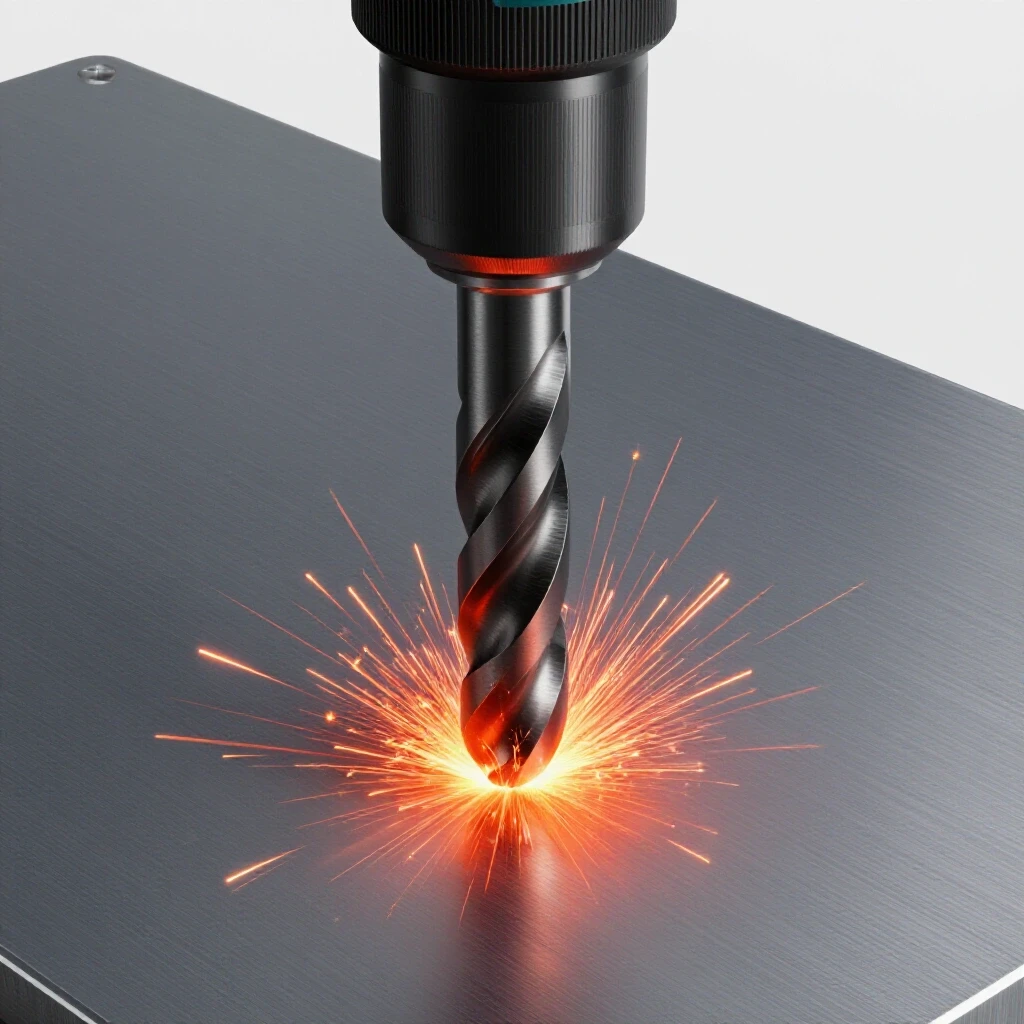
Execution strategies are the specific techniques used during the drilling process to manage heat and chip removal. This includes “pecking,” which involves periodically retracting the bit to clear out waste material and allow coolant to reach the cutting tip.
When you are deep into a piece of steel, the chips (the curly metal shavings) have a long way to travel to get out of the hole. If those chips get trapped, they get recut by the bit. This is the fastest way to ruin a tool. The “peck cycle” is a manual process where you drill down a distance equal to about one or two times the diameter of the bit, then pull the bit completely out of the hole while it’s still spinning.
This action flings the chips away and, more importantly, allows your cutting fluid to flow down to the bottom of the bore. For lubrication, don’t just use WD-40. You need a dedicated sulfur-based cutting oil or a high-quality synthetic coolant. These fluids serve two purposes: they reduce friction and they carry heat away from the cutting edge.
- Feed Rate: You want to see thick, consistent “6” shaped chips. If you see fine powder, you aren’t pressing hard enough (glazing the bit). If the motor is slowing down significantly, you are pressing too hard.
- Speed (RPM): For a 1/2 inch bit in mild steel, start around 600 RPM. For a 1-inch bit, drop down to 300 RPM. If the tips of your chips are turning blue, you are going too fast or don’t have enough lube.
Inspecting Slide Tolerances and Table Flex
Slide tolerances refer to the “fit” between moving parts, such as the quill inside the head or the table on the column. Table flex is the unwanted movement of the work surface when downward pressure is applied during the drilling process.
I’ve seen many fabricators struggle with crooked holes, only to find out their drill press table was sagging under pressure. To test this, place a heavy scrap of steel on your table and apply downward pressure with the feed handle (with the machine off). Watch the gap between the table and the column. If you see the table “nodding” downward, you will never get a straight hole in thick plate.
High-quality machines use a “box way” or a very wide dovetail slide for the table. They also include a table support jack—a threaded post that sits under the front of the table to prevent it from flexing. If your machine doesn’t have one, you can easily fabricate one from a heavy-duty bolt and some scrap tubing. This simple addition can improve your hole accuracy by 50% on a budget machine.
Planning for Maintenance and Spare Parts
Maintenance involves the regular cleaning, lubrication, and adjustment of machine components to ensure long-term accuracy. Spare parts availability refers to the ease with which you can source replacement items like belts, bearings, and switches.
Before you buy a machine, look at the manual. Is there a detailed parts breakdown? Can you call a number and talk to a technician who knows the machine? In my years of maintenance, I’ve had to scrap perfectly good-looking machines because a single plastic gear in the speed controller stripped and the manufacturer no longer existed.
- Bearing Replacement: Check if the spindle bearings are standard ISO sizes (like 6205 or 6008). If they are, you can buy high-quality replacements from any bearing house.
- Belt Access: Ensure you can change the drive belts without disassembling the entire head of the machine.
- Lubrication Points: Look for “Zerk” fittings or oil ports. A machine that can be easily greased is a machine that will stay tight and accurate.
I always tell people to check the “runout” of the company itself. If they have been around for 30 years and haven’t changed their basic machine design, that’s a good sign. It means parts will be available when you need them five or ten years down the road.
Summary of Inspection Benchmarks
When you are out in the field evaluating a new or used machine for creating deep bores in heavy plate, use these benchmarks as your guide. These numbers are based on standard industrial tolerances for medium-duty metalworking.
- Maximum Spindle Runout (TIR): 0.0015 inches (for precision) to 0.003 inches (for general fab).
- Cast Iron Weight Ratio: At least 50 lbs of machine weight for every 1/8 inch of maximum drilling capacity.
- Motor Duty Cycle: Look for “S1” or “Continuous” rating.
- Table Deflection: Less than 0.005 inches under 100 lbs of downward force.
- Spindle Taper: Prefer Morse Taper (MT2 or MT3) over a fixed chuck for more tooling options.
By focusing on these mechanical realities rather than the branding on the side of the headstock, you can invest in a tool that won’t just sit in your shop, but will actually perform when the steel gets thick and the holes get deep.
Frequently Asked Questions
Why does my drill bit keep smoking even though I’m using oil?
Smoking is usually a sign of excessive speed (RPM) or a dull bit. In thick steel, the heat has nowhere to go. If the cutting edge of the bit has been overheated once, it may have lost its “temper” (hardness). Even with oil, a dull bit will create friction instead of cutting, leading to smoke. Sharpen the bit and drop your RPM by 25%.
Can I use a handheld drill to go through 1-inch steel plate?
It is possible but difficult and potentially dangerous. A handheld drill lacks the rigidity to keep the bit perfectly straight, which leads to binding. If the bit binds in thick steel, the drill will kick back with enough force to break a wrist. If you must use a handheld tool, use a magnetic drill (Mag-Drill), which uses an electromagnet to lock the machine to the steel plate.
What is the best way to clear chips from a deep hole?
The most effective way is the “full-retract peck.” Instead of just lifting the bit slightly, pull it completely out of the hole every 1/4 inch of depth. This allows centrifugal force to throw the chips off the flutes and lets you squirt fresh oil directly onto the cutting point.
How do I know if my drill press table is square to the spindle?
Use a tool called a “spindle square” or a simple “tramming” bar. A tramming bar is a bent rod held in the chuck with a dial indicator on the end. As you rotate the chuck by hand, the indicator sweeps a circle on the table. If the reading changes as you rotate, your table is tilted and needs adjustment.
Is a gear-head drill press better than a belt-drive model?
“Better” depends on your needs. Gear-head presses are superior for high-torque, large-diameter holes because they cannot slip. However, they are louder and more expensive to repair. Belt-drive presses are smoother and quieter, making them better for smaller, high-speed drilling, but they may slip when pushed hard in thick plate.
What does “Morse Taper” mean and why should I care?
A Morse Taper is a conical shape on the end of a tool or spindle that allows it to be held in place by friction. For deep drilling, a Morse Taper spindle is better because you can remove the chuck and insert “taper shank” drill bits directly into the machine. This creates a much more rigid connection than a standard 3-jaw chuck.
How often should I sharpen my drill bits when working with heavy plate?
You should touch up the edge as soon as the chips change shape or the “crunching” sound of the cut changes. In thick mild steel, a bit might need a quick honing every 5 to 10 holes. Waiting until the bit is completely dull or “blue” means you’ll have to grind away a lot of expensive tool steel to find a sharp edge again.
Why is my hole triangular or “lobed” instead of round?
This usually happens when the material is thin, but in thick plate, it’s a sign of a lack of rigidity or using a bit with an uneven grind. If one cutting lip is longer than the other, the bit will pivot around the center, creating a multi-sided hole. Check your bit geometry and ensure your workpiece is clamped securely to the table.
Does the color of the chips really matter?
Yes. In mild steel, straw-colored chips are perfect; they show that the heat is being carried away by the chip. Blue chips mean you are at the limit of the tool’s heat tolerance. Purple or black chips mean you are burning the bit and need to increase lubrication or decrease speed immediately.
What is the advantage of a brushless motor for drilling steel?
Brushless motors provide “constant torque” across their entire speed range. On a traditional motor, torque often drops off at very low speeds. A brushless system uses electronics to maintain power, which is incredibly helpful when you are trying to turn a large bit slowly through a thick piece of plate.
(This article was written by one of our staff writers, Steven Brooks. Visit our Meet the Team page to learn more about the author and their expertise.)