Heavy Steel Lifting Equipment for Small Shops (Buying Guide)
The physical toll of scaling a fabrication business is rarely discussed in the glossy brochures for new CNC plasma tables. My back still remembers the year I tried to manhandle 4×8 sheets of half-inch plate by myself in a cramped two-car garage. I was twenty-eight, ambitious, and convinced that grit could replace proper material handling. By thirty-five, after transitioning to a more professional setup, I realized that grit doesn’t scale, but systems do.
When you move from hobbyist projects to micro-manufacturing, your biggest bottleneck isn’t the speed of your torch. It is the time and energy wasted moving raw stock from the rack to the cutting bed. In my twenty years of operating shops, I have found that integrating compact lifting systems is the single most important step in protecting both your health and your profit margins. This guide focuses on the hardware and layout strategies needed to manage heavy steel without the need for a full-scale industrial crane.
Optimizing Material Flow and Floor Load Capacity
A shop’s layout determines how many times you must touch a piece of steel before it becomes a finished product. Every time you move a plate unnecessarily, you are losing money and increasing the risk of injury.
Before you purchase any hoisting hardware, you must evaluate your floor’s structural integrity. Most residential garage floors are four inches thick, rated for approximately 3,000 to 4,000 PSI. While this is sufficient for a parked truck, a portable gantry crane carrying a one-ton plate creates concentrated “point loads” at the casters. I always recommend checking for cracks or settling before positioning a gantry in a permanent “loading zone.”
Building a linear workflow is the most effective way to minimize travel. Ideally, your material storage should be located near the shop entrance, followed by the lifting station, then the CNC table, and finally the welding and finishing area. This “straight line” approach reduces the distance you need to transport heavy plate, which simplifies the requirements for your lifting equipment.
| Layout Factor | Hobby Setup (Static) | Advanced Setup (Linear) |
|---|---|---|
| Material Travel | High (Back and forth) | Low (Single direction) |
| Space Utilization | Random/Cluttered | Zoned/Efficient |
| Safety Risk | High (Manual lifting) | Low (Mechanical assist) |
| Throughput | Limited by fatigue | Limited by machine cycle |
Establishing Machine Spacing and Access Zones
Access zones are the clear floor spaces around your machinery that allow for safe operation and maintenance. For any shop integrating automated cutting tools, these zones are non-negotiable for both safety and efficiency.
In my own shop redesign, I implemented a strict three-foot minimum clearance around the entire perimeter of the CNC plasma table. This allows a portable gantry to straddle the table without hitting workbenches or wall-mounted tool racks. If you are tight on space, use floor tape to mark these boundaries. It prevents “tool creep,” where hammers and grinders slowly migrate into the path of your heavy lifting equipment.
Selecting Compact Gantry Frames and Hoists
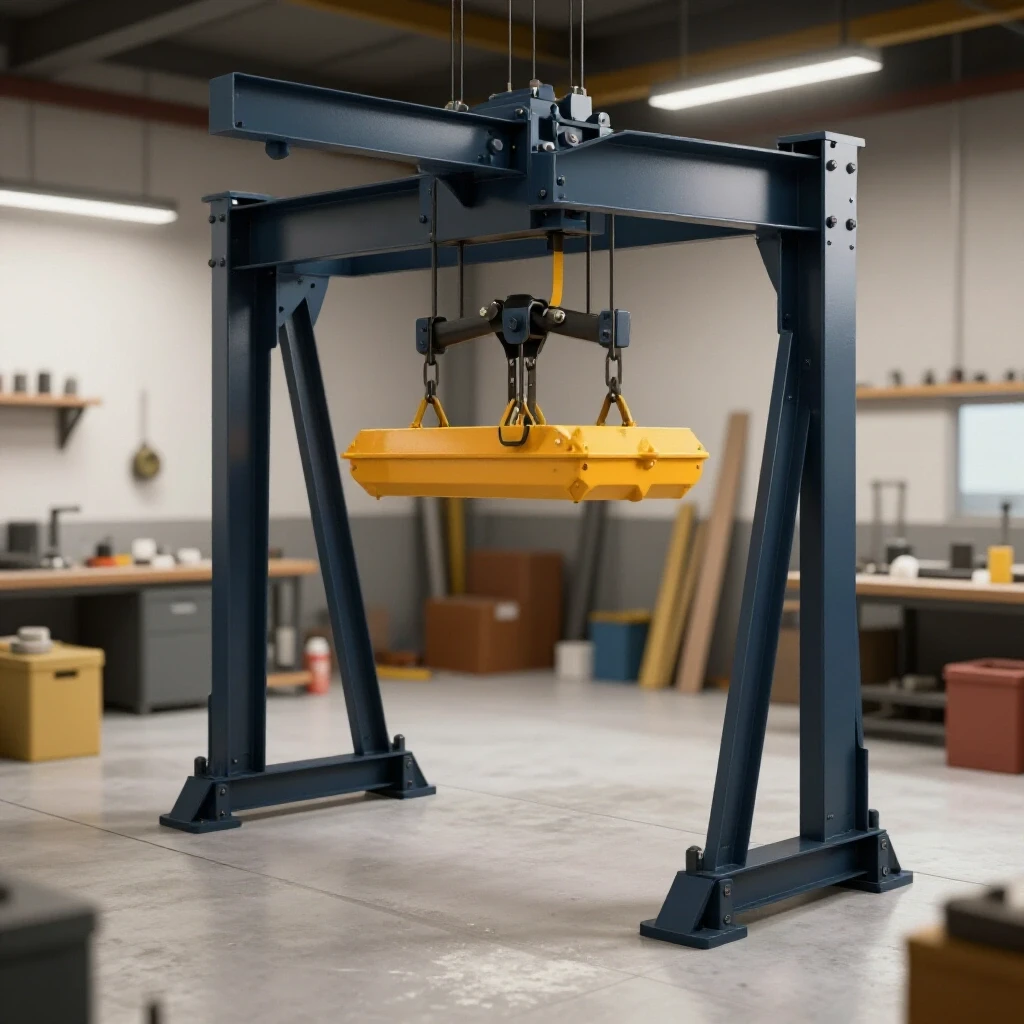
Portable gantry cranes are the workhorses of the advanced small shop because they provide overhead lifting without requiring structural modifications to the building. These frames are typically made of steel I-beams or heavy-duty box tubing and are designed to be moved on casters.
When shopping for a gantry, the span width and the height are your primary metrics. You need a span wide enough to clear your widest machine—usually five to six feet for a 4×4 table or ten feet for a 5×10 table. I prefer adjustable-height models. They allow you to lower the center of gravity when moving the crane and raise it when you need to clear a high-sided welding fixture.
Comparing Manual and Electric Chain Hoists
A hoist is the mechanism that does the actual vertical lifting, usually mounted to a trolley that slides along the gantry’s top beam. For most small-scale steel fabrication, a capacity of one to two tons is the “sweet spot.”
Manual chain hoists are cost-effective and require no electrical hookup, making them highly portable. However, if you are loading plate onto a CNC table ten times a day, the repetitive motion of pulling a hand chain becomes a new bottleneck. Single-phase electric hoists are a significant upgrade. They allow for precise, one-handed operation, which is critical when you are trying to align a heavy sheet of steel with the slats on your cutting bed.
- Manual Chain Hoist: Low cost, no power needed, slower operation.
- Electric Hoist (110V/220V): Higher cost, faster, allows for better load positioning.
- Trolley Type: Always choose a geared trolley for loads over 1,000 pounds to ensure smooth movement along the beam.
Implementing 3-Phase Power for Heavy Equipment
As you scale up, you will likely encounter industrial-grade equipment that requires 3-phase power. Most residential and light commercial shops only have single-phase service, which can feel like a major roadblock to growth.
3-phase power is more efficient because it delivers three alternating currents that are offset in time, providing constant power delivery to motors. This is essential for larger air compressors and high-end CNC controllers. Rather than paying thousands to the utility company to drop a new line, most of us use a rotary phase converter (RPC). An RPC takes your single-phase 240V input and uses a “idler motor” to generate the third leg of power.
Balancing Voltage for Sensitive Electronics
When using a phase converter to power a CNC plasma system, voltage balance is critical. CNC electronics are sensitive to “dirty” power, and an imbalanced third leg can cause the system to crash or burn out expensive stepper drivers.
I recommend using a digital phase converter if your budget allows. Unlike traditional rotary versions, digital converters use solid-state electronics to ensure the voltages stay within a tight 2-3% tolerance. If you stick with a rotary unit, you must use a volt-meter to check the balance under load. Always wire your CNC’s computer and control logic to the two “real” legs of power from your utility, leaving the manufactured third leg to power the heavy induction motors.
- Calculate total full-load amps (FLA) for all machines running simultaneously.
- Size the converter at least 2x the horsepower of your largest motor.
- Install a dedicated sub-panel for 3-phase distribution.
- Use a power conditioner for the CNC control PC to prevent data corruption.
Designing High-Volume Air Filtration and Fume Extraction
Cutting heavy steel with a CNC plasma table generates a massive amount of fine dust and hazardous fumes. Without a dedicated extraction system, this particulate will settle on everything in your shop, including your precision linear rails and your lungs.
A standard shop vac is useless here. You need a high-volume system capable of moving 1,000 to 2,000 cubic feet per minute (CFM). Most advanced shops use either a water table or a “downdraft” system. A downdraft table pulls air through the cutting surface and exhausts it outside or through a multi-stage filtration unit.
Calculating Duct Static Pressure and Velocity
The efficiency of your dust collection is determined by air velocity and static pressure loss. Static pressure is the resistance the air faces as it moves through pipes and filters. If your ducts are too small or have too many 90-degree bends, the air velocity will drop, and dust will settle inside the pipes.
For steel dust, you need a “transport velocity” of about 3,500 to 4,000 feet per minute (FPM). I use smooth-walled metal ducting instead of flexible ribbed hoses whenever possible. Metal ducting has much lower friction, which allows a smaller blower motor to achieve higher CFM at the tool.
- Main Duct Diameter: 6 to 8 inches for primary runs.
- Branch Lines: 4 to 5 inches to individual machines.
- Filter Rating: MERV 15 or higher for fine metal particulates.
- Maintenance: Clean or pulse-jet filters every 20 hours of cutting time.
Integrating CNC Workflows and Automation
The transition to CNC is more than just buying a machine; it is a shift in how you think about production. In a manual shop, you are the “controller.” In an automated shop, you are the “process manager.” This requires a solid grasp of CAD (Computer-Aided Design) and CAM (Computer-Aided Manufacturing) software.
One of the biggest mistakes I see is failing to account for the “loading bottleneck.” If it takes you twenty minutes to find, lift, and square a sheet of steel onto the table, a five-minute cut cycle doesn’t help you much. This is where your material handling hardware pays for itself. By using a gantry with a plate clamp, you can position the steel accurately in seconds, keeping the torch moving and the revenue flowing.
Managing Software and Tooling Files
Automation relies on consistency. You need a library of “cut charts” or tool files that specify the exact speed, amperage, and pierce height for every thickness of steel you cut.
I keep a digital log of every job, noting the air pressure settings and the condition of the consumables. If the cut quality starts to degrade, I can look at my metrics and determine if the issue is moisture in the air lines or a mechanical alignment problem on the gantry. This data-driven approach is what separates a professional operation from a hobbyist setup.
| Component | Purpose | Key Metric |
|---|---|---|
| CAD Software | Designing parts | Precision (0.001″) |
| CAM Software | Generating G-code | Lead-in/Lead-out settings |
| CNC Controller | Moving the motors | Step/Dir pulse rate |
| Plasma Source | Cutting the metal | Duty cycle at 100% |
Investing in Long-Term Shop Efficiency
Scaling a shop is an exercise in capital depreciation and ROI. When I buy a piece of equipment, I don’t just look at the price tag; I look at the “cost per hour” over five years. A cheap, flimsy engine hoist might save $500 today, but if it fails or makes loading plate a struggle, it costs me thousands in lost productivity and potential injury.
I suggest creating an amortization sheet for your major upgrades. If a $2,500 gantry system saves you thirty minutes of labor per day, and your shop rate is $75 an hour, the equipment pays for itself in about 67 workdays. That is a phenomenal return on investment.
Final Checklist for Shop Evolution
- Verify floor PSI and clear 3-foot access zones.
- Install a gantry rated for 125% of your heaviest expected load.
- Balance 3-phase power legs within 3% for CNC safety.
- Seal all ductwork joints with foil tape to maintain static pressure.
- Standardize your CAM toolsets to reduce setup times.
The goal is to build a space where the heavy lifting is handled by steel and electricity, leaving your mind free to focus on the craft and the customers. It took me years to stop “muscling” my way through the day, but once I integrated these systems, my output doubled while my physical fatigue vanished.
Frequently Asked Questions
Can I use a standard engine hoist to load a CNC plasma table? You can, but it is often frustrating. Engine hoists have “legs” that must roll under the object being lifted. Most CNC tables have frame rails or water pans that prevent the hoist legs from getting close enough to center the load. A portable gantry crane that straddles the table is a much more efficient solution for plate handling.
How thick should my concrete floor be for a 2-ton gantry? A standard four-inch slab of 3,000 PSI concrete is generally sufficient for a 2-ton gantry, provided the load is distributed across four large, high-quality casters. If you plan on lifting maximum capacity frequently in the same spot, consider adding a steel plate under the casters to further distribute the weight.
Is a manual trolley safe for moving a 1,000-pound plate? Yes, but it can be difficult to control. A plain “push” trolley requires you to push the load itself to move it along the beam. A “geared” trolley uses a hand chain to move the trolley, providing much better precision and preventing the load from swinging unexpectedly.
Do I need a permit to install a 3-phase converter in a home shop? Electrical codes vary by region, but generally, adding a phase converter is treated like adding any other large appliance or sub-panel. You should always consult a licensed electrician to ensure your main service can handle the additional amperage and that the installation meets the National Electrical Code (NEC).
What is the best way to attach a hoist to a flat steel plate? Never use “makeshift” magnets or hooks. Use a dedicated plate lifting clamp (sometimes called a “dogs”) rated for the thickness and weight of your material. These clamps use a cam-action grip that gets tighter as more tension is applied, ensuring the plate cannot slip during transport.
How often should I replace the casters on my portable gantry? Inspect your casters every six months for flat spots, cracks, or bearing wear. If the gantry becomes difficult to push or starts to “wander,” replace the casters immediately. High-quality polyurethane-on-iron wheels are the best choice for shop floors as they resist metal chips and debris.
Can I run my CNC electronics on the same circuit as my plasma cutter? I strongly advise against this. The high-frequency start and heavy current draw of the plasma power supply can create electrical noise that interferes with the CNC’s low-voltage signals. Use separate circuits, and ideally, a dedicated ground rod for the plasma table frame to drain away interference.
What is the “static pressure” of a dust collector? Static pressure is a measure of the blower’s ability to overcome resistance in the ductwork. Think of it like “suction power.” The more bends and longer the pipes in your system, the higher the static pressure. You need a blower with a “fan curve” that provides high CFM even when the static pressure is high.
How do I know if my 3-phase power is balanced? Use a digital multimeter to measure the voltage between each pair of legs (L1-L2, L2-L3, L3-L1) while the machine is running. In a perfectly balanced system, the voltages should be nearly identical. If one leg is more than 5-10% different from the others, you may need to adjust the capacitors in your rotary phase converter.
Should I buy a steel or aluminum gantry? Steel gantries are heavier and more rigid, making them better for permanent shop use where you are moving heavy plate. Aluminum gantries are much lighter and easier to transport to job sites, but they are more expensive and can “flex” more under load. For a stationary fabrication shop, steel is usually the better value.
(This article was written by one of our staff writers, Edward Sinclair. Visit our Meet the Team page to learn more about the author and their expertise.)