How to Organize Workshop Drawers for Quick Tool Access (Fix)
I started my first fabrication shop in a single-car garage with a basic buzz box welder and a handheld grinder. Back then, I spent more time digging through plastic bins for a specific scribe or set of calipers than I did actually melting metal. As my operation grew into a professional space with CNC plasma tables and heavy-duty press brakes, I realized that my biggest enemy wasn’t the complexity of the jobs. It was the friction of my own workflow. When you move from hobbyist to micro-manufacturer, every second you spend hunting for a tool is a direct hit to your hourly rate.
Transitioning to a high-output environment requires more than just bigger machines. It demands a shift in how you view your floor space and your storage systems. I’ve spent the last two decades refining these processes, moving away from cluttered “catch-all” drawers toward highly systematic retrieval methods. In this guide, I will walk you through the structural and organizational changes needed to transform a bottlenecked workshop into a lean, high-throughput fabrication facility.
Mapping the Micro-Flow: Why Hand Tool Retrieval Dictates Shop Throughput
Micro-flow is the study of the small, repetitive movements a fabricator makes at a workstation, specifically the time taken to find and return hand tools. By reducing these movements, you minimize the “hidden factory” of wasted time that occurs between value-added tasks like welding or cutting.
In my early years, I followed the “more is better” philosophy. I had more tools than I knew what to do with, but they were scattered. When I finally applied lean manufacturing principles to my bench drawers, I saw an immediate 15% increase in assembly speed. The goal is to create a layout where your hand can find a tool without your eyes leaving the workpiece. This requires a rigid commitment to “a place for everything.”
The Cost of Search Time in Fabrication
To understand why this matters, look at the math. If you spend 30 seconds searching for a tool ten times a day, you lose 20 hours a year. In a shop with three employees, that is a full week of production gone. We fix this by treating our tool drawers like a high-speed filing system.
| Current Layout Problem | Impact on Production | Recommended Lean Fix |
|---|---|---|
| Deep, cluttered drawers | High search time and tool damage | Shallow drawers with custom inserts |
| Mixed tool categories | Confusion during high-stress jobs | Task-based drawer zoning |
| No visual indicators | Tools left out on work surfaces | Shadow boarding or foam cutouts |
| Excessive walking distance | Physical fatigue and slow cycles | Point-of-use storage placement |
Building Balanced 3-Phase Power Systems for Modern Machinery
3-phase power is a type of electrical distribution that uses three alternating currents to provide more consistent torque and efficiency for industrial motors. It is the standard for professional-grade CNC machines, large air compressors, and heavy-duty welders.
Most home-based or light commercial shops start with single-phase power. When you upgrade to a CNC plasma table or a 5-horsepower milling machine, you will likely encounter the need for 3-phase. I remember the anxiety of my first 3-phase installation. I had to choose between a rotary phase converter (RPC) and a variable frequency drive (VFD). Each has its place, but for a growing shop, the RPC often provides the most flexibility for running multiple machines.
Comparing Power Conversion Options
A rotary phase converter uses a master motor to generate the third leg of power. It is a robust solution for shops with varying loads. A VFD, on the other hand, is great for controlling the speed of a single motor but isn’t designed to power an entire shop circuit.
- Rotary Phase Converters: Best for powering multiple machines from one source.
- Variable Frequency Drives: Best for precision speed control on a single machine.
- Digital Phase Converters: The most expensive option, but provides the cleanest power for sensitive CNC electronics.
Designing High-Volume Air Filtration for Metalworking Environments
Air filtration in a fabrication shop involves removing hazardous metal dust, welding fumes, and plasma smoke from the breathing zone. This is measured in Cubic Feet per Minute (CFM), which indicates the volume of air the system can move.
When I integrated my first CNC plasma table, I underestimated the volume of smoke it would produce. Within ten minutes of cutting, the shop was a fog. I had to learn the hard way about static pressure—the resistance air meets as it moves through ducts. To keep your air clean, you need a system that can handle the specific CFM requirements of your tools while overcoming the friction of your ductwork.
Airflow Requirements by Tool Station
Every tool has a different “dust profile.” A grinder produces heavy, directional sparks, while a plasma table creates fine, airborne particulates.
- CNC Plasma Table: Requires 1,000–1,500 CFM with a water table or downdraft.
- Stationary Grinding Station: Requires 500–800 CFM with a dedicated hood.
- General Shop Air Scrubbing: Should cycle the entire shop volume 6–8 times per hour.
Optimizing Precision Tool Storage for Rapid Retrieval
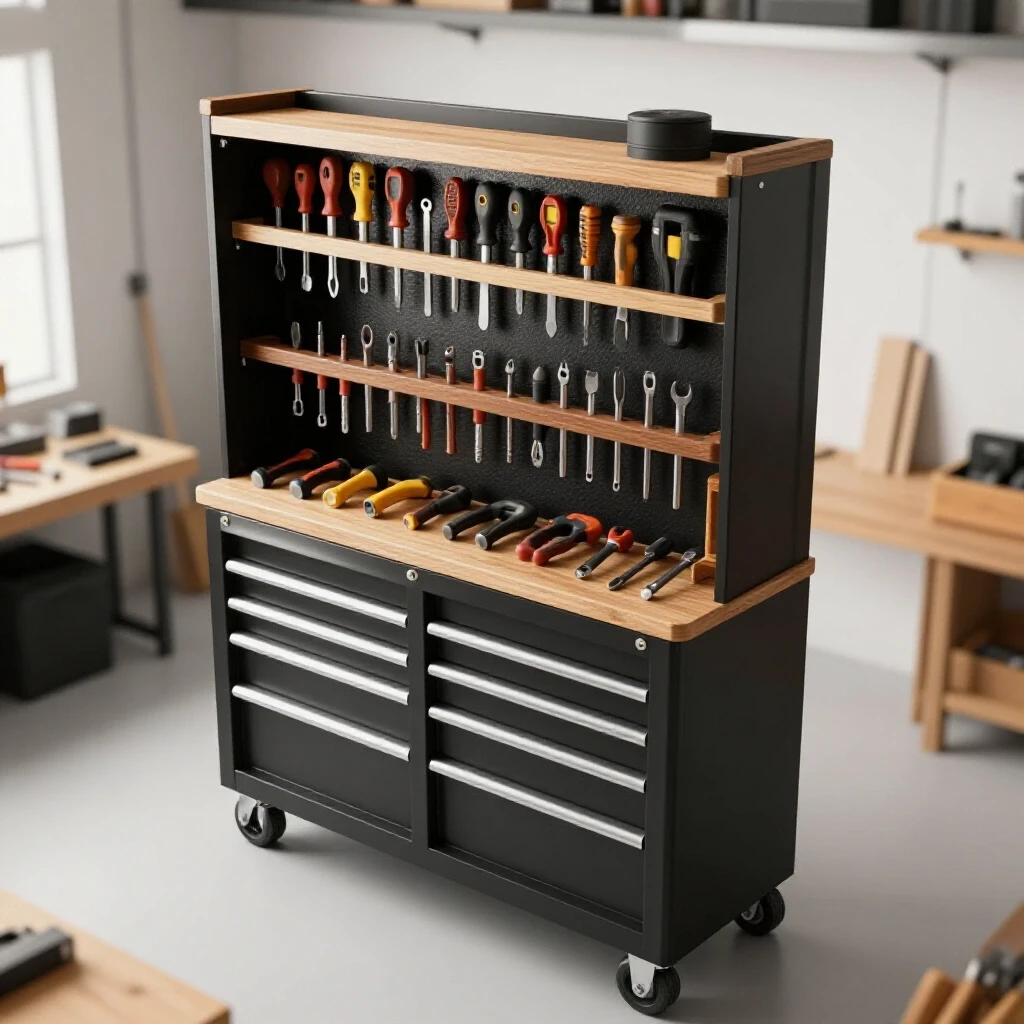
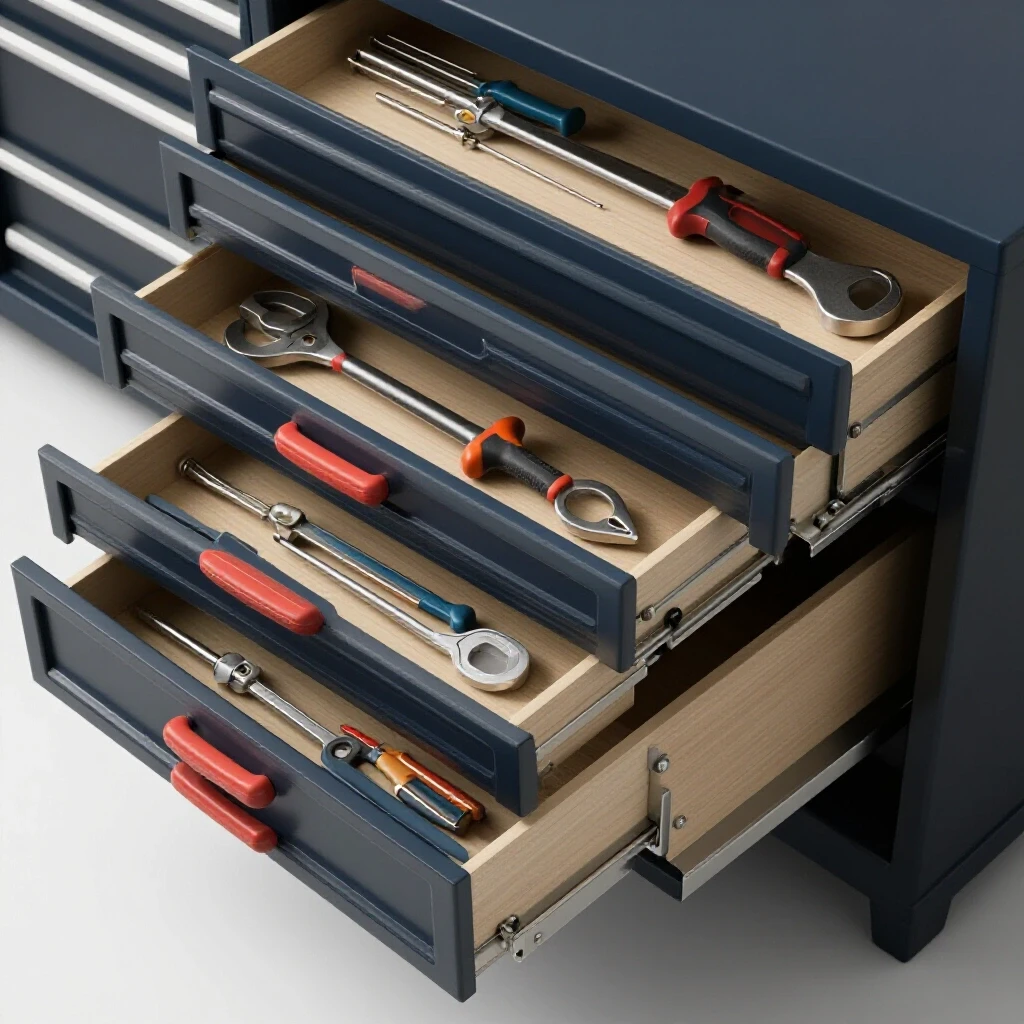
Strategic drawer layout involves placing fabrication tools in specific, labeled locations to reduce search time and protect delicate instruments. This is the heart of maintaining a high-output workflow at the workbench.
In my shop, I use a combination of foam cutouts and magnetic strips to organize my precision tools. For example, my measuring drawer contains my 6-inch calipers, a set of micrometers, and my precision squares. Each tool has a dedicated “shadow” in a high-density foam sheet. If a tool is missing, the bright red foam underneath screams at me. This visual management system ensures I never leave a tool inside a finished assembly or lose it under a pile of scrap.
Step-by-Step Drawer Optimization
- Purge and Categorize: Remove everything from the drawer. Group tools by task (e.g., Layout, Deburring, Fastening).
- Select the Right Depth: Use shallow drawers (2 to 3 inches deep) for hand tools. Deep drawers lead to stacking, which is the enemy of speed.
- Install Tool Control Inserts: Use “Kaizen foam” or plastic dividers. Trace each tool and cut out its shape so it cannot shift.
- Apply Magnetic Strips: For items like files or wrenches, magnetic strips on the side of the drawer can keep them upright and accessible.
- Label Externally: Use a clear labeling system on the outside of the drawer so you don’t have to open three drawers to find the one you need.
Integrating CNC Plasma Lines into the Shop Layout
A CNC plasma line is an automated cutting system that uses a computer-controlled torch to cut shapes out of metal sheets. Integrating this requires careful planning of material flow and electrical shielding.
When I moved my CNC table into its permanent home, I had to consider the “swing zone.” This is the area needed to load a full 4×8 sheet of steel without hitting other machines. I also learned about electromagnetic interference (EMI). High-frequency plasma starters can wreak havoc on nearby computers. I had to ground my table to a dedicated 8-foot copper rod driven into the floor to keep the electronics stable.
Machine Spacing and Access Zones
Efficiency isn’t just about how fast the machine cuts; it’s about how easily you can service it. I follow the 3-foot rule: maintain at least 36 inches of clear space around the perimeter of the CNC table for maintenance and loading.
- Loading Zone: Ensure the forklift or sheet crane has a straight path to the table.
- Operator Station: Place the computer console where the operator can see the torch but stay clear of sparks.
- Slag Management: Leave room to pull the dross trays for cleaning without moving the entire machine.
Implementing Lean Workflows through Tool Zoning
Tool zoning is the practice of placing tools as close as possible to where they are used. This reduces “travel waste,” which is the time spent walking across the shop floor.
I used to have one large tool chest in the center of the shop. As I scaled, I realized this was a bottleneck. Now, I have “point-of-use” stations. My welding table has its own drawer for clamps and wire brushes. My CNC table has a dedicated cabinet for consumables like nozzles and electrodes. By decentralizing your storage, you ensure that the tools needed for a specific task are always within arm’s reach.
Workflow Mapping Exercise
Take a floor plan of your shop and draw a line representing your path during a typical project. If the lines look like a bowl of spaghetti, your layout is killing your productivity. Aim for a linear flow: Raw Material -> Cutting -> Fabrication -> Welding -> Finishing -> Shipping.
Managing the Learning Curve of Automation
Automation integration is the process of moving from manual operations to computer-controlled systems. It involves a steep learning curve in both software (CAD/CAM) and machine maintenance.
The biggest mistake I see advanced hobbyists make is assuming the machine does all the work. In reality, you become a “process manager.” You spend more time in front of a screen and less time with a torch in your hand. I recommend starting with simple parts to understand your “kerf” (the width of the cut) and feed rates before attempting complex assemblies.
Essential Software for the Modern Fabricator
- CAD (Computer-Aided Design): Used for creating the 2D or 3D geometry of your parts.
- CAM (Computer-Aided Manufacturing): Converts the CAD drawing into G-code that the machine understands.
- Nesting Software: Optimizes the layout of parts on a sheet of metal to reduce waste.
- ERP (Enterprise Resource Planning): For tracking material costs, quotes, and lead times as you scale.
Capital Depreciation and the Economics of Upgrading
Capital depreciation is the process of allocating the cost of a large equipment purchase over its useful life. Understanding this helps you make smarter buying decisions.
When I bought my first professional press brake, the price tag was daunting. However, when I calculated the depreciation over five years and factored in the time saved, the machine paid for itself in eighteen months. Don’t just look at the sticker price; look at the “cost per part.” If a new tool storage system saves you five minutes an hour, calculate what that time is worth over a year. Often, the “expensive” solution is the most profitable one.
Maintaining Air Quality with Multi-Stage Cyclone Collectors
A multi-stage cyclone collector is a dust extraction system that uses centrifugal force to separate heavy chips from fine dust before the air reaches the final filter.
In a metal shop, this is critical because metal dust is abrasive and can quickly clog standard filters. I installed a cyclone system with a 5-micron secondary filter. This setup keeps the fine “black dust” off my precision tools and out of my lungs. Remember to check your static pressure regularly; as filters clog, the CFM drops, and your air quality will suffer.
| Feature | Single-Stage Collector | Multi-Stage Cyclone |
|---|---|---|
| Particle Separation | Minimal; all goes to filter | High; 99% of chips separated |
| Filter Life | Short; requires frequent cleaning | Long; filter stays cleaner |
| Suction Consistency | Drops as bag fills | Remains steady until bin is full |
| Ideal Use | Small, occasional use | High-volume production shops |
Finalizing the Professional Shop Layout
The final step in your evolution is the “commissioning run.” This is where you test your new layout and storage systems under actual production conditions.
When I reorganized my assembly area, I did a “dry run” of a common project. I timed how long it took to gather tools, set up the jig, and perform the first welds. I discovered that even with my new drawers, I was still reaching too far for my magnetic squares. A small adjustment to the drawer sequence—moving the most used tools to the top drawer—shaved another two minutes off the setup. These small, data-driven tweaks are what separate a hobby shop from a professional facility.
Practical Steps for Immediate Improvement
- Audit your most-used tools: Identify the five tools you touch every hour. Move them to the most accessible “prime real estate” in your drawers.
- Check your electrical balance: Use a multimeter to ensure your 3-phase legs are within 5-10% of each other to prevent motor overheating.
- Standardize your labeling: Use a consistent font and color for all drawer labels to reduce cognitive load.
- Clean your air: Replace or wash your ambient air filters. If you can see dust on your calipers, your filtration isn’t working.
By focusing on the micro-flow of your hand tools and the macro-flow of your materials, you create an environment where high-quality work happens naturally. It isn’t about working harder; it’s about removing the obstacles that prevent you from working efficiently.
Frequently Asked Questions
How do I prevent my precision tools from rusting in a shop drawer?
In metalworking shops, humidity and coolant mist can cause rapid oxidation on steel tools like calipers and squares. I recommend using “VCI” (Vapor Corrosion Inhibitor) emitters inside your drawers. These small pods release a protective vapor that coats the tools. Additionally, a light wipe-down with a dedicated machine oil after each use is essential for maintaining the accuracy and finish of your instruments.
What is the best material for custom tool drawer inserts?
For a professional fabrication environment, high-density polyethylene (HDPE) or dual-colored “Kaizen” foam is best. I prefer the dual-colored foam because the bottom layer is a bright, contrasting color (like red or yellow). When a tool is removed, the bright color is visible, making it immediately obvious that something is missing. This is a core concept of visual management in lean manufacturing.
Can I run a CNC plasma table on a rotary phase converter?
Yes, you can, but you must be careful. CNC electronics are sensitive to voltage fluctuations. If you use a rotary phase converter, ensure it is “CNC rated,” which means it has tighter voltage balancing between the legs. For the best results, many fabricators prefer a digital phase converter for their CNC equipment because it provides a perfect sine wave and prevents “noise” that can crash the machine’s controller.
How much space should I leave between my welding bench and my tool storage?
I recommend a minimum of 36 to 48 inches of clearance. This allows you to stand comfortably at the bench and still have room for someone to pass behind you. It also ensures that if you are working on a large weldment, you can still open your tool drawers fully without hitting the workpiece.
Why is static pressure important in dust collection?
Static pressure is the resistance your air collector must overcome to move air through the pipes. Every bend, 45-degree elbow, and foot of corrugated hose adds resistance. If your duct design has too many turns or the pipes are too small, the CFM at the tool will drop significantly, leaving dust and fumes in your breathing zone. Always use smooth-walled pipe and long-radius elbows whenever possible.
How do I know if my shop needs 3-phase power?
If you find yourself limited to small, 110V or 220V single-phase motors that bog down under heavy loads, it’s time to look at 3-phase. Most industrial-grade equipment, such as 12-inch cold saws, large ironworkers, and high-duty cycle welders, are designed for 3-phase. It provides more power in a smaller motor package and is generally more reliable for continuous production.
What is the “5S” system and how does it apply to my drawers?
5S stands for Sort, Set in order, Shine, Standardize, and Sustain. In the context of tool drawers, “Sort” means removing unused items. “Set in order” means creating the foam cutouts we discussed. “Shine” is keeping the tools clean. “Standardize” means every drawer in the shop follows the same logic. “Sustain” is the hardest part—making sure you actually put the tools back in their spots every single time.
How often should I maintain my CNC plasma table’s gantry?
For a high-output shop, I recommend a weekly inspection. Check the tension on the drive belts or the engagement of the rack and pinion. Wipe down the rails with a lint-free cloth and apply a dry lubricant. Dust and metal grit can act like sandpaper on your bearings, so keeping the motion system clean is the best way to avoid expensive downtime and maintain cut quality.
Should I use drawers or pegboards for my fabrication hand tools?
While pegboards are popular in hobby shops, drawers are superior for professional fabrication. Drawers protect precision tools from grinding dust, welding sparks, and moisture. They also allow for higher storage density. A single 10-drawer cabinet can hold more tools than 20 linear feet of pegboard, and it keeps your shop looking organized and professional for visiting clients.
What is the best way to organize different types of metal files?
Files should never be thrown loosely into a drawer; the teeth will rub together and dull the tool. I use vertical dividers or magnetic strips to keep my files separated. Organize them by shape (flat, round, half-round) and then by cut (bastard, second-cut, smooth). Labeling the handle or the divider ensures you grab the right file for the material you are working on without a second thought.
(This article was written by one of our staff writers, Edward Sinclair. Visit our Meet the Team page to learn more about the author and their expertise.)