How to Run Three-Phase Shop Machinery on Single Phase (Fix)
For nearly two decades, I have spent my mornings in grease-stained coveralls and my afternoons measuring spindle runout with a dial indicator. My shop has seen everything from 1940s-era bridge mills to modern CNC centers. The most common hurdle I see fabricators face is the “power wall.” You find a beautiful, heavy-duty industrial lathe at an auction for a steal, but then you see the motor plate: 230V, 3-Phase. Most home shops and small garages only have standard single-phase power.
This mismatch often leads buyers to pass on superior industrial machinery in favor of lightweight, flimsy hobbyist tools. I am here to tell you that passing on high-quality iron because of a power mismatch is a mistake. Over my 17 years in maintenance, I have helped dozens of shops bridge this gap safely. The goal is to understand the mechanical and electrical trade-offs so you can invest in tools that last a lifetime rather than toys that flex under pressure.
Choosing the right power solution is just as important as checking the bedways for wear. If you pick the wrong conversion method, you could lose 30% of your motor’s torque or, worse, fry the control electronics. We are going to look at how to bring that industrial performance into a residential setting without compromising the machine’s integrity.
Evaluating the Structural Integrity of Industrial Machinery
Before worrying about the plug, you must evaluate if the machine is worth the effort. High-quality industrial tools use heavy cast iron frames, often Grade 25 or 30, which provide superior vibration dampening compared to the thin sheet steel found in budget models. This mass is what allows for a 0.001-inch tolerance during a heavy cut.
When I inspect a machine, I look at the “bones” first. A machine with a three-phase motor was designed for a factory environment, meaning it likely has better bearings, thicker castings, and more robust gears. However, a motor is easy to power; a warped bed or a cracked casting is a permanent problem. Always prioritize the physical condition of the iron before the electrical requirements.
- Cast Iron Grade: Look for “Meehanite” or high-grade gray iron markings.
- Weight-to-Power Ratio: A quality lathe should weigh at least 500 lbs for every 1 HP of motor output to handle the torque.
- Frame Rigidity: Check for box-way construction rather than thin linear rails on older manual machines.
Why Industrial Motors Outperform Single-Phase Alternatives
Three-phase motors are mechanically simpler and more durable than their single-phase counterparts. They do not require centrifugal switches, start capacitors, or run capacitors, which are the most common failure points in workshop motors. This simplicity results in a motor that can reverse instantly and provide constant torque throughout its rotation.
In my experience, a 2 HP industrial motor will often outperform a “3 HP” peak-rated consumer motor. This is because the industrial motor is rated for continuous duty. When you adapt these motors to your home shop, you are keeping that reliability. You just need a way to “fake” the third leg of electricity or create it locally.
| Feature | Industrial 3-Phase Motor | Consumer 1-Phase Motor |
|---|---|---|
| Starting Torque | Very High | Moderate to Low |
| Vibration | Extremely Low (Smooth) | Moderate (Pulsing) |
| Maintenance | Bearings only | Switches, Brushes, Capacitors |
| Lifespan | 20,000+ hours | 5,000–10,000 hours |
Understanding Variable Frequency Drives (VFDs)
A Variable Frequency Drive (VFD) is a digital device that takes single-phase input and converts it into a simulated three-phase output. It does this by turning the incoming AC power into DC, then “chopping” that DC into a three-phase AC signal. It is the most popular choice for modern small shops because it offers total control over motor speed.
I prefer VFDs for machines like drill presses and milling machines. They allow you to dial in the exact RPM needed for a specific drill bit size without touching a belt. However, they are sensitive electronics. You cannot simply flip a manual drum switch between the VFD and the motor without risking a “magic smoke” event. The VFD must be the primary controller.
- Speed Control: Change motor RPM from 0% to 200% via a dial.
- Soft Start: Gradually ramps up the motor, reducing the dimming of lights in your shop.
- Braking: Can stop a heavy spindle in seconds using “dynamic braking” resistors.
Selecting the Right VFD for Your Workload
When choosing a VFD, you must look at the “Constant Torque” vs. “Variable Torque” ratings. For machine tools like lathes and mills, you always want a Constant Torque drive. These are designed to maintain power even at low speeds, which is critical when you are taking a heavy cut on a large diameter workpiece.
I always recommend sizing your VFD one step higher than your motor. If you have a 2 HP motor, buy a 3 HP rated VFD. This gives the internal capacitors and heat sinks a “safety margin.” In a hot shop, cheap VFDs pushed to their limit will overheat and trip out. Spending an extra $50 on a higher-rated unit is the best insurance you can buy.
- Check Input Voltage: Ensure the VFD is rated for 230V Single-Phase input.
- Verify Amperage: Match the VFD’s output amps to the motor’s Full Load Amps (FLA) on the nameplate.
- Enclosure Type: Use an NEMA 1 or NEMA 4X enclosure to keep conductive metal dust away from the circuit boards.
Using Rotary Phase Converters for Heavy Loads
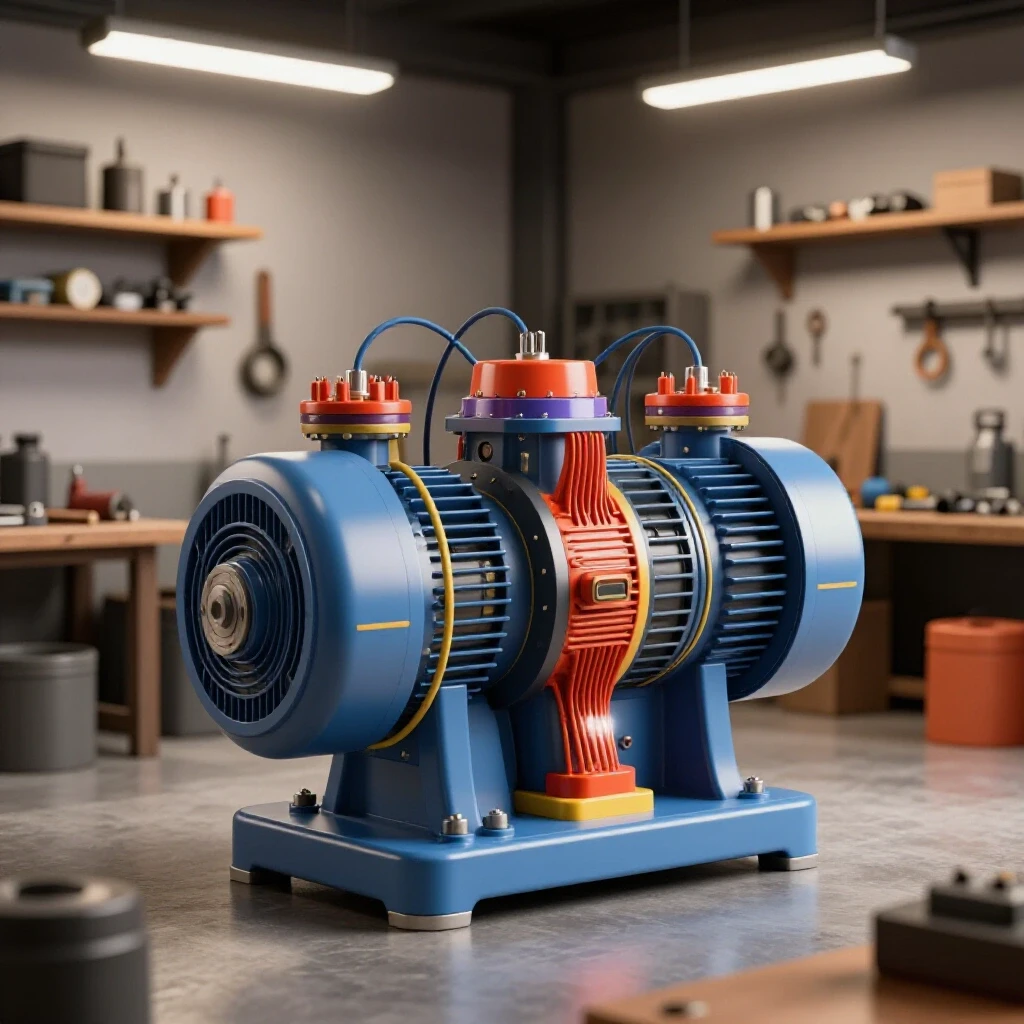
A Rotary Phase Converter (RPC) uses a large “idler motor” to generate the third leg of power mechanically. You plug the RPC into your single-phase wall outlet, and it spins a three-phase motor that acts as a generator. This creates a true three-phase sine wave that can power multiple machines at once.
In my shop, I use an RPC for my heavy gear-head lathe. RPCs are “dumb” technology in the best way possible—they are rugged and can handle massive current spikes when a big motor starts up. Unlike a VFD, an RPC doesn’t care if you use the machine’s original mechanical levers and drum switches. It just provides the power the machine expects to see.
- Durability: No sensitive microchips to fry; it’s mostly copper and iron.
- Multi-Machine Use: One large RPC can power every three-phase tool in your shop (one at a time or together if sized correctly).
- Ease of Install: You don’t have to rewire the machine’s internal control logic.
Sizing an Idler Motor for Your Equipment
The rule of thumb for an RPC is that the idler motor should be at least double the size of the largest motor you plan to start. If you have a 5 HP air compressor, you need at least a 10 HP idler. This is because the starting current (inrush) of a motor can be five to seven times its running current.
Interestingly, the quality of the idler motor matters. I always look for older, “T-Frame” motors with a high service factor (1.15 or better). These have more copper in the windings and more mass in the rotor, which provides better voltage stability. A cheap, modern “rolled steel” motor won’t provide as clean a signal as a heavy cast iron idler.
- Voltage Balance: Check that the voltage between all three legs is within 5% of each other.
- Noise Level: High-quality RPCs use precision-balanced idlers to prevent your shop from sounding like a jet engine.
- Protection: You must use a fused disconnect or circuit breaker between the RPC and your machinery.
The Limitations of Static Phase Converters
A static converter is essentially a box of capacitors that helps a three-phase motor start on single-phase power. Once the motor reaches speed, the capacitors drop out, and the motor runs on only two of its three windings. While this is the cheapest option, it comes with a major performance penalty.
I generally advise against static converters for any machine where you need full power. Because the motor is essentially “limping” on two legs, you lose about 1/3 of the rated horsepower. A 3 HP motor effectively becomes a 2 HP motor. If you push the machine hard, the motor will run significantly hotter, which can degrade the insulation on the windings over time.
- Cost: The most budget-friendly way to get a spindle turning.
- Torque Loss: Expect a 30% to 50% drop in starting and running torque.
- Heat: Not suitable for long duty cycles or heavy industrial production.
When a Static Converter Makes Sense
The only time I recommend a static converter is for light-duty machines that are rarely used at their limit. For example, a small pedestal grinder or a light-duty drill press might be fine. If you are a hobbyist who only makes small cuts in aluminum or wood, the loss of power might not be noticeable.
However, if you are a professional fabricator, the frustration of a stalling motor will quickly outweigh the initial savings. I have seen many buyers install a static converter, realize it’s underpowered, and then spend more money later to upgrade to a VFD or RPC. It is usually cheaper to do it right the first time.
- Check Motor Type: Only works on standard induction motors, not multi-speed or “Wye-Delta” types.
- Monitor Temperature: Keep a non-contact infrared thermometer handy to ensure the motor doesn’t exceed 150°F (65°C) on the casing.
- Listen for Growling: A motor on a static converter often has a distinct “hum” that indicates electrical imbalance.
Measuring Spindle Runout and Mechanical Accuracy
Once you have solved the power issue, you need to verify that the machine’s mechanical components are up to the task. Total Indicated Runout (TIR) is the measurement of how much a rotating part deviates from a perfect circle. On a high-quality lathe, I expect to see a TIR of 0.0005 inches or less at the spindle nose.
Adapting a machine to single-phase power won’t fix bad bearings. In fact, the pulsing nature of single-phase power (especially with static converters) can sometimes exacerbate vibration issues. I use a high-precision dial test indicator with 0.0001-inch graduations to check the spindle, the chuck, and the tailstock alignment.
- Internal Bearing Quality: Industrial machines often use tapered roller bearings or high-precision angular contact bearings.
- Bedway Wear: Look for “scoring” or “ridges” on the ways near the headstock where most work is done.
- Backlash: Measure the play in the lead screws; anything over 0.010 inches may require adjustment or part replacement.
The Impact of Power Quality on Surface Finish
The “smoothness” of your electricity directly impacts the surface finish of your metal parts. Three-phase power provides a constant flow of energy, whereas single-phase power has “zero-crossing” points where the voltage drops to zero 120 times per second. This can cause microscopic vibrations in the motor.
A VFD or a well-balanced RPC smooths out these pulses. If you notice “chatter” marks on your turned parts that look like a consistent pattern, it might not be a dull tool—it might be electrical harmonics. This is another reason why I prefer VFDs for high-precision work; the DC bus inside the drive acts as a buffer, providing very clean power to the motor.
| Tool Type | Recommended Power Fix | Why? |
|---|---|---|
| Metal Lathe | VFD or RPC | Needs high torque and smooth finish. |
| Milling Machine | VFD | Variable speed is a massive productivity boost. |
| Air Compressor | RPC | High starting load; VFDs often struggle with compressors. |
| Table Saw | Static or RPC | Simple load, doesn’t need variable speed. |
Practical Steps for a Safe Installation
Electrical work in a shop environment requires a methodical approach. You are dealing with high voltages that can be lethal. I always tell my clients: “If you aren’t 100% sure, call a licensed electrician.” A professional can verify that your shop’s service panel can handle the increased load and that your grounding system is up to code.
Grounding is especially critical when using VFDs. These drives generate high-frequency electrical noise that can interfere with other electronics or even cause “pitting” in your motor bearings if the motor isn’t properly grounded. Using shielded VFD cable between the drive and the motor is a best practice that prevents many common headaches.
- Size Your Circuit: A 5 HP three-phase motor running on single-phase will pull nearly double the amperage from the wall. Ensure your wire gauge (AWG) is sufficient.
- Use a Disconnect: Every machine should have a physical, lockable switch nearby to cut power for maintenance.
- Protect the Electronics: If using a VFD, ensure it is protected from metal chips and coolant spray.
Managing Heat and Airflow in Power Converters
Both VFDs and RPCs generate heat. A VFD uses a fan to cool its internal transistors, while an RPC is essentially a motor running constantly. If you tuck these devices into a small, unventilated cabinet, they will fail prematurely. I have seen $800 drives burn out because someone thought they looked better hidden in a wooden box.
For RPCs, I prefer to mount the idler motor on vibration isolation pads. This reduces the “droning” sound that can travel through the shop floor. For VFDs, I often mount them on a “heatsink-out” configuration where the cooling fins are outside the main enclosure. This keeps the electronics clean while still allowing them to breathe.
- Filter Intake: If your shop is dusty, use a replaceable filter on your VFD cabinet.
- Ambient Temp: Most VFDs are rated for 104°F (40°C) max; if your shop gets hotter, you must de-rate the drive.
- Clearance: Maintain at least 4 to 6 inches of clear space around the cooling fans.
Long-Term Maintenance and Parts Availability
One of the biggest risks in buying older industrial machinery is the “orphan” factor. If the machine uses a proprietary motor or a specialized electronic controller from 1985, you might be in trouble if it breaks. This is why I love standardizing on modern VFDs and NEMA-frame motors.
If a three-phase motor fails, any local motor shop can rewind it. If a modern VFD fails, you can buy a replacement from dozens of manufacturers and have it shipped overnight. When you “fix” the power issue using standard, off-the-shelf components, you are actually making your machine easier to maintain than it was in its original factory configuration.
- Standardize: Try to use the same brand of VFD for all your machines so you only have to learn one programming manual.
- Documentation: Keep a folder with the parameter settings for every drive. If the drive dies, you can program the new one in minutes.
- Spare Parts: Keep a spare set of drive belts and a set of motor bearings on the shelf.
Evaluating the Cost-to-Performance Ratio
Is it worth spending $500 to run a $1,000 lathe? In almost every case, the answer is yes. A $1,500 investment in a heavy, industrial 12×36 lathe with a VFD will outperform any $2,500 “new” hobbyist lathe on the market. You are getting better accuracy, more mass, and a more reliable power system.
The “hidden” cost of cheap tools is the time spent fiddling with them to get them to cut straight. Industrial iron stays square. Once you have bridged the power gap, you can focus on making parts instead of fixing your tools. That is the ultimate goal of any maintenance-minded shop owner.
Summary of Key Takeaways
- Don’t Fear 3-Phase: It is often a sign of a higher-quality, more durable machine.
- VFDs are Versatile: Best for speed control and precision on mills and lathes.
- RPCs are Rugged: Best for heavy-starting loads and running multiple machines.
- Static Converters are Limited: Only use them for light-duty tools where power isn’t critical.
- Check the Iron First: Ensure the mechanical foundation (TIR, bedways, castings) is worth the electrical investment.
- Safety First: Always use proper circuit protection and consult an electrician for final connections.
Frequently Asked Questions
Can I run a three-phase motor on a standard 110V household outlet?
Usually, no. While some very small VFDs (under 1 HP) can take 110V input and output 230V three-phase, most shop machinery requires a 230V single-phase circuit (like a dryer or welder outlet) to provide enough amperage.
Will a VFD damage my old motor’s insulation?
It is possible on very old motors (pre-1980s). Modern VFDs produce high-voltage spikes. If you have an antique motor, keep the lead length short and consider adding a “load reactor” to protect the windings.
Why not just swap the three-phase motor for a single-phase motor?
Swapping motors is often harder than it looks. Industrial motors often have unique mounting faces (like C-face or D-flange) or non-standard shaft sizes. Additionally, you lose the smooth torque and easy reversing of the three-phase design.
How much power do I lose when using a Variable Frequency Drive?
Very little. A high-quality VFD is about 95-98% efficient. You won’t notice a power loss, and the ability to optimize the RPM for your cut often makes the machine feel more powerful than it did on a fixed-speed factory line.
Is a Rotary Phase Converter loud?
It sounds like a motor running. If the idler motor is in good condition and balanced, it’s a steady hum. Many shop owners place their RPC in an adjacent room or an insulated enclosure to keep the shop quiet.
Can I use one VFD to run multiple machines?
Technically yes, but it is not recommended. You would have to ensure only one machine is connected at a time, and the VFD settings (like motor amps) would have to be changed for each tool. It is much safer and more convenient to have a dedicated VFD for each machine.
What happens if I try to start a 3-phase motor on 1-phase without a converter?
The motor will not start. It will sit there and “growl” or hum loudly. If left in this state, it will quickly overheat and burn out the windings because it cannot generate the rotating magnetic field needed to turn the rotor.
Do I need to change the machine’s internal wiring to use an RPC?
Generally, no. An RPC provides “real” three-phase power, so you can usually just plug the machine in and use its original buttons and switches. This is the biggest advantage of an RPC for complex machinery with built-in contactors and timers.
What is “Dynamic Braking” on a VFD?
It is a feature that uses a large resistor to bleed off the energy from a spinning spindle, allowing it to stop very quickly. This is a huge safety and productivity feature, especially on lathes with large, heavy chucks.
How do I know if my shop’s electrical panel can handle an industrial machine?
Look at the “Full Load Amps” on the motor nameplate. Double that number to account for the single-phase conversion, and ensure you have a circuit breaker and wire gauge that can handle that load continuously. If your main panel is only 100 amps, a 10 HP motor might be pushing your limits.
Can a VFD run a motor at 200% speed safely?
Mechanically, maybe; electrically, yes. However, you must ensure the motor’s bearings and the machine’s gearbox are rated for those speeds. Most industrial motors can safely handle 20% to 50% over-speed, but always check for vibration or excessive heat.
(This article was written by one of our staff writers, Steven Brooks. Visit our Meet the Team page to learn more about the author and their expertise.)