The Most Used Tools in a Small Fabrication Workshop (List)
Selecting the right equipment for a metalworking space often feels like navigating a minefield of marketing buzzwords. After 17 years in industrial maintenance, I have learned that a flashy paint job frequently hides porous castings and undersized bearings. When you are putting your own money into a workshop, you need to look past the brand name and evaluate the mechanical soul of the machine.
I have spent my career tearing down gearboxes and rebuilding spindles that failed prematurely because a manufacturer saved five dollars on a bearing. In this guide, I will walk you through the core equipment found in a productive metal shop. We will focus on physical construction, motor design, and the actual tolerances that determine whether a tool is a lifelong asset or a frustrating liability.
Why Heavy Castings Dampen Harmonics and Reduce Vibration
Rigidity is the most important factor in any machine that cuts metal. It refers to the ability of a machine frame to resist deflection under the pressure of a tool bit or grinding wheel. Without rigidity, you get vibration, poor surface finishes, and broken tools.
When I evaluate a new piece of equipment, the first thing I look at is the weight-to-footprint ratio. A light machine is a vibrating machine. Most high-quality shop equipment uses grey cast iron, specifically grades like GG20 or GG25. Cast iron contains graphite flakes that act as a natural internal dampener. This material absorbs the tiny shocks of a cutting tool hitting the workpiece, preventing those shocks from turning into “chatter.”
Thin sheet steel frames, common in budget equipment, act like a drum. They amplify noise and flex during heavy cuts. If you can push on the headstock of a machine and see the frame move, it will never hold a tight tolerance.
Understanding Cast Iron Grades and Structural Dampening
Cast iron is not all the same. The grade tells you how much tensile strength the material has and how well it will hold its shape over years of thermal cycles.
- GG20 Cast Iron: Standard grade, good for general bases and non-critical components.
- GG25 Cast Iron: Higher density, better wear resistance, and superior vibration dampening. This is what you want for lathe beds and milling columns.
- Ductile Iron: Used for parts that need to flex slightly without snapping, like high-end C-clamps or vises.
| Feature | Sheet Steel Frame | GG20 Cast Iron | GG25 Cast Iron |
|---|---|---|---|
| Vibration Dampening | Low (Amplifies) | Medium | High |
| Weight | Light | Heavy | Very Heavy |
| Stability Over Time | Poor (Can Warp) | Good | Excellent |
| Typical Use | Budget Bench Grinders | Mid-range Drill Presses | Precision Lathes/Mills |
The Horizontal Bandsaw: Evaluating Motor Styles and Gearbox Design
A horizontal bandsaw is the workhorse for stock preparation. It uses a continuous looped blade to cut through solid bars, tubes, and angles. The quality of the cut depends on the rigidity of the saw arm and the consistency of the blade speed.
In my experience, the gearbox is where most budget bandsaws fail. Many entry-level saws use a plastic or low-grade bronze worm gear that strips if the blade binds. Look for a saw with a cast iron gearbox housing and hardened steel gears. Additionally, pay attention to the blade guides. Ball-bearing guides are far superior to simple friction blocks because they keep the blade cooler and reduce the risk of the blade “wandering” during a deep cut.
The Importance of Hydraulic Downfeed Control
A hydraulic descent cylinder, or “dashpot,” allows the saw to lower at a controlled, constant rate. Without this, the saw relies on gravity, which can cause the blade to crash into the material, stripping teeth.
- Manual Feed: High risk of tooth breakage; requires constant operator attention.
- Spring-Tension Feed: Better than manual, but inconsistent as the spring loses tension through the arc.
- Hydraulic Feed: The gold standard for small shops. It ensures the blade enters the cut smoothly and maintains a steady pressure.
Precision in the Hole: Assessing Drill Press Spindle Runout
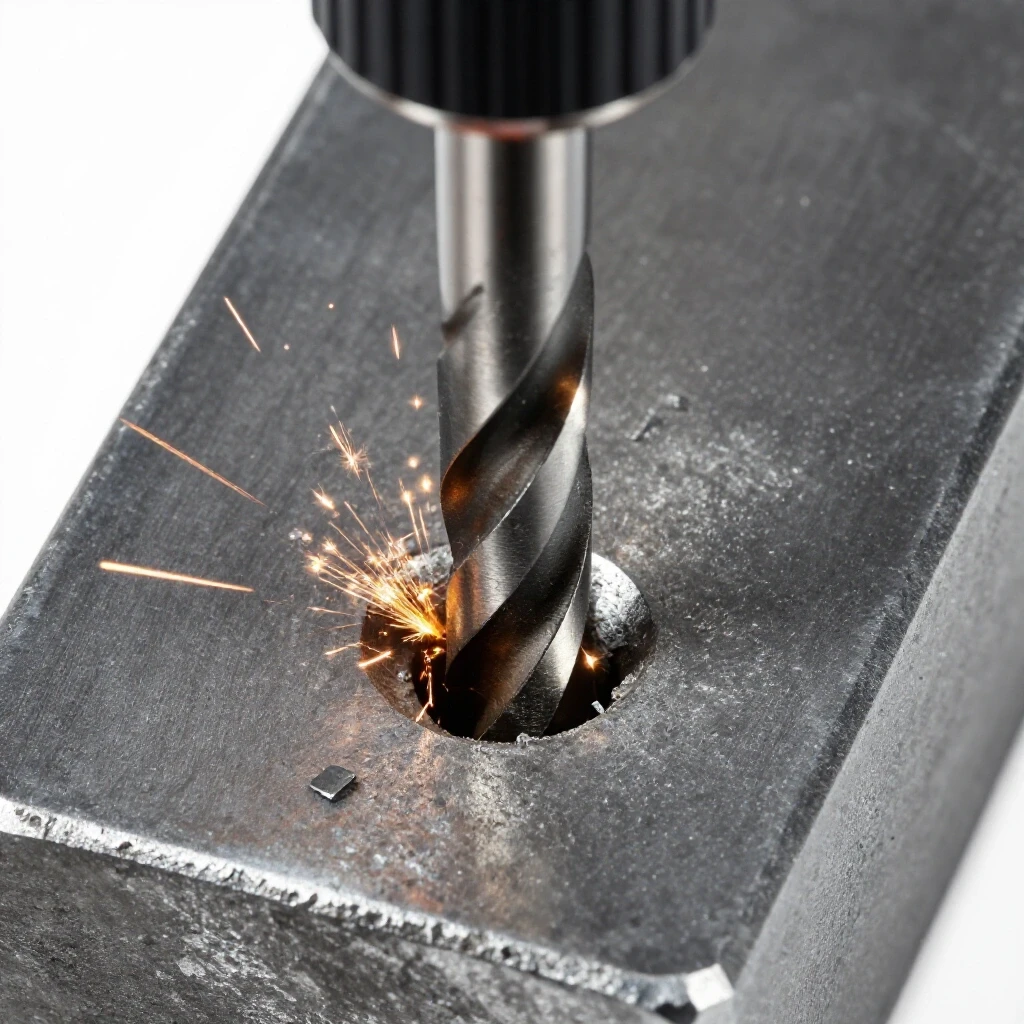
The drill press is used for making accurate holes in metal. Unlike a handheld drill, it provides mechanical advantage and keeps the bit perfectly perpendicular to the work surface. The most critical metric here is Total Indicated Runout (TIR).
TIR is a measurement of how much the center of the spindle wobbles as it rotates. If a spindle has high runout, your 1/2-inch drill bit will actually cut a hole that is 0.510 or 0.520 inches wide. In my shop, I consider a TIR of 0.001 to 0.003 inches acceptable for a standard drill press. Anything over 0.005 inches will cause significant vibration and poor hole quality.
How to Measure Quill Play and Spindle Accuracy
You can test this yourself with a simple dial indicator. Extend the quill (the moving part of the drill) halfway and try to wiggle it by hand. If you feel a “clunk,” the tolerances between the quill and the head casting are too loose.
- Mount a dial indicator on the table with the tip touching the inside of the spindle taper.
- Rotate the spindle slowly by hand.
- Note the total movement of the needle; this is your TIR.
- If the TIR is high, the bearings may be seated poorly or are of low quality.
Metal Lathe Comparison: Bedways, Bearings, and Headstock Design
A metal lathe is a precision tool used for creating cylindrical parts. It rotates the workpiece against a stationary cutting tool. When choosing a lathe, the “ways”—the tracks the carriage moves on—are the most critical component.
Look for “induction hardened and ground” ways. This means the surface of the cast iron was heated and quenched to make it extremely hard, then ground to a mirror finish. Soft ways will get nicked by metal chips, eventually causing the carriage to “hop” or “stick,” which ruins your accuracy. I also look for tapered roller bearings in the headstock rather than standard ball bearings. Tapered bearings can handle both radial and axial loads much better, which is vital when you are shoving a cutting tool into a spinning piece of steel.
Spindle Bearing Lifetimes and Preload
Spindle bearings are the heart of the lathe. They must be “preloaded,” which means they are squeezed together slightly to remove all internal play.
- Ball Bearings: Common in high-speed, light-duty machines. Not ideal for heavy metal removal.
- Tapered Roller Bearings: Found in industrial-grade lathes. They provide a much larger contact patch, leading to higher rigidity.
- Bearing Life (L10 Life): This is a calculation of how many hours a bearing will last. In a small shop, a well-lubricated tapered roller bearing should last 10,000+ hours of intermittent use.
| Metric | Budget Lathe (7×14) | Shop Standard (10×22) | Industrial Toolroom Lathe |
|---|---|---|---|
| Weight | 80-100 lbs | 300-500 lbs | 1,200+ lbs |
| Bed Width | 3 – 4 inches | 5 – 7 inches | 8+ inches |
| Spindle TIR | 0.002″ – 0.004″ | 0.0005″ – 0.001″ | < 0.0002″ |
| Motor Type | Brushed DC | Brushless/VFD | 3-Phase AC |
Milling Machine Buying Tips: Column Stiffness and Drive Systems
A vertical mill uses a rotating cutter to remove material from a workpiece clamped to a table that moves in three axes (X, Y, and Z). For a small shop, the biggest weakness is usually the column—the vertical post that holds the head.
In “round column” mills, the head can swing out of alignment when you move it up or down. I always recommend a “dovetail column” or “square column” design. These keep the head perfectly centered regardless of height. Additionally, consider the drive system. Gear-driven heads are powerful but noisy and can break a gear if you crash the tool. Belt-driven heads are quieter and the belt will slip before a gear shatters, acting as a mechanical fuse.
Why Digital Readouts (DRO) are Non-Negotiable
A DRO uses electronic scales to track the exact position of the table. It bypasses the “backlash” or slop found in the lead screws.
- Backlash: The tiny gap between the screw and the nut. If you turn the handle and the table doesn’t move for the first 0.005 inches, that is backlash.
- DRO Advantage: Since the scale measures the table directly, it doesn’t care about the slop in the screw. It tells you exactly where the part is within 0.0005 inches.
Joining Metal: Choosing Between MIG and Flux-Core Technology
Welding is the primary way we assemble metal projects. For most shops, a MIG (Metal Inert Gas) welder is the most used tool. It uses a motor to feed a wire electrode through a torch while a shielding gas protects the weld from the air.
The internal wire drive assembly is the first thing I check. Cheaper welders use plastic drive rolls and tensioners. These slip and wear out, leading to a “stuttering” arc that produces terrible welds. Look for cast aluminum or machined steel drive assemblies. Also, pay attention to the “Duty Cycle.” This is the percentage of a 10-minute period the welder can operate at a specific amperage before it overheats. A 20% duty cycle means 2 minutes of welding and 8 minutes of cooling—not ideal for structural work.
Inverter vs. Transformer Electrical Efficiency
Modern welders are either transformer-based or inverter-based. Transformers are old-school, heavy, and nearly indestructible. Inverters use solid-state electronics to convert power, making them light and highly efficient.
- Transformer: 60-70% efficient. Very reliable but consumes more power and has a less “tunable” arc.
- Inverter: 85-90% efficient. Allows for advanced features like “pulse” welding and “inductance control” which reduces spatter.
| Component | Budget Welder | Professional Workshop Welder |
|---|---|---|
| Wire Drive | Plastic / Single Roll | Metal / Dual or Quad Roll |
| Duty Cycle | 10-20% at Max Amps | 40-60% at Max Amps |
| Power Supply | Transformer | Inverter (IGBT Technology) |
| Torch Connection | Fixed (Hardwired) | Euro-style (Quick Disconnect) |
Surface Prep: The Mechanics of Angle Grinders and Linishers
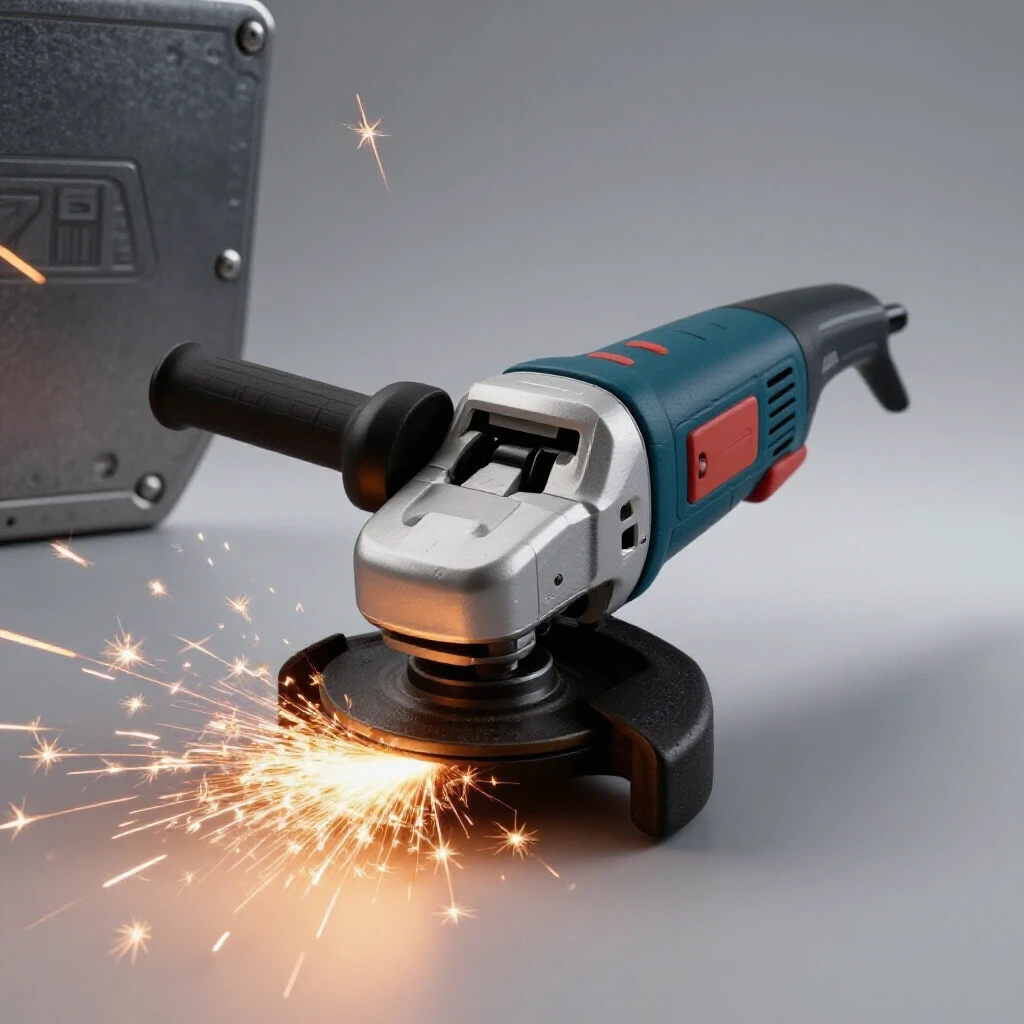
An angle grinder is arguably the most dangerous and most used power tool in the shop. It is used for cutting, grinding, and cleaning metal. Because these tools spin at 10,000+ RPM, the bearing quality and gear mesh are critical for safety and longevity.
I look for “spiral bevel gears” in the head of the grinder. These gears have curved teeth that engage more gradually than straight-cut gears, resulting in less heat, less noise, and a longer lifespan. Also, check the spindle lock. If the button feels mushy or is made of thin plastic, it will eventually shear off, making it impossible to change discs without a pipe wrench.
Motor Cooling and Dust Protection
Metal dust is conductive. If it gets into the motor windings, it will cause a short circuit. High-end grinders use “epoxy-coated” or “armored” windings. This is a layer of hard resin that protects the copper wires from the abrasive “sandblasting” effect of the cooling air pulling in metal grit.
- Check the Vents: Are they positioned to blow dust away from the operator?
- Feel the Vibration: Turn it on. If your hand goes numb in 30 seconds, the armature is out of balance.
- Brush Access: Can you change the carbon brushes easily, or do you have to gut the whole tool?
Precision Measuring: The Foundation of Quality Control
You cannot make what you cannot measure. In a metal shop, a tape measure is for rough cutting, but for assembly and machining, you need calipers and micrometers.
Accuracy is how close a measurement is to the true value. Precision is how consistently you can get that same measurement. A cheap pair of digital calipers might be accurate once, but if you measure the same part five times and get five different numbers, they lack precision. I prefer stainless steel construction over carbon fiber or plastic, as steel does not flex when you apply measuring pressure.
Calibration and Thermal Expansion
Metal expands when it gets hot. If you measure a part right after grinding it, it will be larger than when it cools down.
- Standard Reference Temperature: 68°F (20°C). This is the temperature at which precision tools are calibrated.
- Micrometers: Use a “ratchet thimble” to ensure you apply the exact same amount of pressure every time you take a measurement.
- Surface Plate: A thick slab of granite lapped perfectly flat. This is the “zero” reference for all height measurements in a shop.
Planning for Spare Parts and Long-Term Maintenance
No matter how well a machine is built, parts will eventually wear out. Before buying, I always check the availability of “consumables” like V-belts, bearings, and brushes. If a machine uses proprietary parts that can only be ordered from one warehouse in another country, your shop will be dead in the water when a $10 belt snaps.
I prefer machines that use “standardized” components. This means the bearings are standard ISO sizes (like a 6204-2RS) and the motors are standard NEMA or IEC frames. This allows you to buy replacement parts from local industrial supply houses rather than waiting weeks for a branded replacement.
Creating a Maintenance Tracking Framework
- Lubrication Schedule: Mark every oil nipple on your machines with a bright paint pen. Oil them every time you use the machine.
- Way Oil vs. Gear Oil: Never use WD-40 on machine ways. Use a dedicated “Way Oil” (ISO 68) that contains “tackifiers” to help it stick to vertical surfaces.
- Belt Tension: Check belts monthly. A loose belt slips and generates heat; a tight belt destroys bearings.
- Chip Management: Clean the “swarf” (metal chips) off your machines daily. Chips mixed with oil create an abrasive paste that wears out your precision surfaces.
Final Steps for the Decisive Buyer
Building a workshop is a marathon, not a sprint. It is better to have three high-quality, rigid tools than ten flimsy ones that frustrate you. When you are ready to buy, go to a showroom if possible. Bring a dial indicator. Check the TIR. Feel the weight of the castings.
If you are buying used, look for signs of “crash” damage—nicks in the table or a spindle that sounds like a gravel crusher. A well-maintained machine from thirty years ago will often outperform a brand-new budget machine because the older unit has the mass and the quality of iron that modern “value” brands cut out to save on shipping costs.
Frequently Asked Questions
What is the difference between a brushless motor and a brushed motor in shop tools? Brushed motors use carbon brushes to pass electricity to the spinning armature. These brushes wear out and create sparks. Brushless motors use electronic controllers to manage the magnetic fields. They are more efficient, run cooler, and have no brushes to replace, but the electronic controllers (VFDs) are more complex to repair.
How much spindle runout is too much for a drill press? For general fabrication, anything under 0.004 inches is acceptable. If you are doing precision work or using small carbide bits, you want to see 0.001 inches or less. Excessive runout will cause “drill walk” and can snap small, brittle bits.
Why is weight such a big deal for a benchtop lathe? Weight equals mass, and mass absorbs vibration. A 100-pound lathe will flex when cutting steel, leading to a poor surface finish. A 400-pound lathe of the same size will be much more rigid, allowing for heavier cuts and better accuracy.
Can I use a wood bandsaw for metal? Generally, no. Wood bandsaws run at much higher speeds (3,000+ surface feet per minute). Metal cutting requires much slower speeds (around 100-300 SFPM) and much higher torque. Running a wood saw on metal will instantly dull the blade and likely burn out the motor or melt the tires.
What does “Induction Hardened Ways” mean? This is a process where the surface of the lathe or mill bed is heated using an electromagnetic field and then quickly cooled. This creates a very hard outer “skin” (usually 50+ Rockwell C) that resists wear from metal chips, while the core of the casting remains tough and vibration-dampening.
Is an inverter welder better than a transformer welder for a home shop? For most people, yes. Inverters are much lighter and can run on 110V or 220V power. They also provide a smoother arc which is easier for beginners to learn on. However, transformers are simpler and can often last 40+ years with zero maintenance.
What is “Backlash” and why should I care? Backlash is the play between a screw and a nut. If you turn a handle on a mill, the screw turns a bit before the table actually moves. This makes it hard to do precise work. You can manage it by always approaching your measurement from the same direction, or by installing a Digital Readout (DRO).
What is the most important maintenance task in a metal shop? Lubrication. Metal-on-metal contact will destroy a machine in hours without oil. Using the correct “Way Oil” on sliding surfaces and keeping gearboxes filled with clean oil is the only way to ensure your tools last for decades.
Should I buy a round column or a square column milling machine? Always choose a square (dovetail) column if your budget allows. On a round column mill, when you move the head up or down to accommodate a different tool length, you lose your “X-Y” center. On a square column, the head stays perfectly aligned as it moves vertically.
What is the benefit of a Variable Frequency Drive (VFD)? A VFD allows you to change the speed of an AC motor electronically by turning a knob. This is much faster than stopping the machine to move belts on pulleys. It also allows for “soft starts,” which reduces the mechanical shock on your gears and belts.
(This article was written by one of our staff writers, Steven Brooks. Visit our Meet the Team page to learn more about the author and their expertise.)